
Aircraft Identification Quiz
How the Scales are Structured
Who Usually Takes This Test?
See How You Compare
Below is a preview of how scores are typically distributed across each scale.
Example Questions From the Test
- Junkers Ju 52
- Beechcraft Model 18
- Douglas DC-3
- Douglas DC-6
- Beechcraft Bonanza
- Cessna 172 Skyhawk
- Piper PA-28 Cherokee
- Piper J-3 Cub
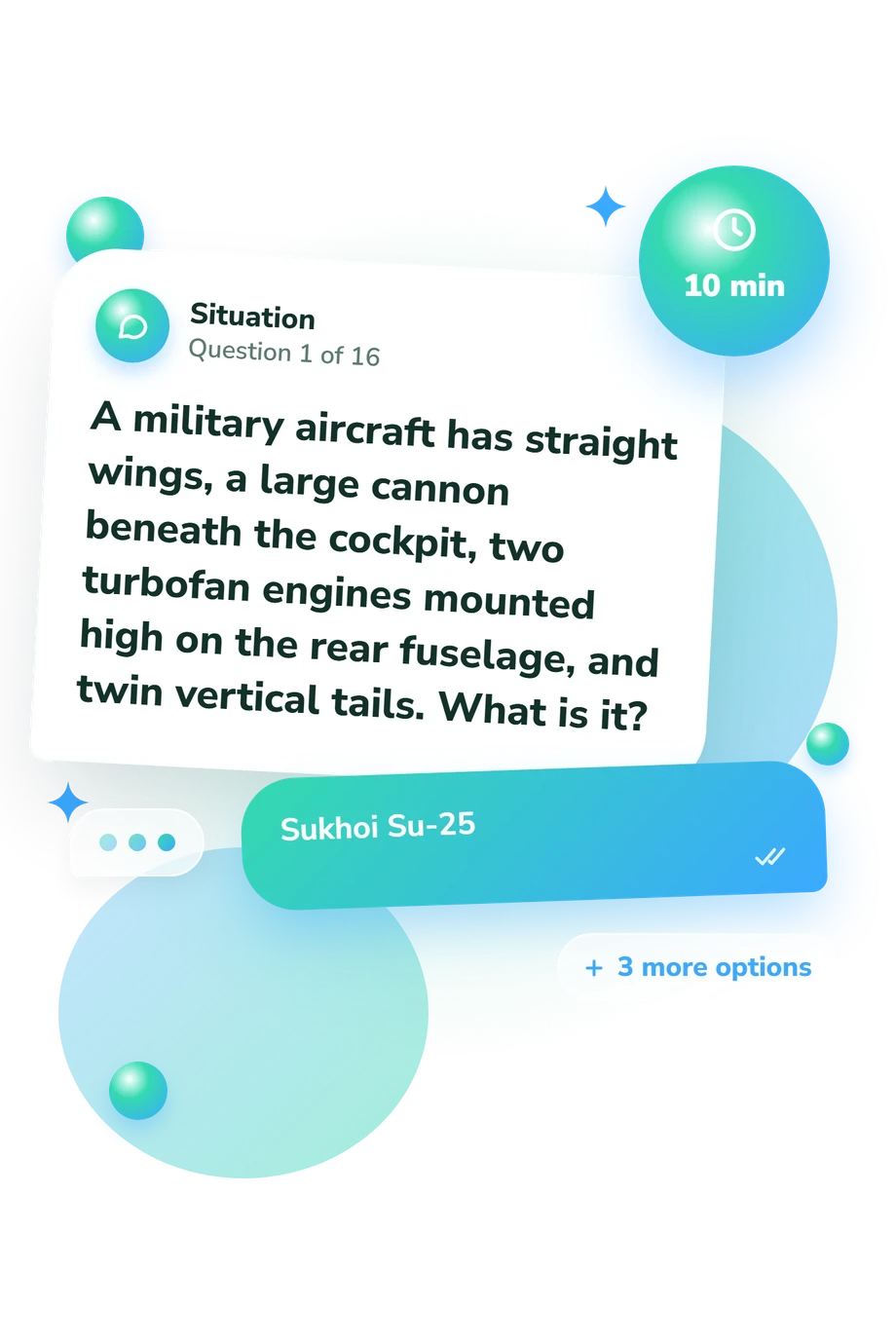
- Sukhoi Su-25
- Fairchild Republic A-10 Thunderbolt II
- Northrop F-5E Tiger II
- SEPECAT Jaguar
Aircraft Identification Quiz - Description and methodology of the test
Curious aviation enthusiasts can use this aircraft identification quiz to turn an interest in aircraft into a short, structured challenge. As a plane identification quiz, it offers a focused way to check one aspect of aviation knowledge rather than a broad personal profile. Its single result gives a descriptive performance level based on correct answers, which you can use as a reference for reflection after completing the assessment.
What This Assessment Explores
This assessment suits readers who want to test aviation knowledge through reasoning. Prompts describe engine placement, wing shape, landing gear, cockpit arrangement, tail design, fuselage form, and operational role. Textual clues make the airplane identification quiz a task of combining them into an aircraft profile rather than relying on one detail.
The question themes are:
- Civil transports and airliners use cabin layout, engines, wings, and fuselage proportions to distinguish passenger aircraft.
- Military aircraft emphasize weapon placement, cockpit position, tail configuration, and mission-related design.
- Historic, specialist, and experimental aircraft test recognition of period-specific structures and unusual solutions such as tilt-rotors, vertical-lift jets, flying wings, and oversized cargo fuselages.
Aircraft Identification Knowledge runs from 0-16 and counts identifications from textual design clues. Foundational 0-6 reflects partial recognition, Developing 7-12 reflects growing discrimination, and Strong 13-16 reflects broad accuracy across civil, military, historic, and specialist aircraft.
Methodology and Evidence Base
Each item presents a description followed by four aircraft names, so the task combines reading comprehension with feature-based recognition. The result is calculated by counting the prompts answered correctly, producing one knowledge score rather than separate subscores.
The design is conceptually consistent with Aircraft recognition (Luborsky, 1945), which examined recognition learning and measurement, but this questionnaire is not an adaptation of that study. Work by Whitmore, Cox, and Friel (1968) and Vicory (1968) adds context on structured training and the history of aircraft-identification instruction. Federico (1991) is relevant to the use of computer-based response formats for recognition measurement. These sources support the assessment’s general approach without establishing norms for this online version.
As an aircraft recognition quiz, it is best interpreted as a focused performance snapshot. Familiarity with aviation, terminology, aircraft history, and design conventions can affect results, while guessing and the wording of a clue can influence an answer. The bands are descriptive levels, not population norms or diagnostic cutoffs, so the score is most useful for identifying strengths and study priorities rather than making a judgment about expertise.
- Luborsky, Lester. “Aircraft Recognition: I. The Relative Efficiency of Teaching Procedures.” Journal of Applied Psychology 29, no. 5 (1945): 385-398. 10.1037/h0054379
- Whitmore, Paul G., John A. Cox, and Don J. Friel. A Classroom Method of Training Aircraft Recognition. HumRRO Technical Report 68-1. Alexandria, VA: Human Resources Research Office, George Washington University, 1968. AD-666 093.
- Vicory, Arthur C. A Brief History of Aircraft Identification Training. HumRRO Professional Paper 27-68. Alexandria, VA: Human Resources Research Office, George Washington University, 1968. AD-676 791.
- Federico, Pat-Anthony. “Recognition Measurement: Computer-Based and Paper-Based Methods.” Proceedings of the Human Factors Society Annual Meeting 35, no. 18 (1991): 1326-1330. 10.1177/154193129103501816
Updated: