
Hamilton Character Quiz
How the Scales are Structured
Who Usually Takes This Test?
See How You Compare
Below is a preview of how scores are typically distributed across each scale.
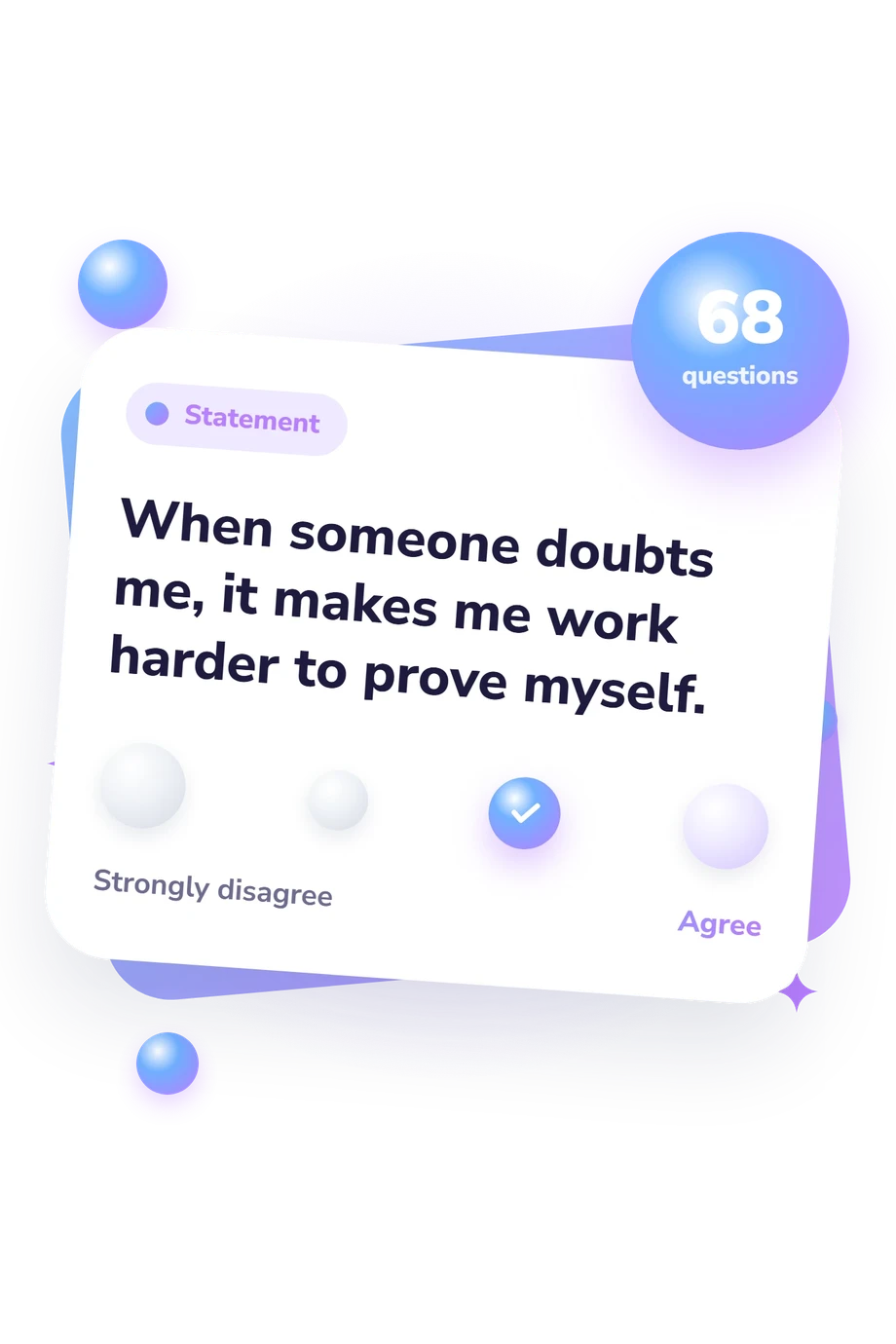
Example Questions From the Test
- Strongly disagree
- Disagree
- Not sure
- Agree
- Strongly disagree
- Disagree
- Not sure
- Agree
- Strongly disagree
- Disagree
- Not sure
- Agree
Hamilton Character Quiz - Description and methodology of the test
Designed for readers who enjoy Hamilton, the Hamilton Character Quiz goes beyond a favorite-character guess by translating familiar themes into everyday tendencies. The question behind hamilton quiz what character are you is answered with a trait-based comparison rather than a fixed identity. It highlights how you pursue recognition, protect commitments, and respond when stakes rise.
What This Assessment Explores
It turns Hamilton themes into three dimensions: ambition reflects pursuit of major goals, achievement, and recognition; loyalty and care reflect commitment, protecting loved ones, and consistent support for people you care about; risk and conflict style reflects responses to uncertainty or disagreement. Fans can consider these tendencies in ordinary decisions.
The displayed scales are:
- Ambition Drive (0-20) measures pursuit of major goals, achievement, and recognition: Steady & Content (0-7), Balanced Striver (8-14), Relentless Go-Getter (15-20).
- Loyalty & Care (0-20) measures commitment, protecting loved ones, and consistent support for people you care about: Independent & Flexible (0-7), Balanced Support (8-14), Deeply Loyal & Steady (15-20).
- Risk & Conflict Style (0-20) shows how you handle uncertainty and confrontation: Cautious & Diplomatic (0-6), Balanced & Situational (7-13), Bold & Confrontational (14-20).
The Hamilton personality test shows tendencies, not better traits.
Methodology and Evidence Base
Items use a four-point agreement scale with Strongly disagree, Disagree, Not sure, and Agree. They cover recognizable choices involving achievement, promises, protection, uncertainty, and confrontation, so respondents rate their own tendencies rather than choose a character directly.
Scores appear as three displayed scale scores. Because the questionnaire does not specify the points assigned to each option, readers should use the displayed bands rather than infer an item-by-item scoring rule.
Methodologically, the quiz is conceptually consistent with Webster and Campbell (2022), whose work shows how people form shared and self-related impressions of fictional characters. The character comparison is also conceptually compatible with Higgins's (1987) self-discrepancy theory, which considers self-perceptions alongside meaningful standards.
Miranda and McCarter’s Hamilton supplies the narrative setting for its themes. Thus, the playful question of which Hamilton character you are is best answered through the three trait patterns, not a fixed identity. Items about proving oneself, keeping promises, stepping in for loved ones, acting under pressure, and addressing tension make the result sensitive to current mood and self-image.
- Webster, Gregory D., and Jessica T. Campbell. (2022). Personality Perception in Game of Thrones: Character Consensus and Assumed Similarity. Psychology of Popular Media, 12(2), 207-218. 10.1037/ppm0000398
- Jorgenson, Eric. (2020). Development of the Statistical “Which Character” Personality Quiz. Open-Source Psychometrics Project.
- Miranda, Lin-Manuel, and Jeremy McCarter. (2016). Hamilton: The Revolution. Grand Central Publishing.
Updated: