
Wiccan Quiz
How the Scales are Structured
Who Usually Takes This Test?
See How You Compare
Below is a preview of how scores are typically distributed across each scale.
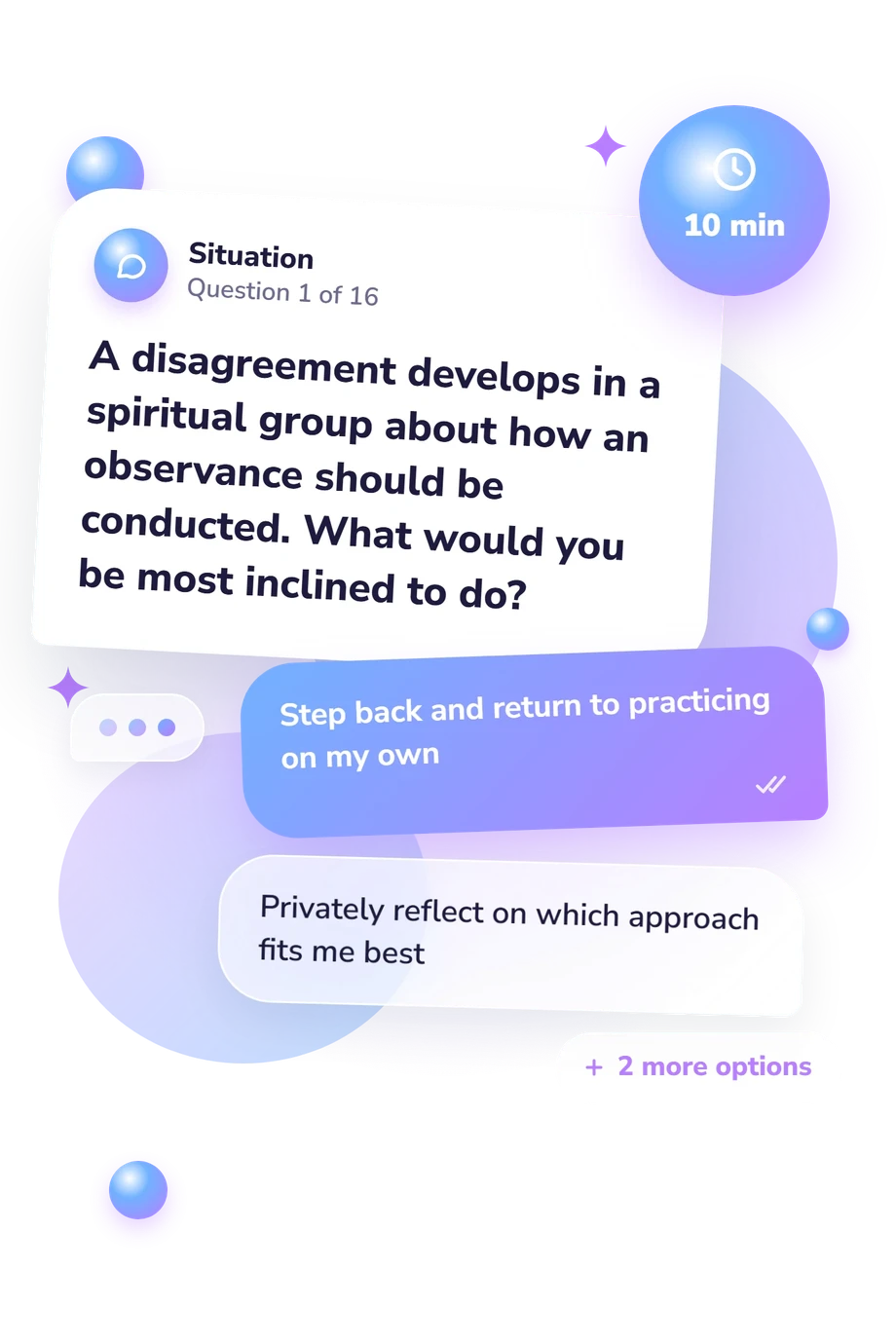
Example Questions From the Test
- Step back and return to practicing on my own
- Privately reflect on which approach fits me best
- Discuss the issue with one or two people I trust
- Help the group hold a structured conversation and find a workable shared approach
- Attend and actively join the shared observance and conversation
- Attend mainly to observe and meet a few people
- Read about the group but probably mark the season alone
- Continue with my private interests without engaging the group
- Improvise a safe way to connect with the weather or local season
- Reschedule the outdoor experience for another day
- Choose an indoor reflective activity instead
- Drop the plan and continue with the rest of my day
Wiccan Quiz - Description and methodology of the test
People curious about Pagan spirituality can use this assessment to explore which forms of practice, meaning, and participation feel most natural to them. People wondering whether Wiccan or Pagan interests fit their outlook can explore this assessment through a nuanced profile rather than a yes-or-no identity verdict. The wiccan quiz maps tendencies without prescribing belief, identity, or religious commitment. It suits anyone seeking a structured starting point for personal reflection.
What This Assessment Explores
Wicca is not a fixed identity. The questionnaire separates four current spiritual affinities, showing current engagements. Results describe preferences, not belief, legitimacy, or a required path.
Dimensions and displayed bands:
- Circle Keeper (0-12) measures affinity for shared observance, mutual learning, and spiritual community: Solitary Path (0-4), Selective Companion (5-8), or Circle Keeper (9-12).
- Deity Explorer (0-12) measures attraction to thoughtful relationships with deities or divine forms: Open Interpreter (0-4), Sacred Story Seeker (5-8), or Deity Explorer (9-12).
- Nature Mystic (0-12) measures how land, seasons, and ecological reciprocity shape spiritual outlook: Independent Observer (0-4), Seasonal Seeker (5-8), or Nature Mystic (9-12).
- Ritual Weaver (0-12) measures attraction to creating and refining intentional ritual as a source of spiritual meaning: Informal Explorer (0-4), Practice Builder (5-8), or Ritual Weaver (9-12).
For people exploring Wiccan spirituality, this pattern shows interests, not a pass/fail result.
Methodology and Scientific Basis
Each item presents a situation involving learning, community, seasonal awareness, deity concepts, environmental responsibility, or Wiccan practice. Four response options describe different styles of engagement, so you choose the one closest to your current outlook; answers are organized into four displayed scores.
The scoring produces four descriptive profiles rather than normative judgments. No per-answer weighting or population cutoffs are stated. The bands are profile labels, not pass/fail standards, and no standardized norms are provided.
Its conceptual frame is consistent with Williams (2010). Oboler’s work addresses nature religion, environmental responsibility, and sacred reciprocity, while Berger, Leach, and Shaffer add context on community, practice, and identity among witches and Neo-Pagans. These sources support thematic comparison; this questionnaire is not an adaptation of, or validated by, those studies.
Self-report results may shift with current interests, cultural knowledge, mood, and willingness to use spiritual language. The profile is therefore a starting point for reflection, not a complete account of belief or practice.
- Williams, Emyr, Leslie J. Francis, and Ursula Billington. "The Williams Scale of Attitude toward Paganism: Development and Application among British Pagans." Archiv für Religionspsychologie 32, no. 2 (2010): 179-193. 10.1163/157361210X500900.
- Oboler, Regina Smith. "Nature Religion as a Cultural System? Sources of Environmentalist Action and Rhetoric in a Contemporary Pagan Community." The Pomegranate: The International Journal of Pagan Studies 6, no. 1 (2004): 86-106. 10.1558/pome.v6i1.86.
- Berger, Helen A., Evan A. Leach, and Leigh S. Shaffer. Voices from the Pagan Census: A National Survey of Witches and Neo-Pagans in the United States. Columbia: University of South Carolina Press, 2003.
Updated: