
Which RV Is Right for Me Quiz
How the Scales are Structured
Who Usually Takes This Test?
See How You Compare
Below is a preview of how scores are typically distributed across each scale.
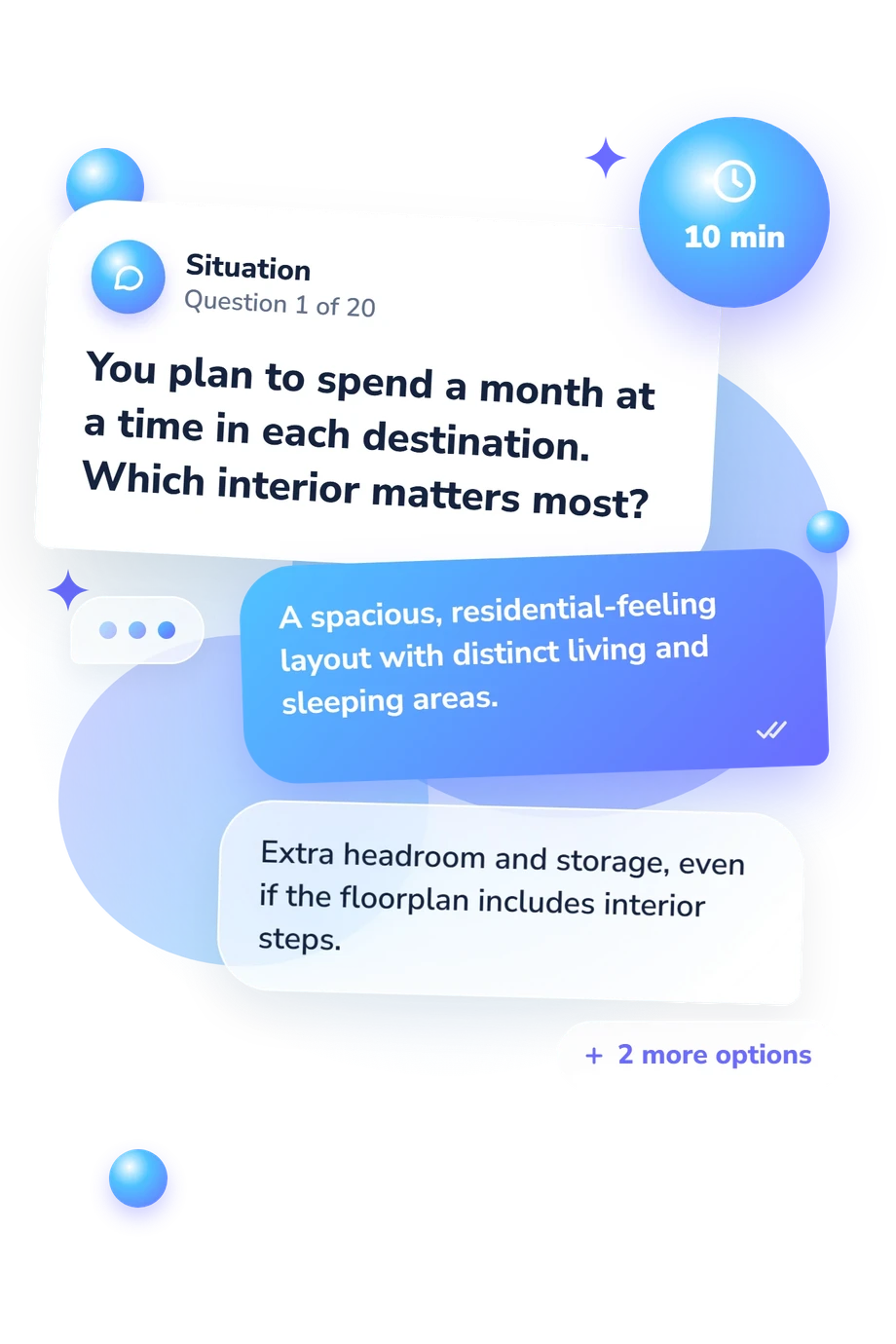
Example Questions From the Test
- Multiple belted travel seats and dedicated or easy-conversion sleeping areas in one motorized RV.
- An integrated RV with enough beds, even if some spaces serve two purposes.
- A towable living space paired with a separate passenger vehicle.
- A minimal two-person layout, with the group using other accommodations.
- A spacious, residential-feeling layout with distinct living and sleeping areas.
- Extra headroom and storage, even if the floorplan includes interior steps.
- A single-level mid-sized layout that is easier to tow and store.
- A compact interior designed mainly for sleeping between active days.
- Higher truck and storage requirements in exchange for generous space and long-stay comfort.
- A moderately sized fifth wheel that balances interior room with maneuverability.
- Less interior space in exchange for a simpler bumper-pull trailer setup.
- Minimal living space in exchange for using one compact motorized vehicle.
Which RV Is Right for Me Quiz - Description and methodology of the test
When weighing an RV purchase or rental, you may ask what RV is right for me while organizing priorities: comfort, towing, driving, storage, campsite access, and travel rhythm. The Which RV Is Right for Me Quiz gives prospective buyers, renters, and travelers a structured way to examine those trade-offs before committing to a layout. This RV quiz highlights compromises that can make one travel style more appealing than another.
What This Assessment Explores
This RV finder quiz examines travel rhythm, space, towing, separation, and access, showing format affinity:
- Camper Van (0-12) measures affinity for frequent movement, easy driving, compact living: Different Priorities (0-4), Possible Van Fit (5-8), Strong Van Affinity (9-12).
- Fifth Wheel (0-12) reflects affinity for spacious living, stable pickup towing: Lighter Setup Preferred (0-4), Fifth-Wheel Possibility (5-8), Strong Fifth-Wheel Affinity (9-12).
- Motorhome (0-12) reflects affinity for integrated Class A/C living, convenient campsite arrival: Towable/Compact Lean (0-4), Motorhome Potential (5-8), Strong Motorhome Affinity (9-12).
- Travel Trailer (0-12) reflects affinity for detachable living, broad layouts, flexible camping: Another Format May Fit (0-4), Selective Trailer Fit (5-8), Strong Travel Trailer Affinity (9-12).
- Truck Camper (0-12) reflects affinity for compact camping, pickup mobility, self-contained footprint: More Space or Separation Wanted (0-4), Truck Camper Potential (5-8), Strong Truck Camper Affinity (9-12).
Methodology and Evidence
Items cover trip duration, interior use, hitching, road access, transportation, and campground arrival. Four choices represent trade-offs; select the response closest to your usual travel.
Responses are compared across five independent profiles, not combined. The highest score indicates strongest affinity; scores within one point create a blended shortlist.
By asking what RV is right for me, this quiz shows which RV formats have the strongest affinity with your preferences, without declaring a layout universally suitable.
This self-report exercise has no published standardized scoring or norms; its 0-12 profiles and supplied bands are descriptive guides rather than established population cutoffs. It aligns conceptually with Hawes (1978) on RV market segments, Hardy and Gretzel (2011) on user motivations, and Templeton et al. (2017) on campground selection. The questionnaire is not an adaptation of these sources.
Interpretation should include payload, axle, hitch, loaded-weight, clearance, storage, budget, and campsite constraints. Verify vehicle and RV limits before buying. Self-report can shift with experience and current plans; the profile works as a planning aid.
- Douglass K. Hawes (1978). Empirically Profiling Four Recreational Vehicle Market Segments. Journal of Travel Research, 16(4), 13-20. 10.1177/004728757801600403
- Anne Hardy and Ulrike Gretzel (2011). Why We Travel This Way: An Exploration into the Motivations of Recreational Vehicle Users. In Bruce Prideaux and Dean Carson (Eds.), Drive Tourism: Trends and Emerging Markets, pp. 194-209. Routledge.
- A. J. Templeton, Jill Fjelstul, Kimberly Severt, and Yeon Ho Shin (2017). Driving RV Park/Campground Selection: A Grounded Theory Approach. Journal of Tourism Insights, 8(1), Article 3. 10.9707/2328-0824.1071
Updated: