
Nucleotide Quiz
How the Scales are Structured
Who Usually Takes This Test?
See How You Compare
Below is a preview of how scores are typically distributed across each scale.
Example Questions From the Test
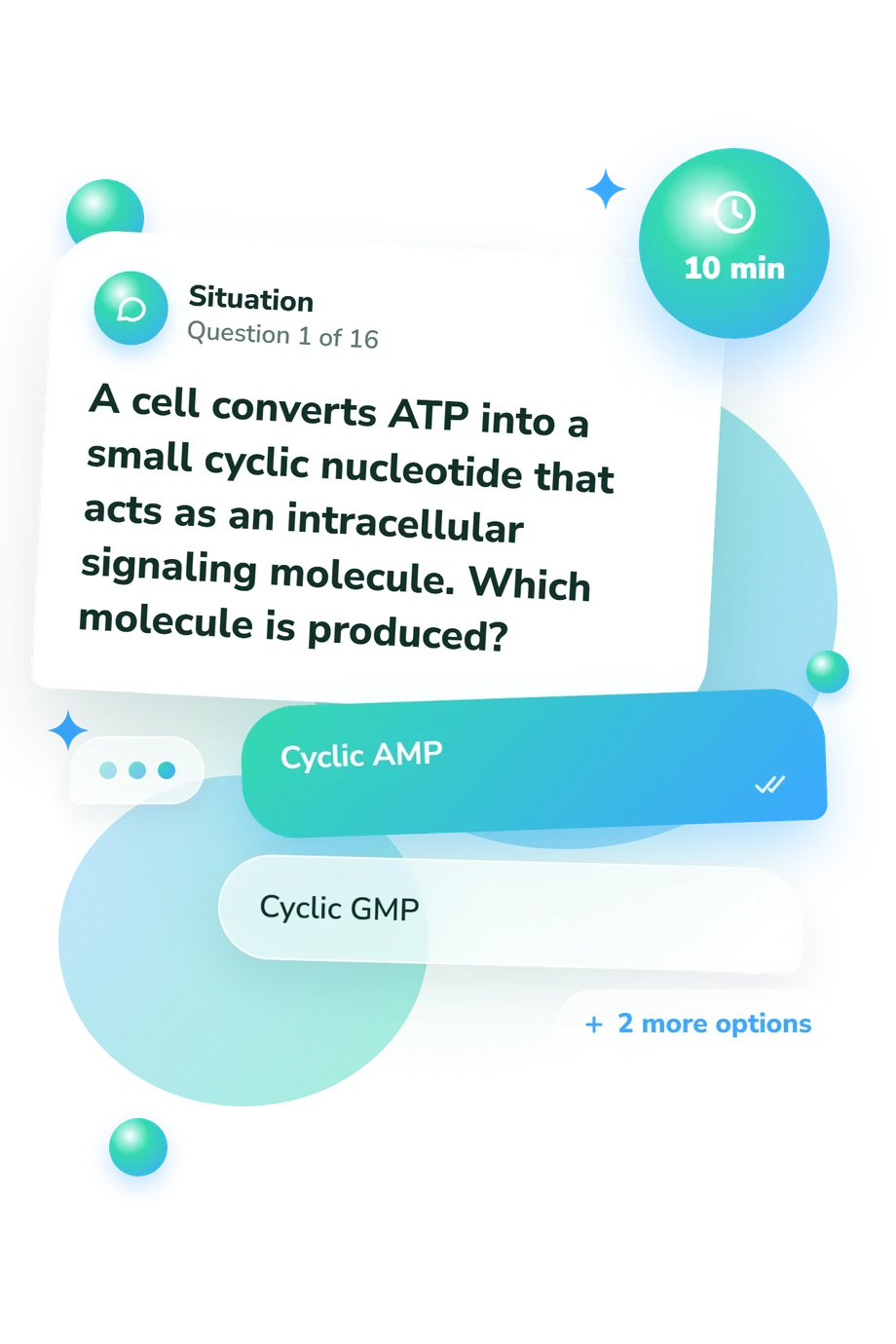
- Cyclic AMP
- Cyclic GMP
- ADP-ribose
- Deoxyadenosine monophosphate
- 3′-AGTC-5′
- 3′-TCAG-5′
- 5′-TCAG-3′
- 3′-UCAG-5′
- Peptide bond
- Phosphodiester bond
- Glycosidic bond
- Hydrogen bond
Nucleotide Quiz - Description and methodology of the test
Students, trainees, and curious readers who want to check their grasp of molecular biology can use this nucleotide quiz to connect familiar terms with the structures and reactions behind them. The result is most useful when you want a focused nucleotide knowledge test that identifies secure foundations and topics needing review. It suits independent study, course revision, and a quick check before more advanced work.
What This Assessment Measures
At its core, the assessment checks whether you can recognize nucleotide parts and apply relationships among bases, sugars, phosphates, strands, and bonds. It suits learners reviewing introductory biochemistry, genetics, cell biology, or molecular biology because this nucleotide structure quiz tests application as well as recall.
The main content areas covered by the questions are:
- Components and terminology show whether you distinguish nucleotides, nucleosides, bases, sugars, and phosphates.
- Bonds and sequence reasoning show whether you follow phosphodiester links, strand direction, pairing, and mutation categories.
- Functions and molecular differences show whether you interpret ATP reactions, cyclic nucleotides, synthesis, and DNA-RNA distinctions.
The Nucleotide Knowledge scale runs from 0-16: Building Foundations (0-6) signals review needs; Developing Knowledge (7-12) reflects many core ideas with some gaps; Strong Knowledge (13-16) reflects a well-developed grasp across common biochemical situations.
Methodology and Evidence Base
Each item uses four-option multiple choice. The questions range from identifying components and abbreviations to applying complementarity, hydrolysis, sugar chemistry, backbone bonding, and base-substitution rules. Selecting the best biochemical interpretation makes the task a knowledge check rather than a rating of symptoms or personal experience.
The result is reported on the displayed scale, with its category indicating your current level of knowledge. The items also require attention to 5′ and 3′ orientation, sugar substitutions, standard base-pair proportions, and the distinction between nucleotides and nucleosides. As a nucleotide base structure quiz, this assessment can provide a useful study starting point, although preparation, fatigue, and context may affect performance.
Its content is conceptually consistent with abeQbank (Arbor et al., 2020), the IUPAC-IUB Commission on Biochemical Nomenclature’s nucleotide conventions, and Lehninger Principles of Biochemistry. These sources support content alignment, not proof that this online questionnaire is an adaptation or standardized version of them. The result is therefore most informative when missed concepts are reviewed alongside the relevant biochemical principles.
- Arbor, Sage, Judith Binstock, Sankhavaram Panini, Hanin Rashid, and Emine Ercikan Abali. (2020). Development and Validation of a Shared Secure Biochemistry Test Bank for Medical, Dental, and Pharmacy Schools. Medical Science Educator, 30(1), 403-415. 10.1007/s40670-020-00919-y
- IUPAC-IUB Commission on Biochemical Nomenclature (CBN). (1970). Abbreviations and Symbols for Nucleic Acids, Polynucleotides and their Constituents: Recommendations 1970. European Journal of Biochemistry, 15(2), 203-208. 10.1111/j.1432-1033.1970.tb00995.x
- Nelson, David L., Michael M. Cox, Aaron A. Hoskins, and Albert L. Lehninger. (2021). Lehninger Principles of Biochemistry. 8th ed. New York, NY: Macmillan Learning.
Updated: