
Classic Literature Quiz
How the Scales are Structured
Who Usually Takes This Test?
See How You Compare
Below is a preview of how scores are typically distributed across each scale.
Example Questions From the Test
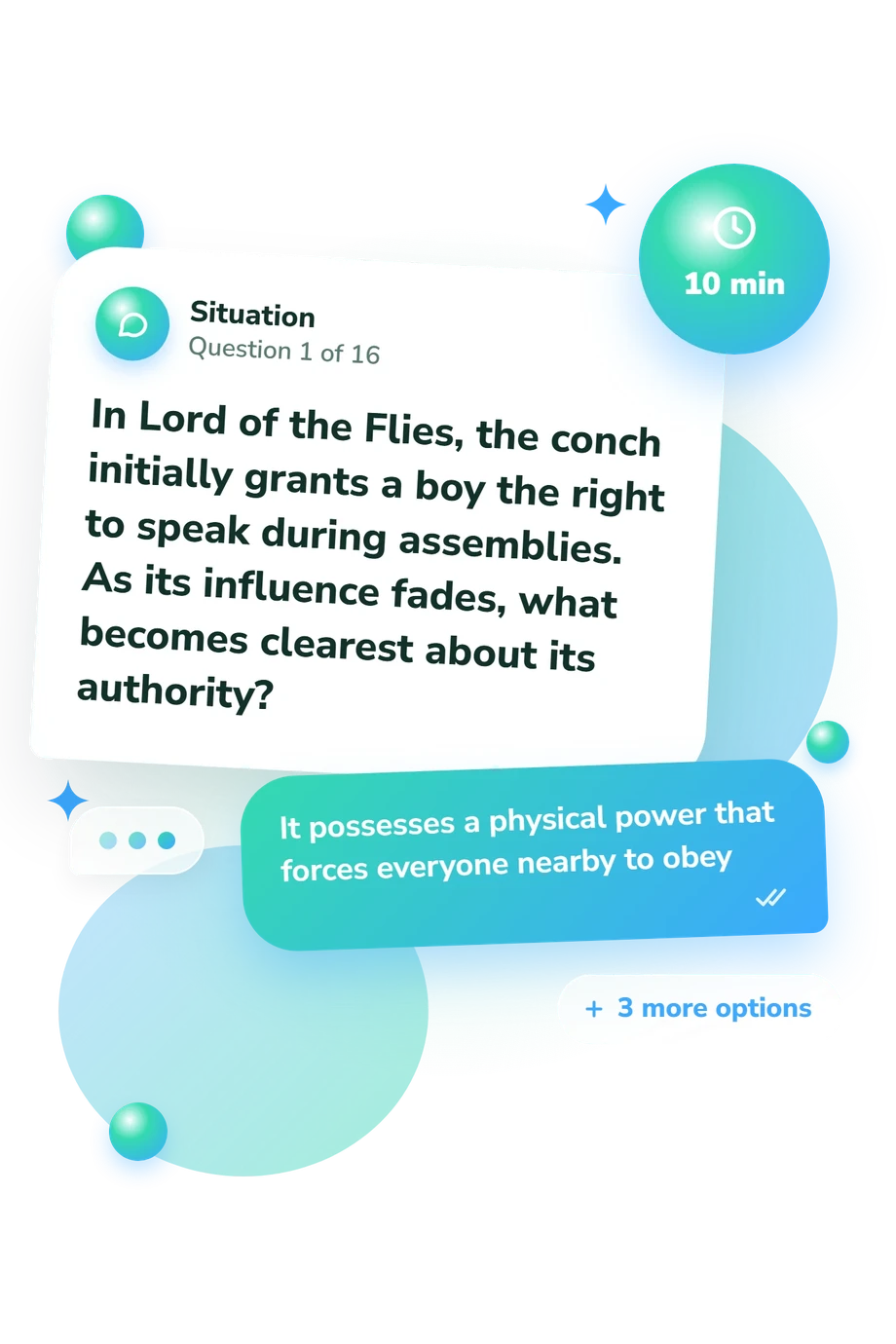
- It possesses a physical power that forces everyone nearby to obey
- It was secretly designed as a weapon rather than a civic symbol
- Its power depends on the group's shared willingness to respect rules and orderly discussion
- It derives its authority from the adult world continuing to supervise the island
- The collision between idealized chivalric imagination and ordinary material reality
- The effort to replace oral storytelling with written history
- The rivalry between urban merchants and rural landowners
- The struggle between religious faith and scientific experimentation
- Joe Gargery
- Mr. Jaggers
- Abel Magwitch
- Herbert Pocket
Classic Literature Quiz - Description and methodology of the test
Readers who want to check how they interpret major works can use this classic literature quiz as a focused self-assessment. It is designed for curious students, lifelong readers, and anyone returning to demanding reading. Questions about literary details make this a classic book quiz with interpretation alongside recognition. The result records one total for performance across the selected knowledge-and-interpretation items.
What This Assessment Explores
These questions treat literary knowledge as more than names or endings. They connect a scene, formal choice, or recurring image with a work’s larger concerns, so the result records performance across the selected questions rather than separate abilities.
Across this classics quiz, the items represent four areas without producing independent scores:
- Plot and character items connect decisions, conflicts, and consequences.
- Symbolic interpretation items relate objects and images to meanings and themes.
- Narrative-form items cover framing, layered narration, shifting chronology, and controlled language.
- Ethical and social items present tensions involving power, ambition, responsibility, memory, and autonomy.
Classic Literature Knowledge (0-16) records one point per correct answer. Emerging Foundation is 0-6, Developing Reader is 7-12, and Strong Command is 13-16. These bands describe performance on this item set, not every literary tradition.
Methodology and Evidence Base
Each item presents a question about a novel, play, or epic with four answer choices. The respondent selects the best explanation, and each correct answer contributes one point to the displayed score. The questionnaire therefore uses a structured knowledge-and-interpretation format rather than an open-ended literary response.
Its closest conceptual anchor is Li, Purves, and Shirk (1990), whose work treats literary learning as domains rather than recall alone. Brody, DeMilo, and Purves (1989) support attention to literary understanding in assessment. Miall and Kuiken (1995) and van Schooten, Oostdam, and de Glopper (2001) examine literary response, including how readers process form and meaning. The questionnaire is conceptually consistent with these works, but it is not an adaptation of them.
This questionnaire has no published standardization, external norms, or validation evidence for interpreting its total against a reference population. In this literary knowledge test, the score can reflect prior exposure to featured texts, familiarity with common interpretations, and item wording. The bands are descriptive guides for this item set, so rereading and discussion can extend what the result suggests.
- Li, Hongru, Alan C. Purves, and Margaret Shirk. Prototype Measures of the Domain of Learning in Literature. Report Series 3.3. Albany, NY: Center for the Learning and Teaching of Literature, State University of New York, 1990.
- Brody, Pamela, Carol DeMilo, and Alan C. Purves. The Current State of Assessment in Literature. Report Series 3.1. Albany, NY: Center for the Learning and Teaching of Literature, State University of New York, 1989.
- Miall, David S., and Don Kuiken. Aspects of Literary Response: A New Questionnaire. Research in the Teaching of English, 29(1), 37-58, 1995. 10.58680/rte199515356
- van Schooten, Erik, Ron Oostdam, and Kees de Glopper. Dimensions and Predictors of Literary Response. Journal of Literacy Research, 33(1), 1-32, 2001. 10.1080/10862960109548101
Updated: