
Royal or Rebel Quiz
How the Scales are Structured
Who Usually Takes This Test?
See How You Compare
Below is a preview of how scores are typically distributed across each scale.
Example Questions From the Test
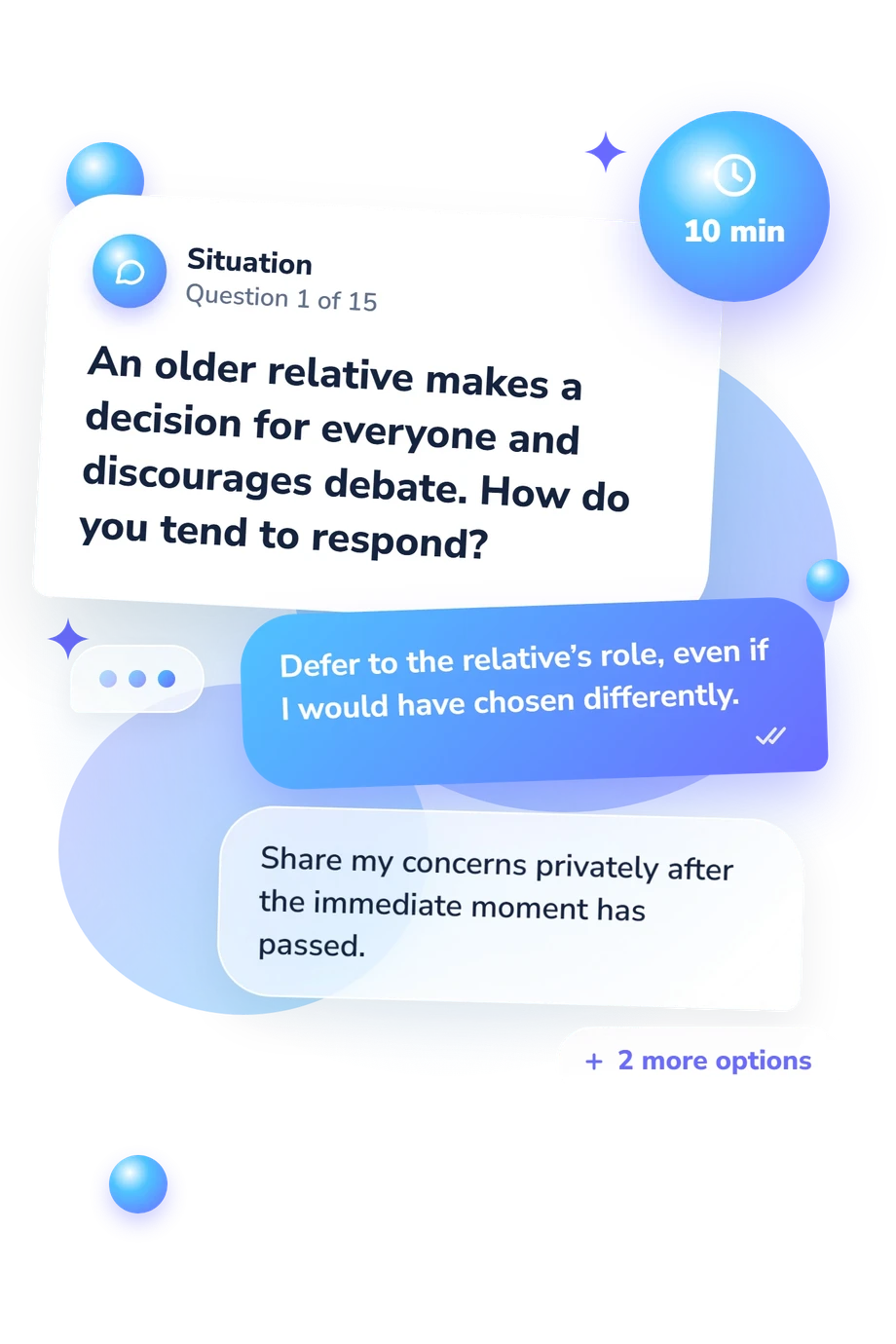
- Defer to the relative’s role, even if I would have chosen differently.
- Share my concerns privately after the immediate moment has passed.
- Ask pointed questions that encourage the group to reconsider.
- State my disagreement directly and defend everyone’s right to choose.
- Align with the group whose position seems stronger.
- Wait for emotions to settle rather than becoming involved.
- Carry concerns privately between people who will not speak directly.
- Help both groups name their priorities and look for compatible ground.
- Follow it unless it creates a serious practical problem.
- Watch how others handle it before deciding whether to respond.
- Bend it quietly when it does not make sense in the situation.
- Question it directly and propose a different rule.
Royal or Rebel Quiz - Description and methodology of the test
People curious about how they balance inherited customs with personal freedom can use the Royal or Rebel Quiz to examine those instincts in ordinary family situations. As a tradition and independence quiz, it helps readers notice whether they tend to preserve continuity, challenge expectations, or connect viewpoints without treating any profile as a fixed identity. The result gives language for reflecting on choices that surface in families, ceremonies, and everyday decisions.
What This Assessment Explores
At its core, the questionnaire examines responses to family authority, inherited customs, personal difference, and competing viewpoints. The profiles describe affinities, not virtues: a royal or rebel personality may lean toward continuity, autonomy, or integration, or combine them.
The three result dimensions are:
- Diplomatic Bridge-Builder (0-15) reflects affinity for translating perspectives, adapting traditions, and creating shared ground: Light affinity (0-5), Situational connector (6-10), and Strong connector (11-15) show increasing integration.
- Rebel Trailblazer (0-15) reflects affinity for autonomy, candid rule-questioning, experimentation, and breaking inherited patterns: Light affinity (0-5), Selective challenger (6-10), and Strong trailblazer (11-15) show increasing independence.
- Royal Traditionalist (0-15) reflects affinity for continuity, ceremony, inherited customs, and clear roles: Light affinity (0-5), Selective custodian (6-10), and Strong custodian (11-15) show increasing commitment to tradition.
Methodology and Scientific Basis
Each item presents a family or ceremonial situation with four response choices. Across disagreements, rituals, etiquette, career expectations, and inherited objects, the options contrast preserving convention, accommodating difference, integrating viewpoints, and challenging a rule.
The scoring compares responses across the three dimensions. The highest score is the strongest affinity, and scores within one point of it form a blended result. This makes the output a profile of relative tendencies, not a single type.
Friedman and Weissbrod (2004) provide the closest conceptual comparison through research on continuing family rituals; Fiese and Kline (1993) contribute the Family Ritual Questionnaire’s focus on ritual meaning and practice. Themes of autonomy, continuity, and integration are also conceptually consistent with Schwartz’s (1992) theory of basic human values and Schwartz et al. (2001), but this questionnaire is not an adaptation of those instruments.
In its are-you-a-royal-or-rebel quiz format, the assessment turns abstract preferences into concrete situations. The online profile is not norm-referenced or clinically classified; self-report answers may shift with current family dynamics, mood, and self-presentation, so the result describes present tendencies rather than fixed character.
- Friedman, Stacey R., and Carol S. Weissbrod. 2004. "Attitudes Toward the Continuation of Family Rituals Among Emerging Adults." Sex Roles 50(3-4): 277-284. 10.1023/B:SERS.0000015558.21334.6b
- Fiese, Barbara H., and Christine A. Kline. 1993. "Development of the Family Ritual Questionnaire: Initial Reliability and Validation Studies." Journal of Family Psychology 6(3): 290-299. 10.1037/0893-3200.6.3.290
- Schwartz, Shalom H., Gila Melech, Arielle Lehmann, Steven Burgess, Mari Harris, and Vicki Owens. 2001. "Extending the Cross-Cultural Validity of the Theory of Basic Human Values with a Different Method of Measurement." Journal of Cross-Cultural Psychology 32(5): 519-542. 10.1177/0022022101032005001
- Schwartz, Shalom H. 1992. "Universals in the Content and Structure of Values: Theoretical Advances and Empirical Tests in 20 Countries." Advances in Experimental Social Psychology 25: 1-65. 10.1016/S0065-2601(08)60281-6
Updated: