
Dividing Fractions Quiz
How the Scales are Structured
Who Usually Takes This Test?
See How You Compare
Below is a preview of how scores are typically distributed across each scale.
Example Questions From the Test
- 3/4 × 6/5 = 9/10
- 3/4 × 5/8 = 15/32
- 5/8 × 6/5 = 3/4
- 5/8 × 3/4 = 15/32
- a and b are equal
- a is the reciprocal of b
- a is twice b
- The numerators of a and b add to their denominators
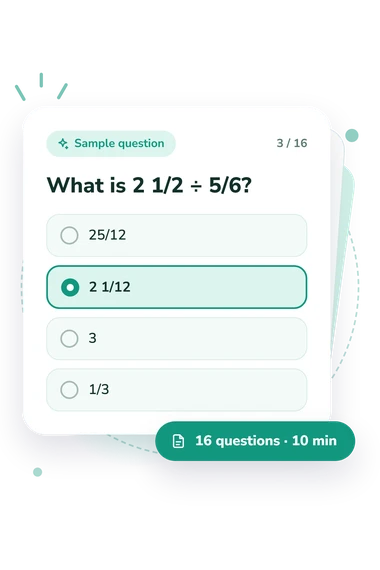
- 25/12
- 2 1/12
- 3
- 1/3
Dividing Fractions Quiz - Description and methodology of the test
Students, parents, and educators who want a focused check of fraction-division understanding can use this dividing fractions quiz to see how accurately the learner reasons through procedures and applications. Learners can use this online quiz on dividing fractions to review classroom knowledge, notice errors, and choose what to practise next. The result describes current performance rather than a permanent ability level.
What This Assessment Explores
These questions examine more than whether the respondent remembers a rule. They connect division with multiplication, reciprocal reasoning, quotient size, and practical meaning. The result helps a learner reviewing fraction division practice or an adult identify ideas needing another explanation.
Recurring question themes contribute to one overall knowledge score:
- Reciprocal reasoning shows whether you can turn division into multiplication by the divisor’s reciprocal.
- Calculation and simplification show whether you can handle mixed numbers and preserve equivalent values.
- Comparison, application, and error analysis show whether you can judge quotient size, solve measurement problems, and correct common misconceptions.
The single scale is Dividing Fractions Knowledge (0-16): Foundations to build (0-6) signals a need to review core ideas; Developing knowledge (7-12) reflects generally secure procedures with some inconsistency; Strong knowledge (13-16) indicates accurate, flexible performance across the tested situations.
Methodology and Evidence Base
Each item presents a problem with four answer choices. The set combines calculations with conceptual comparisons, checks of proposed solutions, correction of straight-across errors, and measurement or sharing contexts. This selected-response format tests both whether you can divide fractions and whether you understand what the operation means.
Each correct answer adds one point to the total. The fixed bands frame the result as learning guidance: the result can point you toward reviewing reciprocals, mixed-number conversion, simplification, or why dividing by a number below one can increase a value.
The content is conceptually consistent with Bulgar (2003) on sense-making in fraction division, Cheng (2013) on mathematical thinking in this topic, and Yao, Jia, and Cai (2023) on the difference between procedural performance and conceptual understanding. It is not an adaptation of those studies, and they do not validate its scoring.
Because notation familiarity, classroom experience, and a careless choice can affect a short result, interpret it as a focused snapshot of performance on these item types, not overall mathematical ability.
- Bulgar, Sylvia. (2003). Children’s sense-making of division of fractions. The Journal of Mathematical Behavior, 22(3), 319-334. DOI 10.1016/S0732-3123(03)00024-5
- Cheng, Chun Chor Litwin. (2013). Teaching of division of fractions through mathematical thinking. Journal of the Korean Society of Mathematical Education Series D: Research in Mathematical Education, 17(1), 15-27. DOI 10.7468/jksmed.2013.17.1.015
- Yao, Yiling, Suijun Jia, and Jinfa Cai. (2023). Beyond computation: Assessing in-service mathematics teachers’ conceptual understanding of fraction division through problem posing. Asian Journal for Mathematics Education, 2(4), 413-429. DOI 10.1177/27527263231217826
Updated: