
Area Quiz
How the Scales are Structured
Who Usually Takes This Test?
See How You Compare
Below is a preview of how scores are typically distributed across each scale.
Example Questions From the Test
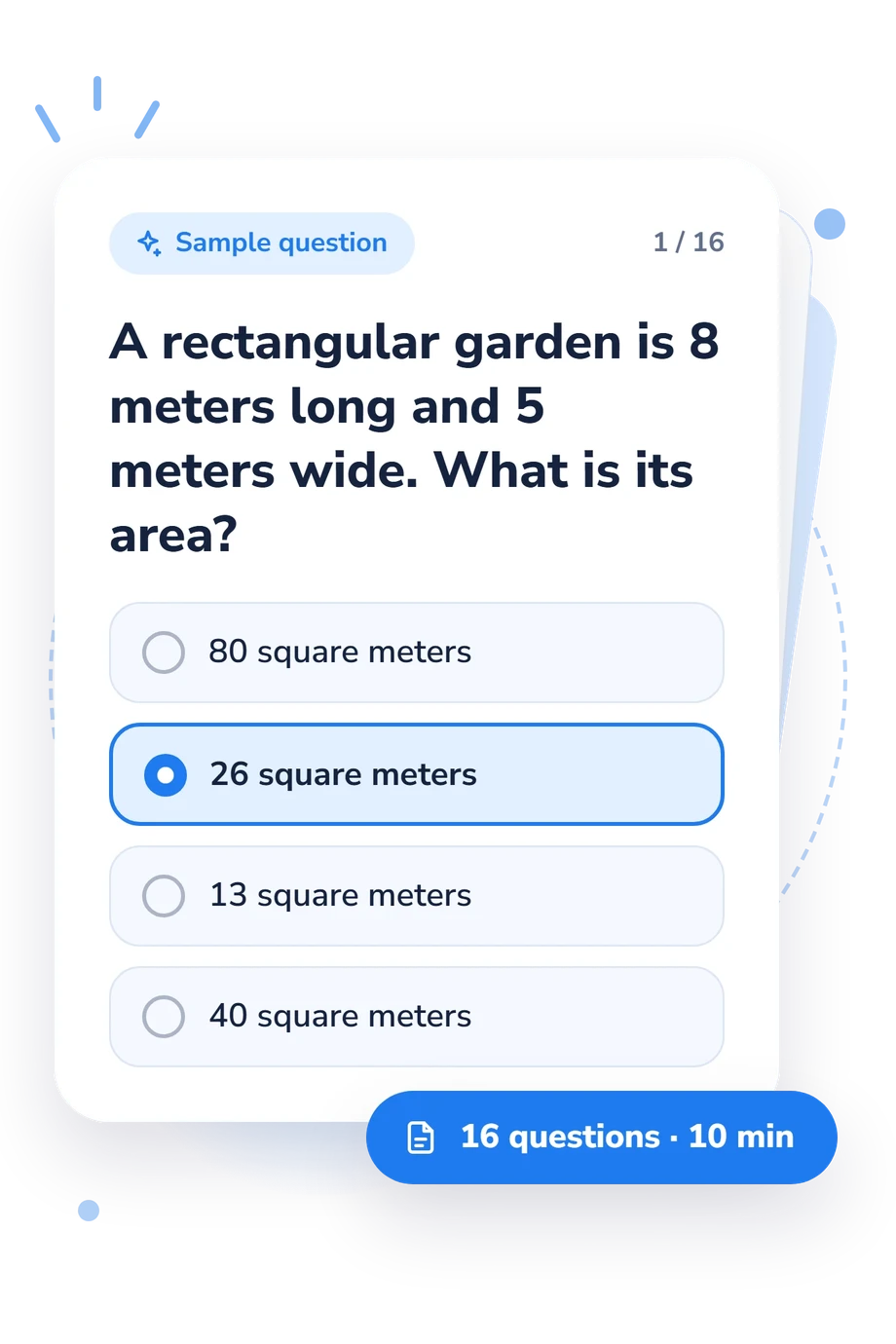
- 80 square meters
- 26 square meters
- 13 square meters
- 40 square meters
- The rectangle's area is 3 square units greater
- Their areas are equal
- The square's area is 12 square units greater
- The square's area is 2 square units greater
- 100π square inches
- 25π square inches
- 10π square inches
- 5π square inches
Area Quiz - Description and methodology of the test
Students, parents, and adult learners revisiting measurement can use this area quiz to identify which kinds of area reasoning feel secure and which need practice. Framed as a geometry quiz about area, it focuses on applying concepts rather than surveying every part of mathematics. The result gives a practical snapshot of formula use, unit awareness, shape comparisons, and problem solving with familiar figures.
What This Assessment Measures
Area is treated as the amount of two-dimensional surface inside a figure, measured in square units. The questions test more than formula recall: they ask you to compare shapes, find missing dimensions, apply scale factors, and subtract an excluded region. Alongside conceptual reasoning, the area formula test checks whether familiar relationships can be used in context.
The result uses one Area Knowledge scale from 0-16: Foundations to build (0-6), Developing knowledge (7-12), and Strong knowledge (13-16). It reflects four connected abilities:
- Formula choice shows whether you select the right relationship for common plane figures.
- Unit awareness shows whether you report surface measures in appropriate square units.
- Comparison and scaling show whether you track how dimensions affect area.
- Composite reasoning shows whether you combine or subtract simpler regions accurately.
Methodology and Evidence Base
Each item presents a short mathematical situation with four answer choices. The respondent selects the best answer, and each correct response earns one point, producing the displayed score. The bands offer study guidance: they indicate whether core area procedures appear ready, developing, or in need of review, rather than ranking the respondent against a norm group.
The content is conceptually consistent with Huang and Witz (2011), whose work emphasizes area measurement through units, covering, relationships, and meaning rather than memorized rules. It also aligns with Lehmann (2023), especially the need to decompose and recombine regions carefully when working with composite shapes. These sources support the mathematical themes, but this online area measurement test is not presented as an adaptation of either study.
Targeted practice becomes easier when results point toward issues such as choosing a radius instead of a diameter, overlooking square units, or mishandling a subtraction step. Performance can also vary with attention, arithmetic accuracy, prior instruction, and familiarity with notation, so the score is a focused learning snapshot rather than a complete measure of mathematical ability.
- Huang, Hsin-Mei E., & Witz, Klaus G. (2011). Developing children's conceptual understanding of area measurement: A curriculum and teaching experiment. Learning and Instruction, 21(1), 1-13. 10.1016/j.learninstruc.2009.09.002
- Lehmann, Timothy H. (2023). Learning to measure the area of composite shapes. Educational Studies in Mathematics, 112(3), 531-565. 10.1007/s10649-022-10191-z
Updated: