
Types of Energy Quiz
How the Scales are Structured
Who Usually Takes This Test?
See How You Compare
Below is a preview of how scores are typically distributed across each scale.
Example Questions From the Test
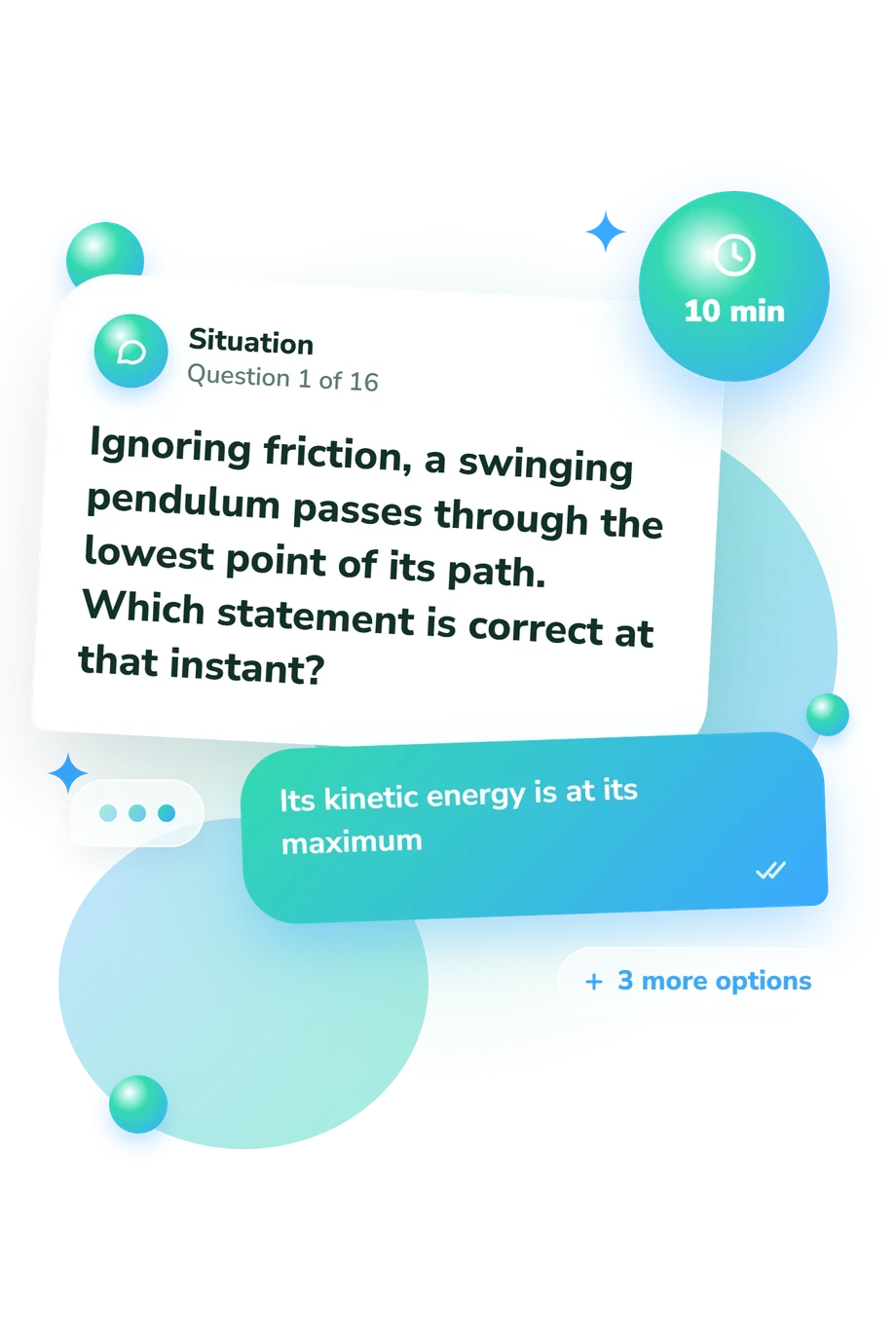
- Its kinetic energy is at its maximum
- Its gravitational potential energy is at its maximum
- Its elastic potential energy is at its maximum
- All of its energy has become thermal energy
- Chemical energy to electrical energy
- Thermal energy to nuclear energy
- Elastic potential energy to kinetic energy
- Sound energy to gravitational potential energy
- Kinetic energy
- Radiant energy
- Elastic potential energy
- Gravitational potential energy
Types of Energy Quiz - Description and methodology of the test
Students, teachers, and curious learners can use the Types of Energy Quiz to examine whether familiar examples are understood as energy forms, stores, and changes rather than memorized labels. It is a practical quiz about forms of energy that connects classroom vocabulary with motion, position, friction, electricity, light, sound, and heat. The result points to concepts worth reinforcing.
What This Assessment Explores
The assessment checks whether a learner can identify energy forms and stores and follow energy as it moves or changes. It suits anyone reviewing physical science.
Examples span a pendulum, spring, dam, bicycle, battery, solar panel, toaster, and loudspeaker. The forms of energy quiz questions ask respondents to distinguish motion, position, stored energy, and transformations.
Four recurring themes appear in the questions while one total score reflects knowledge of energy forms, transformations, and conservation:
- Stored and moving energy is identified from motion, height, deformation, particles, or nuclei.
- Energy changes are traced between forms in devices and daily events.
- Energy forms are distinguished from transformations and transfer processes; friction transfers motion into thermal energy.
- Conservation links starting and later states rather than treating energy as lost.
A stronger total suggests broader recognition while lower performance may indicate areas for review.
Methodology and Scientific Basis
Each item presents a situation and asks the respondent to select the form, store, or transformation that best explains it. This energy knowledge assessment uses four choices and one correct response per item. One point is awarded for each correct answer, so the total reflects demonstrated knowledge rather than confidence.
Questions connect familiar cases to distinctions such as kinetic versus potential energy, stored energy, and energy transformations.
The approach aligns conceptually with Herrmann-Abell and DeBoer (2018), whose learning-progression work describes increasingly connected understanding of energy ideas. Their 2014 assessment chapter is relevant because its distractor-driven method uses incorrect options to expose confusions, such as reversing a transformation. This questionnaire is consistent with those ideas, not a validated adaptation of either publication.
The displayed scale, Types of Energy Knowledge (0-16), reports Foundations to build (0-6), Developing knowledge (7-12), or Strong knowledge (13-16). These bands describe performance on this questionnaire, not a universal standard for science mastery. Interpretation can be shaped by instruction, wording, attention, guessing, and current context, so the total is best read as a snapshot of performance.
- Herrmann-Abell, Cari F., and George E. DeBoer. “Investigating a Learning Progression for Energy Ideas from Upper Elementary Through High School.” Journal of Research in Science Teaching, vol. 55, no. 1, 2018, pp. 68-93. 10.1002/tea.21411
- Herrmann-Abell, Cari F., and George E. DeBoer. “Developing and Using Distractor-Driven Multiple-Choice Assessments Aligned to Ideas About Energy Forms, Transformation, Transfer, and Conservation.” Teaching and Learning of Energy in K-12 Education, edited by R. F. Chen, A. Eisenkraft, D. Fortus, J. Krajcik, K. Neumann, J. C. Nordine, and A. Scheff, Springer, 2014, pp. 103-133. 10.1007/978-3-319-05017-1_7
Updated: