
What Tablet Should I Buy Quiz
How the Scales are Structured
Who Usually Takes This Test?
See How You Compare
Below is a preview of how scores are typically distributed across each scale.
Example Questions From the Test
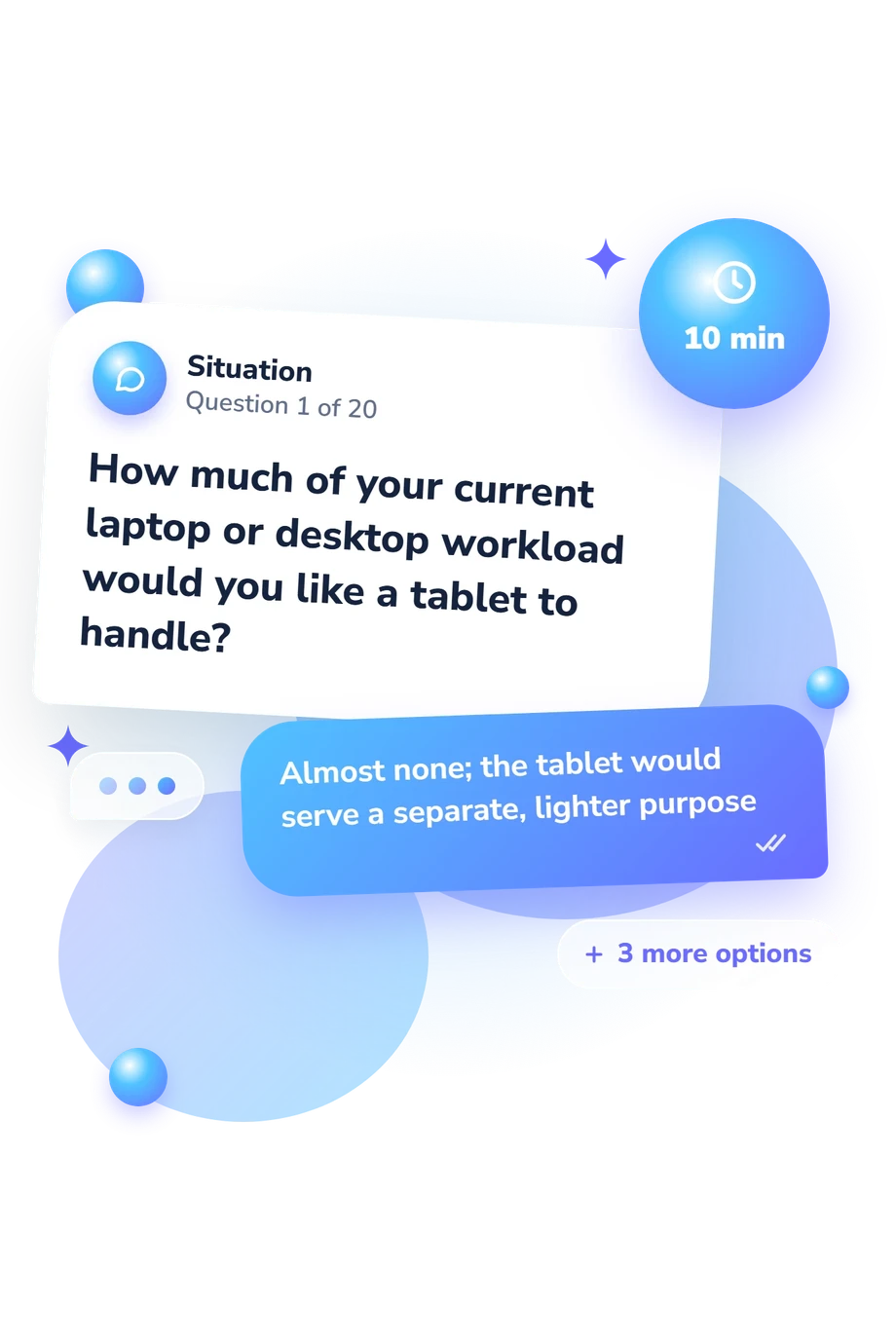
- Almost none; the tablet would serve a separate, lighter purpose
- A few simple tasks such as email or reviewing documents
- A substantial share of routine work or study
- Most mobile tasks, including writing and switching among several apps
- Rarely or never; touch and keyboard input would cover my needs
- Occasionally for signatures, quick notes, or simple markups
- Several times a week for notes or creative projects
- Most days as a central part of study, work, or art
- Rarely; it would normally stay in one familiar place
- A few times a month for selected trips or appointments
- Several times a week in a bag
- Almost daily, often while commuting or moving between locations
What Tablet Should I Buy Quiz - Description and methodology of the test
People comparing tablets often need help clarifying which features matter most for their routine. The What Tablet Should I Buy Quiz helps turn everyday habits into practical buying priorities rather than chase a single best device. It acts as a quiz about how to choose a tablet, organizing trade-offs before model comparisons, from portability and accessories to performance and software.
What This Assessment Explores
Across five profiles, this tablet quiz distinguishes specialist and balanced priorities; scores within one point of the highest indicate a blended fit, not product quality.
- Creative Pen Tablet (0-12) measures stylus input, handwriting, illustration, design, and annotation: Pen Optional (0-4), Creative Companion (5-8), Strong Creative Fit (9-12).
- Everyday Entertainment Tablet (0-12) measures streaming, browsing, calls, casual apps, and shared use: Specialized Priorities (0-4), Useful Casual Fit (5-8), Strong Everyday Fit (9-12).
- High-Performance Gaming Tablet (0-12) measures demanding games, responsiveness, display, storage, and accessories: Casual Play (0-4), Regular Player (5-8), Strong Gaming Fit (9-12).
- Portable Reading & Travel Tablet (0-12) measures compactness, low weight, reading, and carrying: Mostly Stationary (0-4), Travel-Friendly Interest (5-8), Strong Portable Fit (9-12).
- Productivity 2-in-1 Tablet (0-12) measures keyboard-ready work, study, documents, meetings, and multitasking: Companion Device (0-4), Hybrid Helper (5-8), Strong 2-in-1 Fit (9-12).
Methodology and Scientific Basis
Each item presents an everyday scenario with four choices about work, gaming, entertainment, mobility, or stylus use. The options express priorities rather than right answers, so the most realistic response is more useful than an idealized one.
Answers generate five comparative profile totals. The strongest scores show which roles deserve attention; results within one point of the highest indicate a blended fit. This preference-based method does not rank brands, operating systems, or individual products.
Conceptually, the questionnaire aligns with Leung and Zhang (2016) on tablet motivations, leisure context, and multitasking, and with Müller, Gove, and Webb (2012) on varied tablet activities. Katz, Blumler, and Gurevitch’s uses-and-gratifications perspective helps explain different device goals, while Annett and Bischof (2015) add context for stylus accuracy. These publications are conceptual reference points rather than validation studies for this questionnaire; they do not establish its reliability, validity, or norms. The questionnaire's scoring is not standardized.
This tablet finder quiz gives you a starting profile for comparing size, display, pen support, accessories, performance, software, and storage. Budget, current projects, self-awareness, and honest self-report can shift scores, so they describe present priorities rather than a fixed identity.
- Leung, Louis, and Renwen Zhang (2016). Predicting tablet use: A study of gratifications-sought, leisure boredom, and multitasking. Telematics and Informatics, 33(2), 331-341. 10.1016/j.tele.2015.08.013
- Müller, Hendrik, Jennifer L. Gove, and John S. Webb (2012). Understanding tablet use: A multi-method exploration. In Proceedings of the 14th International Conference on Human-Computer Interaction with Mobile Devices and Services (MobileHCI ’12), 1-10. ACM. 10.1145/2371574.2371576
- Annett, Michelle, and Walter Bischof (2015). Hands, hover, and nibs: Understanding stylus accuracy on tablets. Proceedings of Graphics Interface 2015, 203-210.
- Katz, Elihu, Jay G. Blumler, and Michael Gurevitch (1973). Uses and gratifications research. Public Opinion Quarterly, 37(4), 509-523. 10.1086/268109
Updated: