
Pride and Prejudice Character Quiz
How the Scales are Structured
Who Usually Takes This Test?
See How You Compare
Below is a preview of how scores are typically distributed across each scale.
Example Questions From the Test
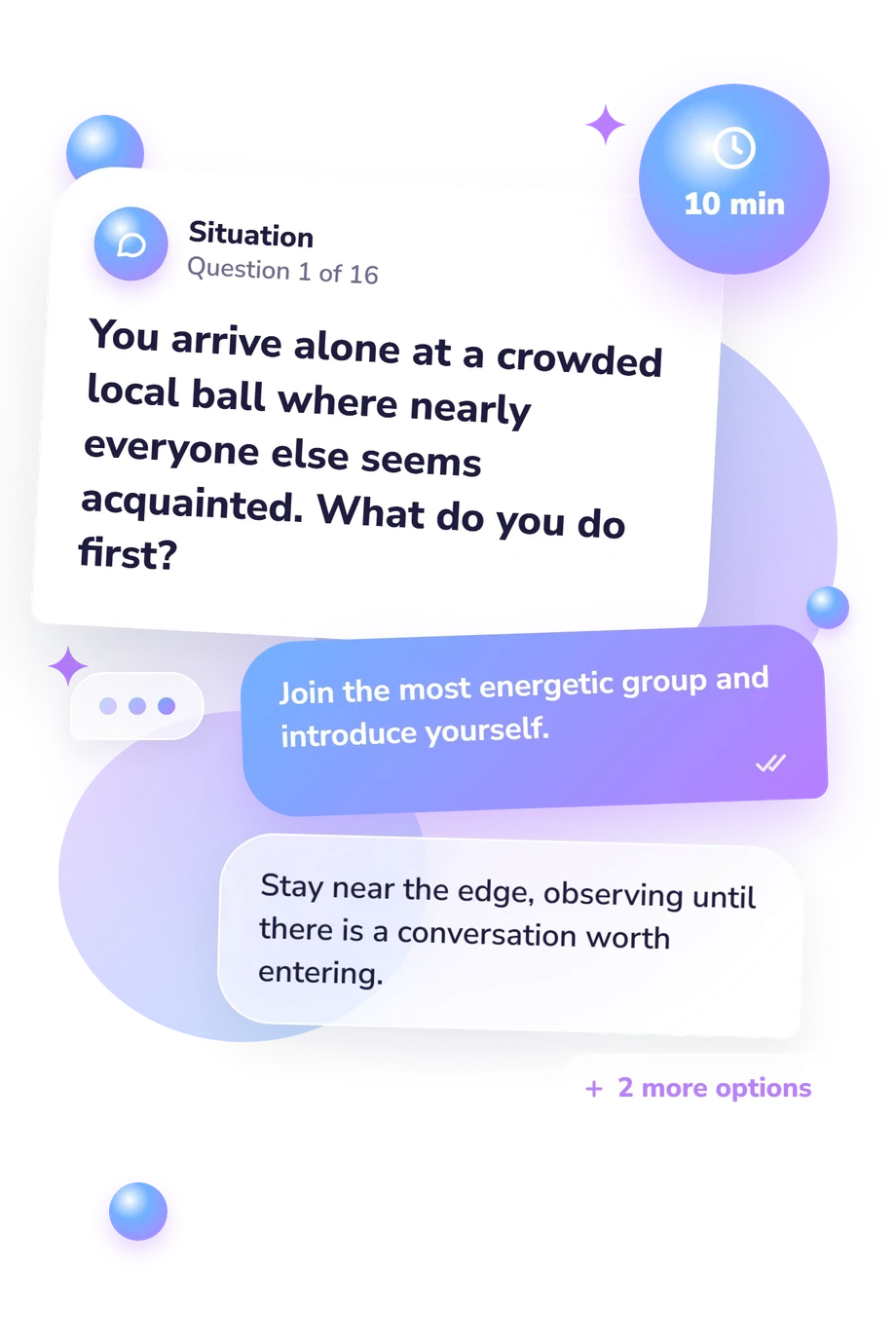
- Join the most energetic group and introduce yourself.
- Stay near the edge, observing until there is a conversation worth entering.
- Speak courteously with a few people while keeping your manner composed.
- Find one welcoming person and let them draw you into the gathering.
- Turn the disagreement into a lively exchange and test their reasoning directly.
- Listen closely, then state your position only if the issue has practical consequences.
- Look for shared ground before discussing the difference.
- Challenge one assumption with a teasing question and see where the conversation goes.
- Ask a sincere question to understand what they meant.
- Offer a light, pointed reply that exposes the pomposity without starting a quarrel.
- Let the remark pass and redirect attention to someone more approachable.
- Keep your reaction private and observe the room.
Pride and Prejudice Character Quiz - Description and methodology of the test
Readers who want a playful way to reflect on social style, judgment, loyalty, and independence can use the pride and prejudice character quiz as a literary self-reflection exercise. It compares patterns in your choices with four Austen characters rather than assigning a fixed identity. It also works as a pride and prejudice personality quiz, giving those reflections a clear literary frame.
What This Assessment Explores
Choices about social entry, disagreement, motives, first impressions, help, and duty feed four character-affinity dimensions. This Pride and Prejudice character test compares those patterns without claiming that you are identical to a fictional person.
These profiles describe what each affinity means for your result:
- Charles Bingley Affinity (0-12) shows sociability and adaptability: More Deliberate Energy (0-4), Companionable Streak (5-8), or Strong Bingley Affinity (9-12).
- Elizabeth Bennet Affinity (0-12) shows wit, candor, independence, and revised judgment: Different Temperament (0-4), Kindred Spark (5-8), or Strong Elizabeth Affinity (9-12).
- Fitzwilliam Darcy Affinity (0-12) shows reserve, loyalty, duty, and deliberation: More Open Style (0-4), Quiet Resonance (5-8), or Strong Darcy Affinity (9-12).
- Jane Bennet Affinity (0-12) shows warmth, patience, restraint, and charitable interpretations: Different Emotional Lens (0-4), Shared Grace (5-8), or Strong Jane Affinity (9-12).
Methodology and Evidence Base
The questionnaire presents four options for each scenario. Items ask how you would act or interpret social entry, disagreement, first impressions, discreet support, romantic judgment, and family duty. Choosing an option is self-report, not a test of novel recall.
The four reported affinity scores are compared with one another. The highest indicates your strongest affinity, while scores within one point indicate a blended result. The displayed bands describe represented styles rather than clinical categories or fixed personality types; they also show how closely your choices align with each character’s qualities.
Rytting (2018) provides a relevant comparison through Myers-Briggs type ideas applied to Jane and Bingley. Austen’s novel supplies the character portrayals, while Padmawati, Jayantini, and Resen (2021) discuss contrasting qualities in Elizabeth and Darcy. This questionnaire is conceptually consistent with those literary and character-analysis sources, but it is not presented as an adaptation of a published psychological instrument.
The result of this Pride and Prejudice quiz compares character affinities rather than naming which character you are; a close profile can show a blended pattern. Mood, current relationships, familiarity with the characters, and honesty can influence self-report choices.
- Rytting, Jenny Rebecca. “Jane, Bingley, and the Myers-Briggs Type Indicator: Or, the Other Couple in Pride and Prejudice.” Persuasions On-Line, vol. 39, no. 1, Winter 2018.
- Austen, Jane. Pride and Prejudice. London: Thomas Egerton, 1813.
- Ni Made Padmawati, I Gusti Agung Sri Jayantini, and I Wayan Resen. “Exploring Characterization of Main Characters: Elizabeth and Darcy in Pride and Prejudice.” ELYSIAN Journal: English Literature, Linguistics and Translation Studies, vol. 1, no. 1, 2021, pp. 105-112. 10.36733/elysian.v1i1.1657
Updated: