
Rate My Life Quiz
How the Scales are Structured
Who Usually Takes This Test?
See How You Compare
Below is a preview of how scores are typically distributed across each scale.
Example Questions From the Test
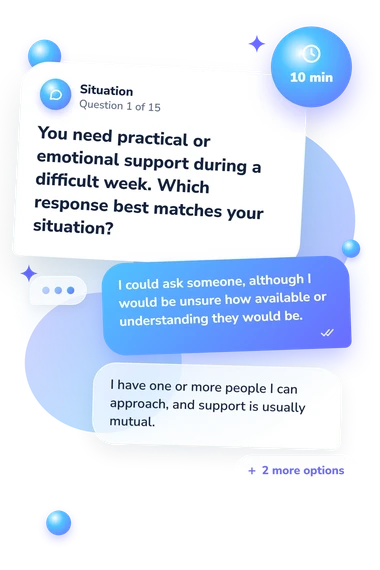
- I could ask someone, although I would be unsure how available or understanding they would be.
- I have one or more people I can approach, and support is usually mutual.
- I can identify possible support, but asking would still feel somewhat difficult.
- I would expect to manage alone because no realistic source of support comes to mind.
- I feel recognized and able to contribute in ways that suit me.
- I am present, but I mostly feel interchangeable or unnoticed.
- I sometimes feel included and can point to a modest role I play.
- I generally feel outside the group, even when I participate.
- I usually have enough energy left for something I enjoy or value.
- I am often depleted, with little capacity beyond essential tasks.
- My energy varies, but I can sometimes make room for myself afterward.
- I can finish what is necessary, though little energy remains afterward.
Rate My Life Quiz - Description and methodology of the test
People seeking a structured way to reflect on their current well-being can use the Rate My Life Quiz to look beyond a single success or difficulty. It is suited to anyone considering how relationships, daily demands, and personal direction are working together. It also helps you ask how good your life feels in practice, clarifying what feels supported, strained, or ready for a small change.
What This Assessment Explores
Questions cover support, belonging, energy, recovery, enjoyment, competing obligations, and direction when plans change. The result describes current patterns rather than a permanent personality trait. This well-being assessment helps identify a practical starting point.
The three dimensions shown in the result are:
- Your Connection and Belonging result falls into Connection Feels Distant (0-5), Selectively Connected (6-10), or Deeply Connected (11-15), reflecting limited, partial, or generally mutual, authentic belonging.
- Your Everyday Balance and Vitality result falls into Running on Limited Reserves (0-5), Uneven but Sustaining (6-10), or Well Supported (11-15), reflecting limited, uneven, or generally adequate energy, enjoyment, and recovery.
- Your Purpose and Direction result falls into Searching (0-5), Taking Shape (6-10), or Strongly Oriented (11-15), reflecting uncertain, developing, or generally clear links between priorities, choices, and values.
Methodology and Evidence Base
Each prompt in this life evaluation quiz describes an everyday situation and offers four response options. The respondent chooses the statement that best matches their experience. Responses are summarized within the displayed dimensions; the ranges and bands organize the profile into descriptive levels.
Mental Health Continuum-Short Form (MHC-SF) is the closest named comparison for the emphasis on positive functioning in personal and social life. The questionnaire is conceptually consistent with Keyes (2002), who described well-being along a continuum, and with Diener and colleagues (2010), whose short measures address flourishing and feelings. This is a conceptual relationship, not an adaptation or validated reproduction of those instruments.
Interpretation should stay close to the situations the respondent recognized. Lower results may point to limited support, depleted routines, or uncertain priorities; higher results suggest more available resources in that area. Scores can shift with circumstances, recall, and self-awareness. The displayed ranges are reflective, non-diagnostic bands; they do not provide population-normed or clinical interpretation, so the profile is best read as structured self-reflection.
- Keyes, Corey L. M., Wissing, Marié, Potgieter, Johan P., Temane, Michael, Kruger, Annamarie, and van Rooy, Sinette. (2008). Evaluation of the mental health continuum-short form (MHC-SF) in Setswana-speaking South Africans. Clinical Psychology & Psychotherapy, 15(3), 181-192. 10.1002/cpp.572
- Keyes, Corey L. M. (2002). The mental health continuum: From languishing to flourishing in life. Journal of Health and Social Behavior, 43(2), 207-222. 10.2307/3090197
- Diener, Ed, Wirtz, Derrick, Tov, William, Kim-Prieto, Chu, Choi, Dong-won, Oishi, Shigehiro, and Biswas-Diener, Robert. (2010). New Well-being Measures: Short Scales to Assess Flourishing and Positive and Negative Feelings. Social Indicators Research, 97, 143-156. 10.1007/s11205-009-9493-y
Updated: