
Classic Movie Quiz
How the Scales are Structured
Who Usually Takes This Test?
See How You Compare
Below is a preview of how scores are typically distributed across each scale.
Example Questions From the Test
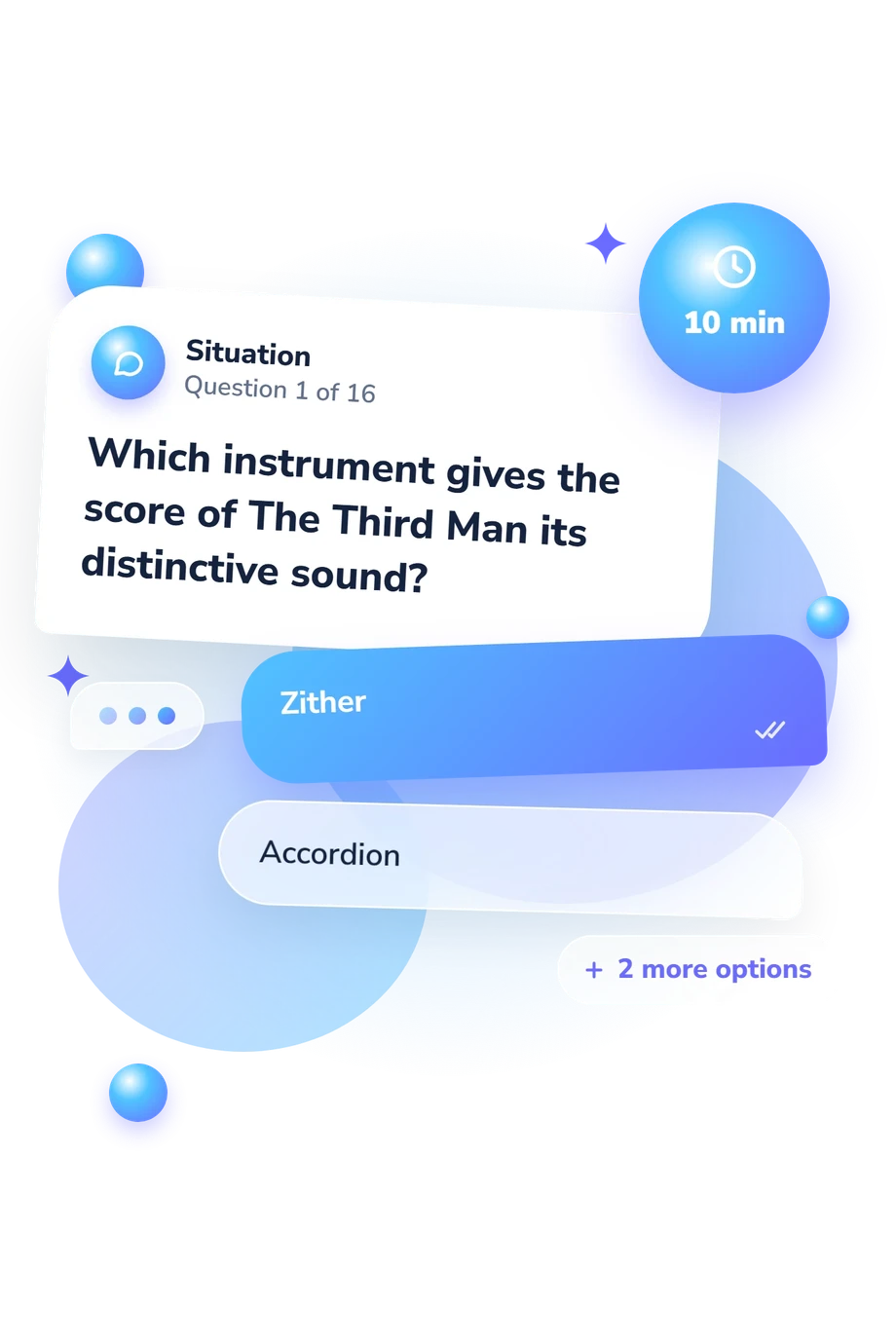
- Zither
- Accordion
- Violin
- Piano
- The Night of the Hunter
- Psycho
- Dial M for Murder
- The Postman Always Rings Twice
- A stone wall around an estate
- A row of roadside cabins
- A blanket hung between their beds
- A nickname for a police roadblock
Classic Movie Quiz - Description and methodology of the test
People who want a focused knowledge challenge about landmark cinema can use this classic movie quiz to decide whether their familiarity with widely known films merits broader viewing or a deeper test. It suits curious viewers who prefer a factual check of cultural knowledge to a personality profile. For readers interested in an old movie quiz, it gives a compact indication of whether their overall recall is developing, solid, or detailed.
What This Assessment Explores
These questions cover landmark films through plot events, characters, settings, objects, music, and history. They ask readers to identify titles, recall motives or endings, and connect production changes with story context. The result uses classic film trivia to test cultural recall.
The themes span recall types, while one overall score reflects knowledge across them:
- Classic Movie Knowledge (0-16) is the single result: Opening Credits (0-6) marks recognition of touchstones with stories and details left to explore; Matinee Regular (7-12) indicates solid knowledge across major films, genres, characters, and scenes; Classic Cinema Connoisseur (13-16) indicates broad, detailed command of enduring films and important moments.
- Title recognition asks you to connect scenes or objects with films.
- Story recall asks how well you remember motives, turns, and endings.
- Film-culture recall covers music, genres, and technological change.
Methodology and Scientific Basis
Each item uses four answer options and one best answer. The questions test recognition and recall rather than agreement, making the format a classic cinema quiz about film-content knowledge rather than opinion. Its format is compatible with general multiple-choice guidance from Haladyna, Downing, and Rodriguez, including clear stems and plausible alternatives; but that guidance does not establish a documented design standard for this questionnaire.
A film-literacy work by Garcia and Belecina offers context for broader knowledge of films and their formal or cultural features. This questionnaire is not an adaptation of it, and the comparison does not establish its narrower factual-recall construct. Bordwell, Thompson, and Smith’s film-studies framework supplies vocabulary for narrative, style, genre, sound, and historical change, but it is a conceptual reference rather than validation of the online quiz.
The result is one score interpreted through the bands above. These descriptive labels are not population norms, and no standardization, reliability, or validity evidence is established for this online questionnaire; memory, cultural familiarity, and exposure to prominent titles can affect self-administered recall, so interpret the outcome as a focused self-check.
- Garcia, Enrico 'Omael Khalil Sharif B., and Rene R. Belecina. "Initial Steps in the Development and Validation of an Instrument to Measure Film Literacy." The Normal Lights: Philippine Normal University Journal on Teacher Education, vol. 7, no. 2, 2013, pp. 97-117.
- Bordwell, David, Kristin Thompson, and Jeff Smith. Film Art: An Introduction. 12th ed., McGraw-Hill Education, 2019.
- Haladyna, Thomas M., Steven M. Downing, and Michael C. Rodriguez. "A Review of Multiple-Choice Item-Writing Guidelines for Classroom Assessment." Applied Measurement in Education, vol. 15, no. 3, 2002, pp. 309-333. 10.1207/S15324818AME1503_5
Updated: