
Dewey Decimal System Quiz
How the Scales are Structured
Who Usually Takes This Test?
See How You Compare
Below is a preview of how scores are typically distributed across each scale.
Example Questions From the Test
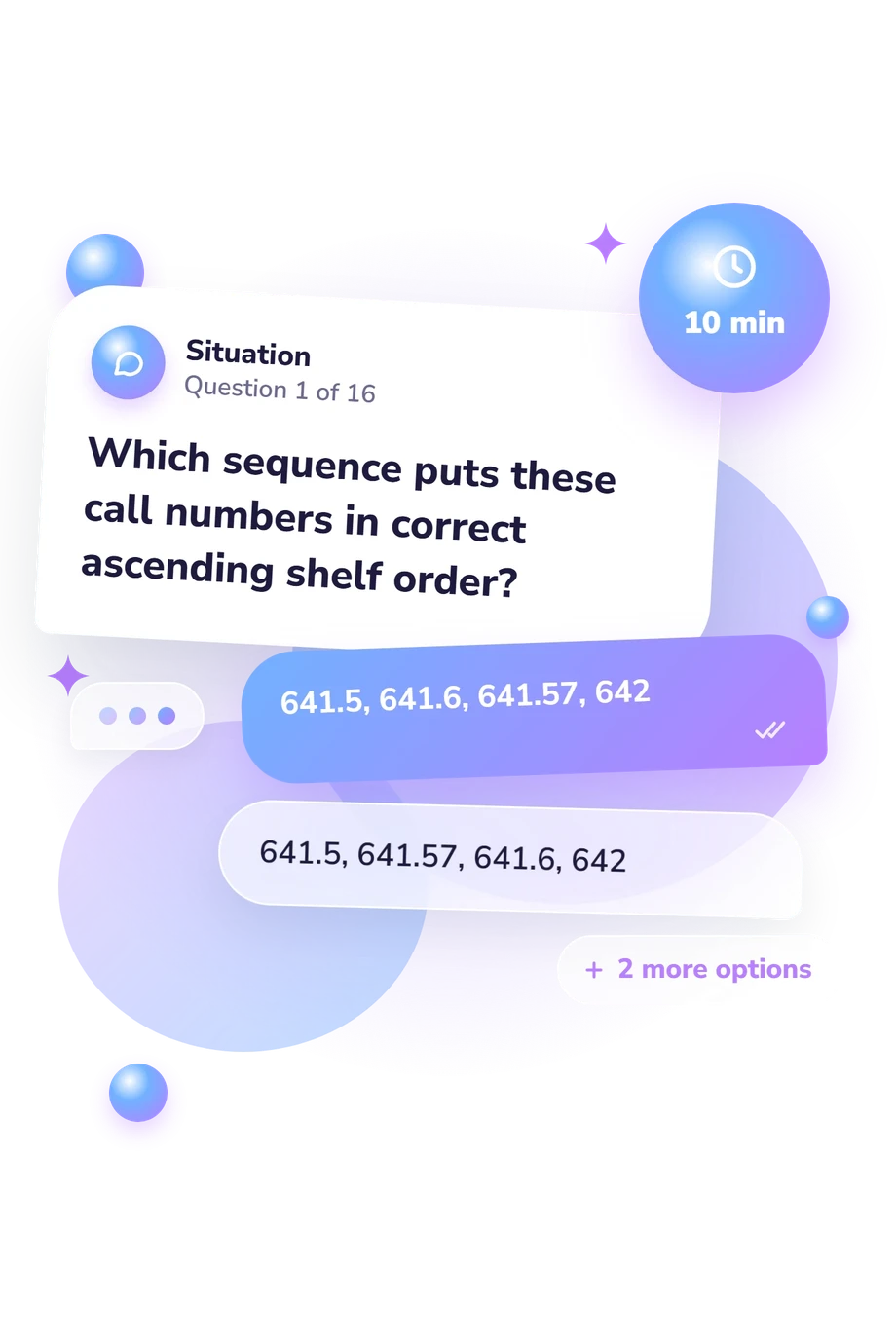
- 5, 641.6, 641.57, 642
- 5, 641.57, 641.6, 642
- 57, 641.5, 641.6, 642
- 642, 641.6, 641.57, 641.5
- Chemistry
- Astronomy
- Physics
- Mathematics
- Earth sciences
- Engineering
- Medicine and health
- Management
Dewey Decimal System Quiz - Description and methodology of the test
Students, library users, and anyone revising classification can use this dewey decimal system quiz to see how confidently they read Dewey numbers and place broad subjects. It offers focused Dewey classification practice by combining class recognition, number placement, and shelf-order reasoning before further study. The overall result indicates Dewey knowledge, while the questions and review process can guide attention to secure skills and topics needing another pass.
What This Assessment Explores
The questions test understanding of the Dewey Decimal System, giving readers practice with Dewey Decimal classification rather than label recall. They span main classes and connect subjects with broad numbers in mathematics, science, technology, arts, literature, geography, law, and psychology. Items examine how subdivisions refine topics such as cooking, music, folklore, and library science.
The assessed abilities fall into four areas:
- Main-class recognition shows whether a reader identifies broad subject territory.
- Subject placement shows whether neighboring fields are distinguished when categories overlap.
- Decimal notation shows how added digits create more specific locations.
- Shelf-order reasoning shows whether call numbers can be compared in ascending sequence.
The quiz reports one scale, Dewey Decimal System Knowledge (0-16): Foundation to build (0-6), Developing navigator (7-12), or Strong Dewey knowledge (13-16). These bands indicate overall performance in this educational summary rather than cataloging certification.
Methodology and Scientific Basis
Each item presents a short library-classification problem with four answer choices. Respondents select the option that best matches a main class, a specific number, or the correct order of call numbers. The quiz reports one overall result, which should be read as a broad indication of performance across these topics rather than as separate area scores.
The questionnaire’s questions are conceptually consistent with the Dewey Decimal Classification hierarchy and notation, which move from broad classes toward more specific placement. That relationship appears in questions about class recognition, decimal specificity, and ascending call-number order.
Performance can reflect prior library experience, terminology familiarity, attention to decimal order, and interpretation of a question. Use the score as a review guide: revisit main classes, compare related numbers, and practice Dewey number order. Reviewing performance across class recognition, number placement, and shelf-order questions can show which topics deserve further study.
- Dewey, Melvil. Dewey Decimal Classification and Relative Index. 23rd ed., edited by Joan S. Mitchell, Julianne Beall, Rebecca Green, Giles Martin, and Michael Panzer. Dublin, OH: OCLC Online Computer Library Center, Inc., 2011.
- Chan, Lois Mai, and Joan S. Mitchell. Dewey Decimal Classification: Principles and Application. 3rd ed. Dublin, OH: OCLC Online Computer Library Center, 2003.
- Josephson, A. G. “The Dewey Decimal Classification and Scientific Classification.” Science 4, no. 88 (1896): 315-316. 10.1126/science.4.88.315
Updated: