
Filipino Quiz
How the Scales are Structured
Who Usually Takes This Test?
See How You Compare
Below is a preview of how scores are typically distributed across each scale.
Example Questions From the Test
- Disagreement with the speaker
- A request to change languages
- Respect or politeness
- Informal familiarity between close friends
- Benguet
- Ifugao
- Mountain Province
- Nueva Vizcaya
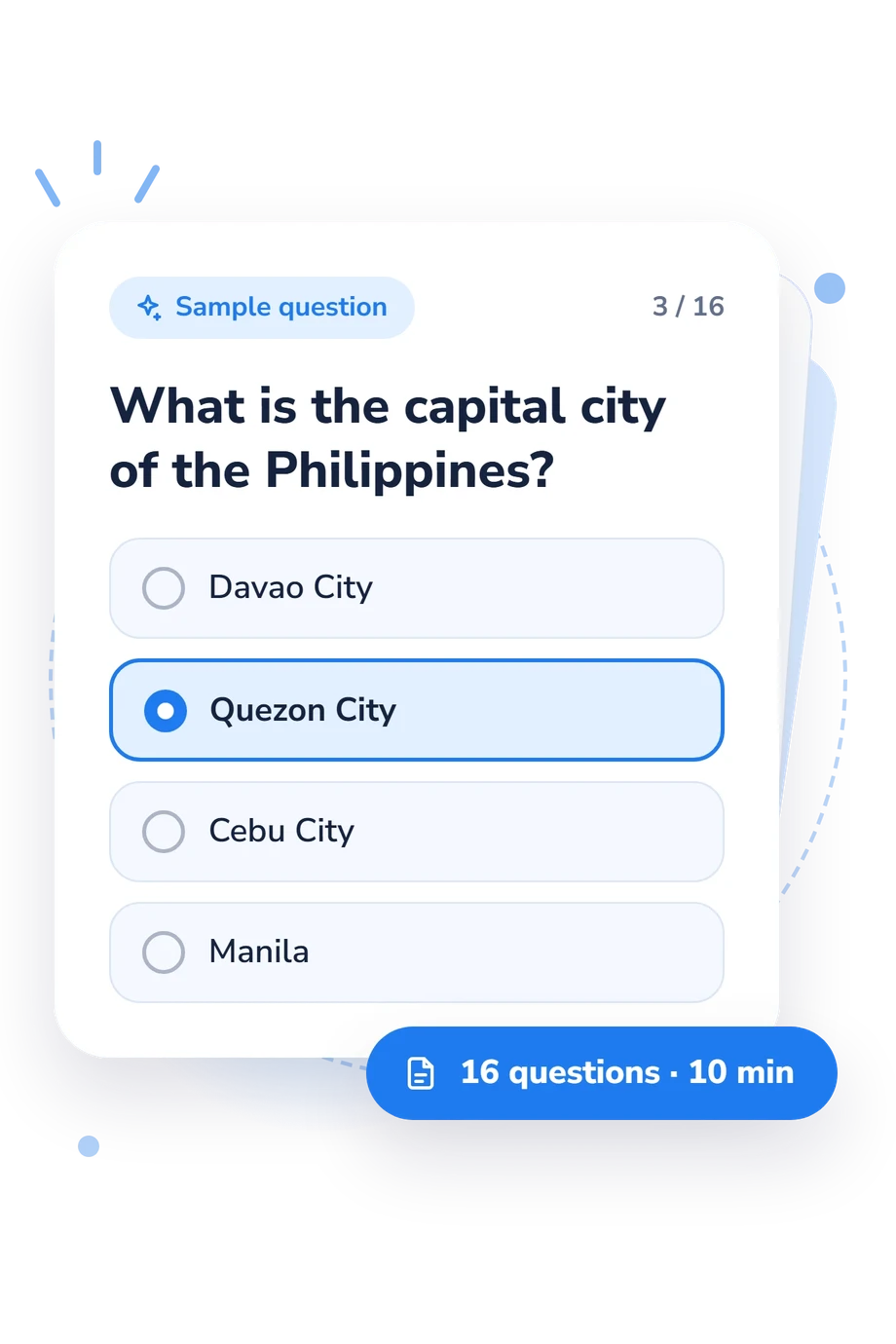
- Davao City
- Quezon City
- Cebu City
- Manila
Filipino Quiz - Description and methodology of the test
People who want a quick way to check their familiarity with the Philippines can use the Filipino Quiz as a broad general-knowledge exercise. It suits curious learners, travelers, students, and anyone revisiting facts about the country. A pinoy trivia quiz format like this can show which areas feel secure and which invite further reading, while keeping the result focused on knowledge rather than personality.
What This Assessment Explores
The questions combine factual recall with cultural meanings and everyday contexts. They range across geography, history, government, language, literature, food, clothing, transport, festivals, and social values, so the result reflects breadth rather than mastery of one subject.
As a Philippines knowledge quiz, it suits travelers, learners building cultural literacy, and people checking what they remember. Each item presents four answer choices and asks for the best-supported response, not a personal opinion.
The main content areas are:
- Geography and landmarks show recognition of destinations, physical features, and major island divisions.
- History and national identity indicate familiarity with independence, symbols, literature, and constitutional language.
- Culture and everyday life reveal knowledge of food, clothing, transport, festivals, and shared social concepts.
- Language and civic context connect common expressions with the respectful or communal meanings they carry.
Methodology and Evidence Base
Methodologically, this is a content-based, selected-response questionnaire for factual recall. Four options create a recognition task: the respondent chooses the answer that best fits the fact or situation described. The displayed Filipino Knowledge scale (0-16) uses Foundation Building (0-6), Developing Knowledge (7-12), and Strong Knowledge (13-16). It is not presented as a standardized or norm-referenced instrument; the bands describe increasing breadth and accuracy within sampled topics, not diagnostic cutoffs.
The factual frame is conceptually consistent with Tope et al. (2022), with Rood (2019) adding historical and civic context and the 1987 Constitution supporting the national-language item. Kalahi (Montalan et al., 2024) is a relevant cultural and language evaluation reference, but none of these works is the source instrument or scoring manual for this online quiz. A Philippines trivia test result is therefore best read as a snapshot of current recall. Results can shift with education, travel, media exposure, guessing, and familiarity with a particular item, so the bands identify useful areas for further learning rather than measuring intelligence or cultural competence.
- Lily Rose R. Tope, Jill Keppeler, Detch P. Nonan-Mercado, and Jui Lin Yong. Philippines. 4th ed. Cavendish Square Publishing, 2022. ISBN 978-1-5026-6699-4.
- Steven Rood. The Philippines: What Everyone Needs to Know. Oxford University Press, 2019. 10.1093/wentk/9780190920609.001.0001.
- Jann Railey Montalan, Jian Gang Ngui, Wei Qi Leong, Yosephine Susanto, Hamsawardhini Rengarajan, Alham Fikri Aji, and William Chandra Tjhi. Kalahi: A handcrafted, grassroots cultural LLM evaluation suite for Filipino. Proceedings of the 38th Pacific Asia Conference on Language, Information and Computation, 2024, pp. 497-523.
- Republic of the Philippines. The Constitution of the Republic of the Philippines, 1987. Official Gazette of the Republic of the Philippines.
Updated: