
Crossdressing Quiz
How the Scales are Structured
Who Usually Takes This Test?
See How You Compare
Below is a preview of how scores are typically distributed across each scale.
Example Questions From the Test
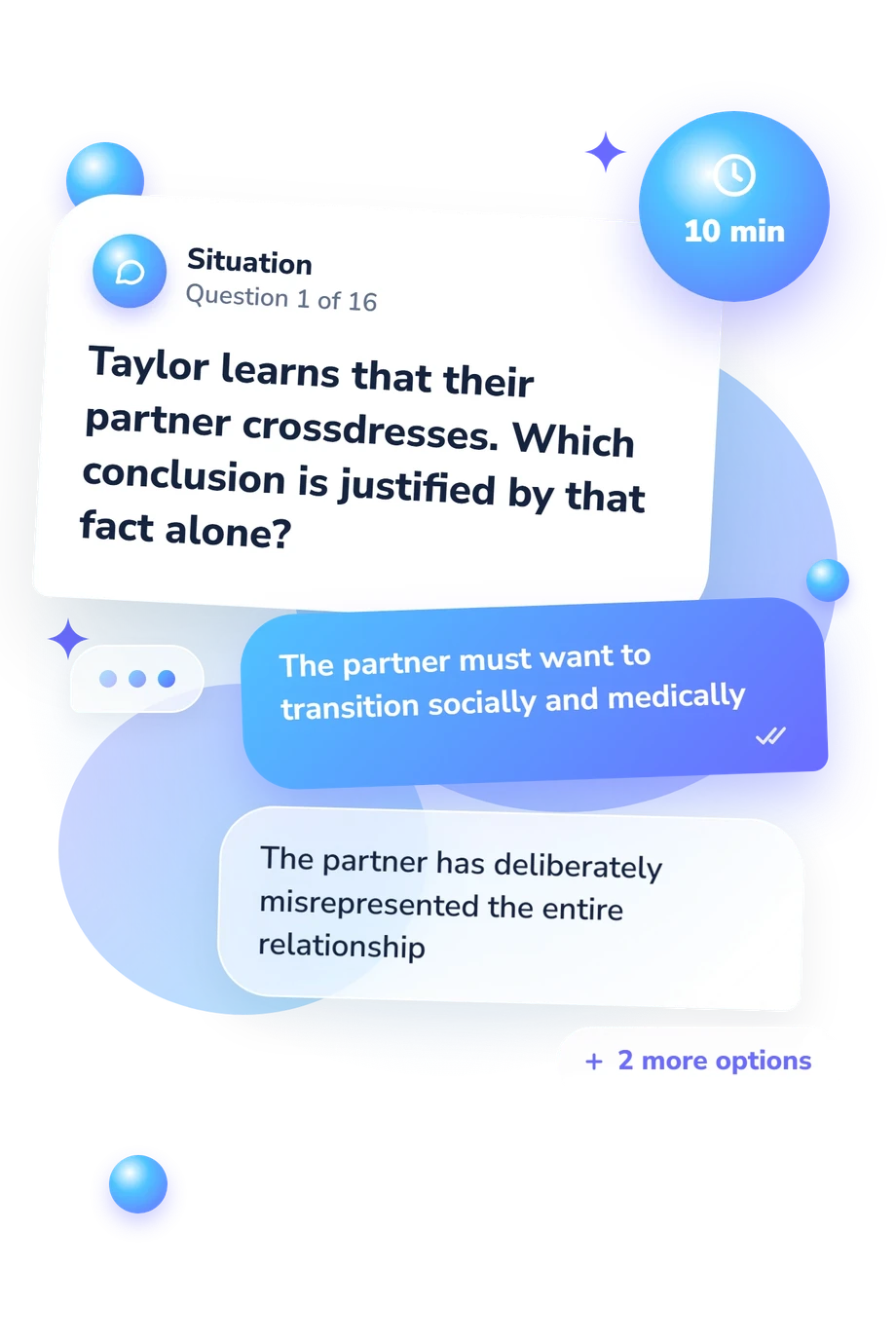
- The partner must want to transition socially and medically
- The partner has deliberately misrepresented the entire relationship
- No conclusion about identity, orientation, or relationship satisfaction is certain; those topics require conversation
- The partner is necessarily dissatisfied with their shared sex life
- Telling other supportive friends, provided they promise not to judge
- Discussing it with Sam while keeping it from others unless Sam permits further sharing
- Posting the story without Sam’s name because that makes further permission unnecessary
- Informing Sam’s partner because partners are automatically entitled to the information
- Couples automatically share clothing unless one person has previously objected
- Using it is acceptable whenever the partner is not at home
- Permission is unnecessary if Morgan plans to clean or replace the item
- Morgan should ask before using the item, because relationship status does not replace permission
Crossdressing Quiz - Description and methodology of the test
This assessment is intended for people who want a clearer, less stereotyped understanding of crossdressing and a practical way to check how they reason about common situations. The crossdressing quiz presents educational scenarios with four choices and turns those choices into a focused knowledge result. The scenarios give this cross dressing quiz a practical focus on respectful distinctions and boundaries. Its result supports informed reflection.
What This Assessment Explores
The questionnaire measures whether respondents can separate clothing practices from identity, orientation, diagnosis, and relationship assumptions. It tests how consent, privacy, pronoun preferences, cultural context, and personal boundaries apply in everyday situations. As a crossdressing test, this assessment supports personal, relational, or general reflection.
The result is reported as Crossdressing Knowledge (0-16). Its thematic areas are:
- Clothing and presentation are treated as culturally shaped expression, not proof of identity.
- Identity and orientation remain distinct, so clothing alone establishes neither.
- The questions treat motivation as variable, from comfort and exploration to performance or erotic meaning.
- Consent and privacy depend on explicit communication, not relationship assumptions.
Foundations to build (0-6) indicates that reviewing core distinctions may be useful; Developing understanding (7-12) shows many correct ideas with possible misconceptions; Strong understanding (13-16) reflects broad understanding and respectful communication.
Methodology and Scientific Basis
Each item presents a short scenario or statement with four answer choices. The questions address definitions, identity, motivation, consent, privacy, cultural meanings, boundaries, and supportive responses. The respondent selects the option that best fits the principle being tested, and the result summarizes performance as an educational knowledge score rather than a clinical rating.
Docter and Prince (1997) provide the closest subject-specific context, especially for varied experiences and motivations linked to crossdressing. This questionnaire is conceptually consistent with that work, not an adaptation of it. WPATH and the APA guidelines support separating gender expression from identity, avoiding assumptions, and respecting each person’s language and goals. The DSM-5-TR likewise distinguishes clothing behavior from a mental-health diagnosis, which cannot be inferred from clothing alone.
The displayed bands are educational result bands, so this crossdressing questionnaire reports understanding of the tested concepts. Performance can be affected by prior knowledge, comprehension of wording, and interpretation of scenarios. Read the band as feedback about the tested concepts, not a definitive account of anyone’s identity, motivation, orientation, or mental health.
- Docter, Richard F., and Virginia Prince. (1997). Transvestism: A Survey of 1032 Cross-Dressers. Archives of Sexual Behavior, 26(6), 589-605. 10.1023/A:1024572209266
- World Professional Association for Transgender Health. (2014). WPATH Statement Concerning Cross-dressing, Gender-Nonconformity, and Gender Dysphoria. World Professional Association for Transgender Health.
- American Psychological Association. (2015). Guidelines for Psychological Practice with Transgender and Gender Nonconforming People. American Psychologist, 70(9), 832-864. 10.1037/a0039906
- American Psychiatric Association. (2022). Diagnostic and Statistical Manual of Mental Disorders (5th ed., text rev.; DSM-5-TR). American Psychiatric Association Publishing.
Updated: