
Work-Life Balance Quiz
How the Scales are Structured
Who Usually Takes This Test?
See How You Compare
Below is a preview of how scores are typically distributed across each scale.
Example Questions From the Test
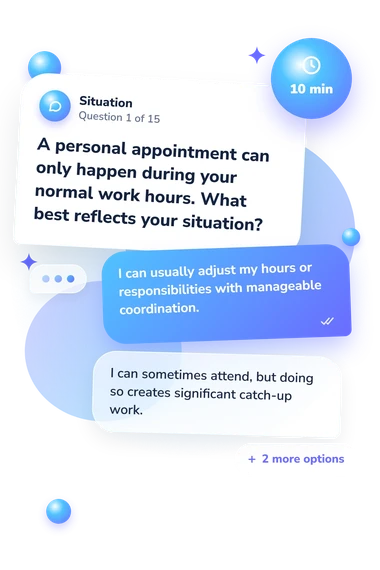
- I can usually adjust my hours or responsibilities with manageable coordination.
- I can sometimes attend, but doing so creates significant catch-up work.
- It is usually impractical, so I tend to postpone or miss such appointments.
- I can normally make an arrangement, though it may require advance planning or a tradeoff.
- I respond only for the limited situations we have agreed are truly urgent.
- I often handle requests because leaving them may create more work later.
- I usually answer quick questions but postpone anything substantial.
- I respond when delay would have a meaningful consequence, not merely for convenience.
- Work thoughts occupy most of the remaining day.
- They return often, even when I am doing something unrelated.
- I need some transition time, then I can usually focus elsewhere.
- I can generally disengage after a brief and familiar transition.
Work-Life Balance Quiz - Description and methodology of the test
People who want to understand whether their working pattern leaves enough room for health, relationships, responsibilities, and meaningful activities can use this work life balance quiz as a structured reflection. It suits employees, freelancers, managers, and others navigating changing demands. By treating work and personal time together, this life balance quiz points to areas where a realistic adjustment may matter, without reducing balance to a single good-or-bad judgment.
What This Assessment Explores
Questions place everyday situations beside choices about flexibility, recovery, and control over work’s reach. Appointments, sleep, breaks, messages, and responsibilities show where demands reduce space or energy.
The profile reports three dimensions:
- Life Fit and Flexibility (0-15) measures room for relationships, health, care, and meaningful priorities. Constrained fit (0-5), Mixed fit (6-10), and Supportive fit (11-15) show the level.
- Recovery and Renewal (0-15) measures access to rest, mental detachment, and restoring activities. Recovery crowded out (0-5), Recovery is uneven (6-10), and Recovery is supported (11-15) show the level.
- Work Boundary Control (0-15) measures whether work stays within intended hours, channels, and commitments. Boundaries under pressure (0-5), Boundaries in progress (6-10), and Boundaries well established (11-15) show the level.
Together, the profile from this work-life balance test shows separate life-fit, recovery, and boundary-control areas. A mixed life-fit result invites one recurring mismatch to examine.
Methodology and Scientific Basis
Each item presents a situation with four descriptions of what happens. The options distinguish flexibility, interference, recovery, and control, while responses combine into three dimension scores. The online questionnaire reports three scale scores using the displayed ranges and bands, but its answer-to-point scoring is not standardized.
Conceptually, the questionnaire is consistent with the Work-Life Balance Scale (Hayman, 2005), which connects work demands with non-work life. Its framing also relates to Fisher, Bulger, and Smith’s work/nonwork interference and enhancement model. The recovery dimension echoes detachment, relaxation, mastery, and control examined by the Recovery Experience Questionnaire (Sonnentag and Fritz, 2007). The boundary dimension is compatible with Kossek and colleagues’ work-nonwork boundary-management profiles.
This work life balance assessment is an online self-report questionnaire that is conceptually consistent with these published instruments, not an adaptation of them. It has no standardized administration, so their norms and psychometric findings cannot be transferred to this version. Workload, current circumstances, self-awareness, and candid responding can shift the result, making the bands descriptive prompts for reflection rather than a diagnosis or fixed verdict.
- Hayman, Jeremy. (2005). Psychometric Assessment of an Instrument Designed to Measure Work Life Balance. Research and Practice in Human Resource Management, 13(1), 85-91.
- Fisher, Gwenith G., Carrie A. Bulger, and Carlla S. Smith. (2009). Beyond Work and Family: A Measure of Work/Nonwork Interference and Enhancement. Journal of Occupational Health Psychology, 14(4), 441-456. 10.1037/a0016737
- Sonnentag, Sabine, and Charlotte Fritz. (2007). The Recovery Experience Questionnaire: Development and Validation of a Measure for Assessing Recuperation and Unwinding from Work. Journal of Occupational Health Psychology, 12(3), 204-221. 10.1037/1076-8998.12.3.204
- Kossek, Ellen Ernst, Marian N. Ruderman, Phillip W. Braddy, and Kelly M. Hannum. (2012). Work-Nonwork Boundary Management Profiles: A Person-Centered Approach. Journal of Vocational Behavior, 81(1), 112-128. 10.1016/j.jvb.2012.04.003
Updated: