
Guess the Footballer Quiz
How the Scales are Structured
Who Usually Takes This Test?
See How You Compare
Below is a preview of how scores are typically distributed across each scale.
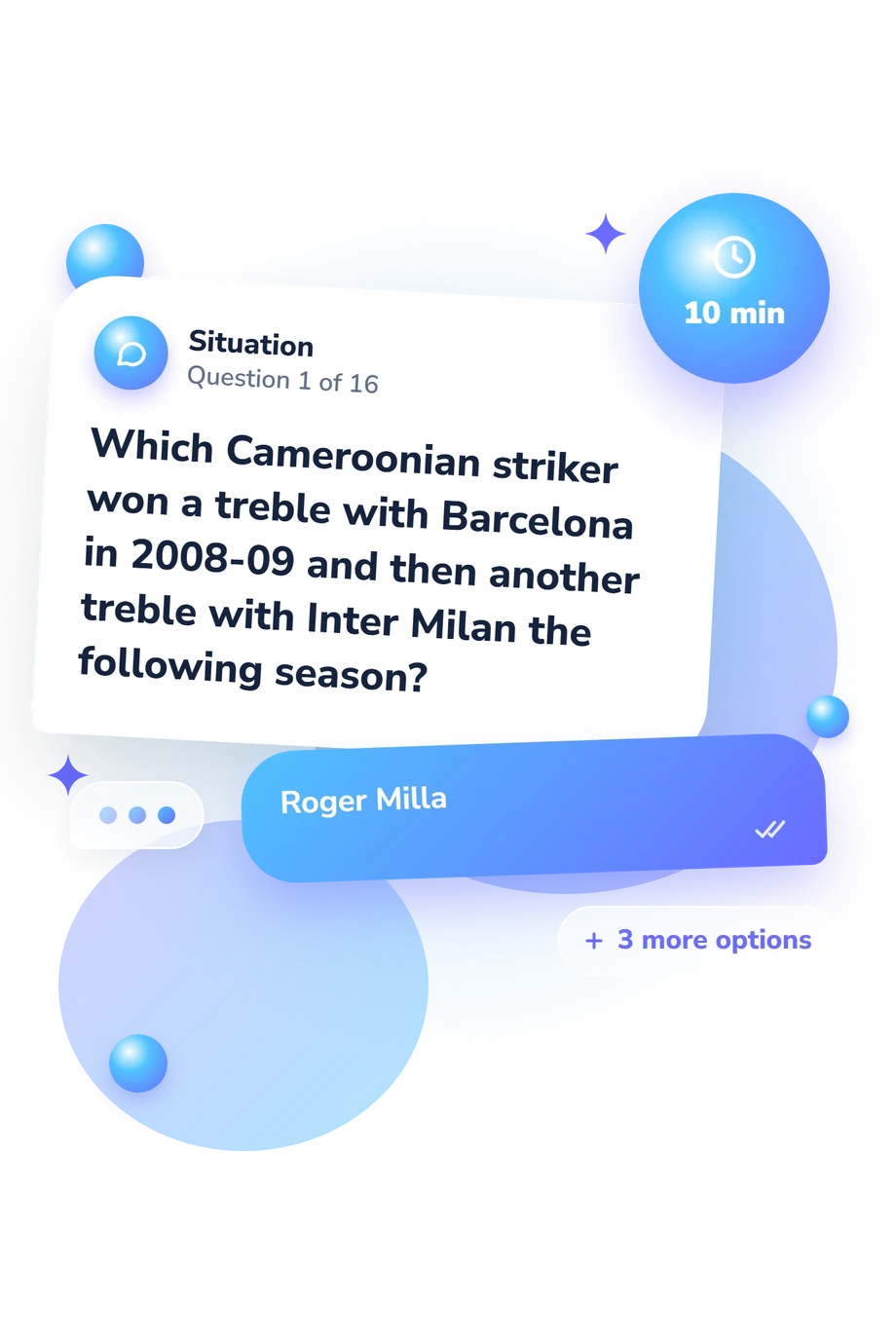
Example Questions From the Test
- Roger Milla
- Samuel Eto'o
- Patrick Mboma
- Pierre-Emerick Aubameyang
- Zinedine Zidane
- Didier Deschamps
- Patrick Vieira
- Youri Djorkaeff
- Mohamed Salah
- Riyad Mahrez
- Mohamed Elneny
- Omar Marmoush
Guess the Footballer Quiz - Description and methodology of the test
Designed for readers who enjoy identifying players from memorable career details, the Guess the Footballer Quiz turns football history into a focused knowledge task. It uses a who-am-I style football quiz format, because each answer depends on recognizing a player from biographical evidence rather than recalling an isolated fact. The result describes how accurately you connect achievements, teams, eras, and players across club and international football.
What This Assessment Measures
Clues move across clubs, trophies, national teams, World Cups, Champions League campaigns, positions, and distinctive career milestones. The selection also crosses men's and women's football, so the result reflects breadth as well as recall.
As a football-player identification quiz, it asks which kinds of football history you recognize most readily. Footballer Knowledge (0-16) reflects how accurately you identify notable footballers from career clues.
The three result bands explain the profile:
- Building the Squad (0-6) shows that major names are familiar, while broader club, tournament, and era knowledge is developing.
- Strong Supporter (7-12) shows that you connect many achievements and career paths with the right players.
- Football Expert (13-16) shows wide, precise knowledge across international, club, men's, and women's football history.
Methodology and Evidence Base
Each item pairs a career clue with four named answer choices. You select the player who best matches the evidence, linking a name to the correct club, tournament, position, achievement, or sequence of teams. This tests recognition and association rather than recall of isolated facts.
Its approach is conceptually consistent with Tsuda et al. (2023), which examines common content knowledge in soccer, and with Bruett et al. (2018), which offers general evidence about expertise and learned associations. These sources provide context for sports knowledge; this questionnaire is not presented as an adaptation or validation of either published instrument.
Scoring is shown as one descriptive total mapped to the three result bands above. As a footballer knowledge quiz, it captures performance on these clues rather than every part of football understanding. The total reflects how accurately you identify the players described, while the bands characterize performance on this task.
Familiarity with particular leagues, memory for names, guessing, and current attention can affect performance, so a result is not a fixed measure of ability or a diagnosis.
- Bruett, Heather, Xiaoping Fang, Deepan C. Kamaraj, Elizabeth Haley, and Marc N. Coutanche. "Expertise Moderates Incidentally Learned Associations Between Words and Images." Frontiers in Psychology, 9, article 2085, 2018. 10.3389/fpsyg.2018.02085
- Tsuda, Emi, Phillip Ward, Obidiah J. Atkinson, Yaohui He, and Deb Sazama. "Establishing the Validity of a Test of Common Content Knowledge for Soccer." International Journal of Kinesiology in Higher Education, 7(1), 48-60, 2023. 10.1080/24711616.2022.2034490
Updated: