
Estrogen Dominance Quiz
How the Scales are Structured
Who Usually Takes This Test?
See How You Compare
Below is a preview of how scores are typically distributed across each scale.
Example Questions From the Test
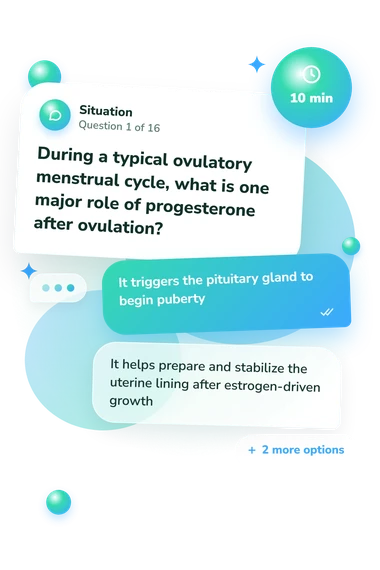
- It triggers the pituitary gland to begin puberty
- It helps prepare and stabilize the uterine lining after estrogen-driven growth
- It permanently stops estrogen production for that cycle
- It causes menstruation immediately after the egg is released
- Progesterone must rise earlier than usual
- The usual post-ovulation progesterone rise may not occur
- Ovulation has no relationship to progesterone production
- Progesterone remains permanently elevated
- The corpus luteum
- The uterine lining
- The thyroid gland
- The pituitary stalk
Estrogen Dominance Quiz - Description and methodology of the test
People who want to understand claims about estrogen and progesterone can use this questionnaire to review core concepts and compare possible explanations for common concerns. The estrogen dominance quiz offers a structured review of hormone relationships, symptoms commonly attributed to estrogen dominance, testing limits, and situations that warrant medical attention. This is a quiz about estrogen dominance symptoms that tests knowledge of their interpretation, rather than measuring symptoms or detecting an imbalance.
What This Assessment Explores
The questionnaire measures hormone knowledge. It asks readers to distinguish normal reproductive physiology from the informal idea of estrogen dominance and recognize that bleeding changes or fatigue are nonspecific.
Its displayed scale is Estrogen Dominance Knowledge: 0-16. Foundation to build (0-6) signals review of hormone patterns; Developing knowledge (7-12) shows grasp of core ideas with gaps about testing limits and alternative causes; Strong knowledge (13-16) reflects understanding while remaining an unvalidated educational summary.
The learning goals cover three areas:
- Ovulation and progesterone explain the corpus luteum’s role after ovulation.
- Bleeding, reproductive transitions, symptoms, and laboratory results show why timing and context matter.
- Medication and safety scenarios identify when prescriber review or urgent help is appropriate.
For anyone considering an estrogen dominance assessment, the result maps concepts to revisit, including timing, symptom overlap, and evaluation decisions.
Methodology and Scientific Basis
Each item presents four answer choices and asks for the most accurate response. Scenarios cover progesterone after ovulation, anovulatory cycles, reproductive aging, medication effects, laboratory context, and warning signs.
The displayed result is an educational knowledge summary, and the questionnaire does not specify how individual answers contribute to its total. As an estrogen dominance test, it directs attention to concepts such as hormone timing, symptom overlap, and clinical context.
The content is conceptually consistent with the PALM-COEIN classification, developed by Munro and colleagues to consider structural and non-structural causes of abnormal uterine bleeding instead of reducing it to one hormone explanation. Mesen and Young discuss ovulation and luteal progesterone, while Harlow and colleagues describe reproductive aging as a fluctuating transition. Together, these works explain the questionnaire’s emphasis on timing, context, and alternative causes; they neither validate nor make it an adaptation.
Its educational score cannot confirm or exclude a condition. Self-report response bias, limited self-awareness, guessing, prior knowledge, and current concerns can affect answers, while symptoms also vary with pregnancy status, medications, cycle timing, and menopause status.
- Munro MG, Critchley HOD, Broder MS, Fraser IS; FIGO Working Group on Menstrual Disorders. FIGO classification system (PALM-COEIN) for causes of abnormal uterine bleeding in nongravid women of reproductive age. International Journal of Gynecology & Obstetrics. 2011;113(1):3-13. 10.1016/j.ijgo.2010.11.011
- Mesen TB, Young SL. Progesterone and the luteal phase: a requisite to reproduction. Obstetrics and Gynecology Clinics of North America. 2015;42(1):135-151. 10.1016/j.ogc.2014.10.003
- Harlow SD, Gass M, Hall JE, Lobo RA, Maki PM, Rebar RW, Sherman S, Sluss PM, de Villiers TJ. Executive summary of the Stages of Reproductive Aging Workshop +10: addressing the unfinished agenda of staging reproductive aging. Menopause. 2012;19(4):387-395. 10.1097/gme.0b013e31824d8f40
Updated: