
GCS Quiz
How the Scales are Structured
Who Usually Takes This Test?
See How You Compare
Below is a preview of how scores are typically distributed across each scale.
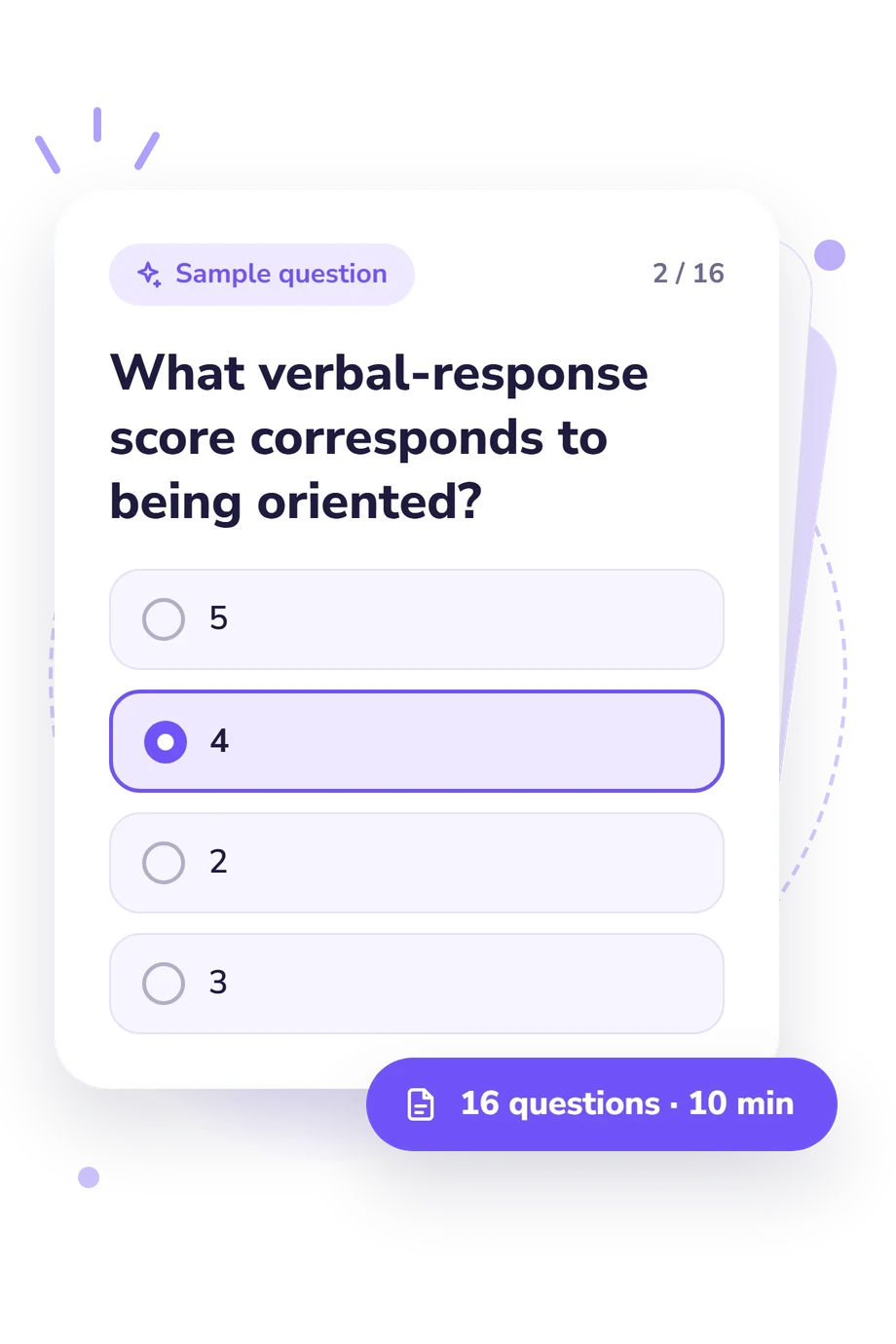
Example Questions From the Test
- E2
- E1
- E4
- E3
- 5
- 4
- 2
- 3
- 12
- 13
- 15
- 14
GCS Quiz - Description and methodology of the test
People revising neurological assessment can use the GCS Quiz to check whether they can translate common clinical observations into standard Glasgow Coma Scale scores. This Glasgow Coma Scale quiz suits learners who want focused self-testing, especially before reviewing emergency or bedside assessment material. The result highlights secure knowledge and topics that may benefit from another pass.
What This Assessment Explores
The questionnaire measures knowledge of the standard adult GCS rather than a patient's level of consciousness. Its items ask learners to recognize response levels, select component scores, and combine eye, verbal, and motor values. This makes it useful for learners revising neurological assessment who need to distinguish neighboring categories and apply the scoring sequence accurately.
The result is best read as feedback from a GCS knowledge test, showing how accurately the learner applies the scoring rules. The questions cover three response domains:
- Eye opening shows whether eyes open spontaneously, to speech, to pressure, or not at all.
- Verbal response distinguishes orientation, confusion, recognizable words, sounds, and no verbal response.
- Motor response records obedience to commands and graded reactions to pressure.
For interpretation, Glasgow Coma Scale Knowledge (0-16) is displayed as Foundation needed (0-6), Developing knowledge (7-12), or Strong knowledge (13-16).
Methodology and Scientific Basis
Each item offers four options and tests E, V, and M notation, component values, total calculation, or documentation when intubation prevents speech assessment. The result reports correct answers and places them in the displayed band; scenarios test rule application.
Conceptually, this online knowledge questionnaire is consistent with the Glasgow Coma Scale described by Teasdale and Jennett (1974), not an adaptation of that clinical instrument. Teasdale and Jennett (1976) connect coma assessment with prognosis after head injury, while Teasdale et al. (2014) review the scale's continuing use. Scenarios test response levels, component values, total scores, and documentation when speech cannot be assessed.
Interpretation should stay close to the tested content. In this Glasgow Coma Scale scoring quiz, a lower band points to rules or distinctions to revisit, while a higher band suggests stronger recall of standard GCS observations and scoring. The displayed bands are educational summaries, not validated measures of clinical competence or patient status. Quiz performance can vary with memory, wording, and recent practice, while sedation or intubation can complicate the relationship between standard GCS scoring and a patient's bedside assessment.
- Teasdale G, Jennett B. Assessment of coma and impaired consciousness. A practical scale. The Lancet. 1974;2(7872):81-84. 10.1016/S0140-6736(74)91639-0
- Teasdale G, Jennett B. Assessment and prognosis of coma after head injury. Acta Neurochirurgica. 1976;34(1-4):45-55. 10.1007/BF01405862
- Teasdale G, Maas A, Lecky F, Manley G, Stocchetti N, Murray G. The Glasgow Coma Scale at 40 years: standing the test of time. The Lancet Neurology. 2014;13(8):844-854. 10.1016/S1474-4422(14)70120-6
Updated: