
Media Bias Quiz
How the Scales are Structured
Who Usually Takes This Test?
See How You Compare
Below is a preview of how scores are typically distributed across each scale.
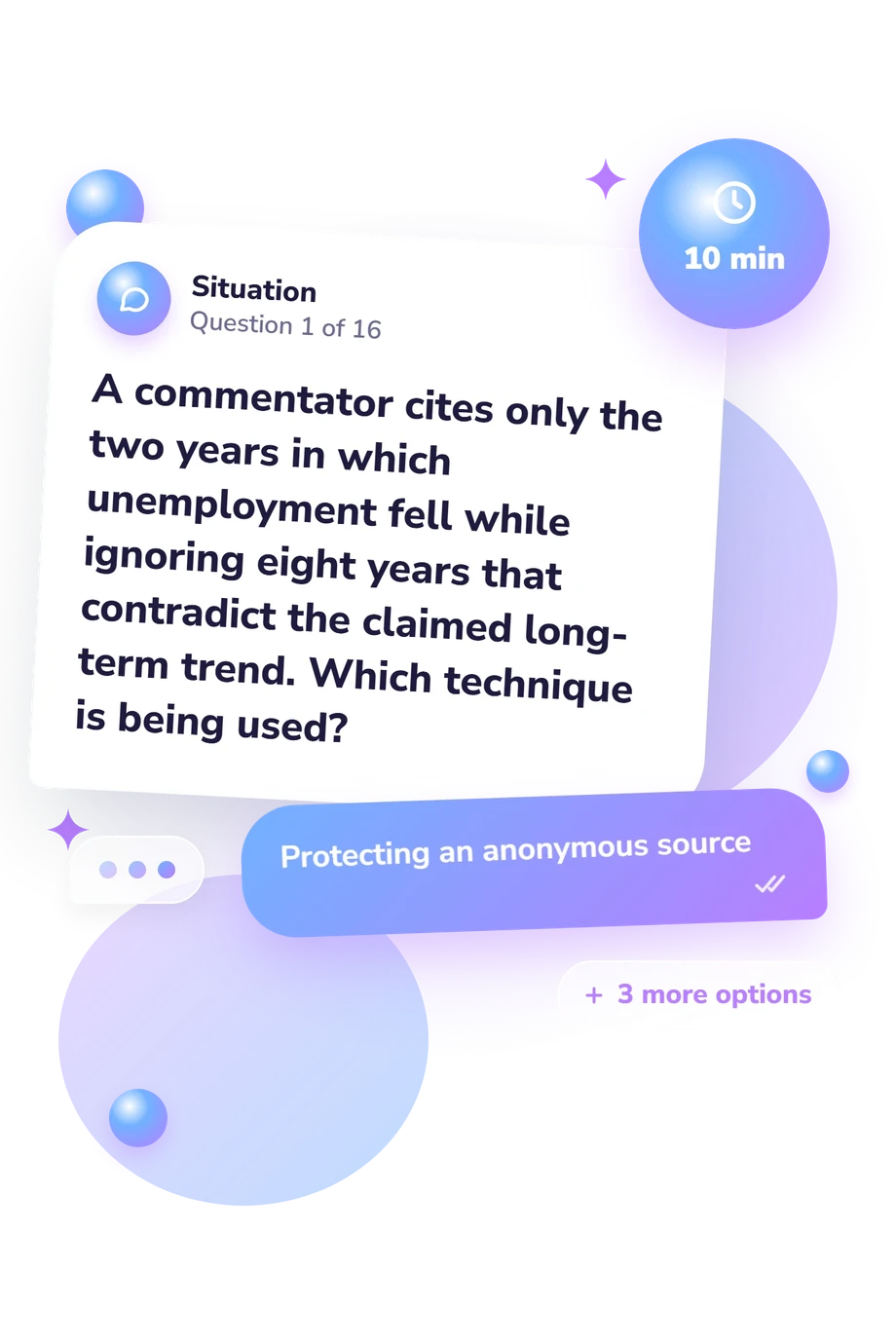
Example Questions From the Test
- Using a quotation outside its original language
- Treating correlation as proof of causation
- Presenting too many independent variables
- Giving equal weight to two competing explanations
- Protecting an anonymous source
- Cherry-picking evidence
- Correcting for seasonal variation
- Separating reporting from opinion
- “Council Votes 6-3 on Parking Proposal”
- “Parking Proposal Would Change Fees in Three Districts”
- “Greedy Officials Push Outrageous Parking Cash Grab”
- “Council Publishes Revised Parking Proposal”
Media Bias Quiz - Description and methodology of the test
For readers who want to judge headlines more carefully, the media bias quiz offers a focused way to examine how they recognize misleading reasoning, selective presentation, and weak verification. It suits anyone seeking a clearer picture of their news-evaluation skills. This news bias quiz indicates your overall knowledge of the covered concepts, while leaving specific habits for further reflection.
What This Assessment Explores
Rather than asking which outlet or political viewpoint you prefer, the questionnaire tests whether you can spot techniques that shape interpretation: causal errors, cherry-picking, confirmation bias, loaded language, false balance, selective emphasis, source quality, and context.
The result of this media bias test summarizes overall quiz knowledge: it shows how readily you recognize warning signs in brief media examples, not whether every real-world judgment will be correct.
The main thematic groups are:
- Reasoning items show whether you separate correlation, causation, and evidence.
- Framing items show how wording, selection, and design steer interpretation.
- Source items test recognition of sponsorship, satire, and original documents.
- Verification items reflect familiarity with lateral reading and reverse-image checking.
The displayed scale is Media Bias Knowledge: 0-16, with Foundation to build (0-6), Developing evaluator (7-12), and Strong evaluator (13-16).
Methodology and Scientific Basis
Each prompt presents a short scenario, headline, chart, image, or claim with several answer choices. You select the best explanation or verification step, so the format emphasizes recognition and application rather than written justification. The score summarizes performance across the items.
Conceptually, the media bias questionnaire is consistent with the News Media Literacy Scale (Ashley et al., 2013) and civic online reasoning research. Maksl, Ashley, and Craft (2015) describe related knowledge, motivation, skepticism, and engagement, while Breakstone et al. (2021) emphasize checking who is behind a source, tracing claims, and investigating beyond surface appearance.
It is not an adaptation of either source or a standardized administration of either, and its scoring is not norm-referenced; the displayed bands show how the task-specific score reflects recognition of bias techniques and verification steps.
Results can be affected by guessing, prior exposure to media-literacy terms, and the time or context in which a person answers. Use the band as a prompt to review verification habits, especially when a striking claim encourages a quick conclusion.
- Ashley, Seth, Adam Maksl, and Stephanie Craft. "Developing a News Media Literacy Scale." Journalism & Mass Communication Educator 68, no. 1 (2013): 7-21. 10.1177/1077695812469802
- Maksl, Adam, Seth Ashley, and Stephanie Craft. "Measuring News Media Literacy." Journal of Media Literacy Education 6, no. 3 (2015): 29-45. 10.23860/jmle-6-3-3
- Breakstone, Joel, Mark Smith, Sam Wineburg, Amie Rapaport, Jill Carle, Marshall Garland, and Anna Saavedra. "Students' Civic Online Reasoning: A National Portrait." Educational Researcher 50, no. 8 (2021): 505-515. 10.3102/0013189X211017495
Updated: