
1984 Part 2 Quiz
How the Scales are Structured
Who Usually Takes This Test?
See How You Compare
Below is a preview of how scores are typically distributed across each scale.
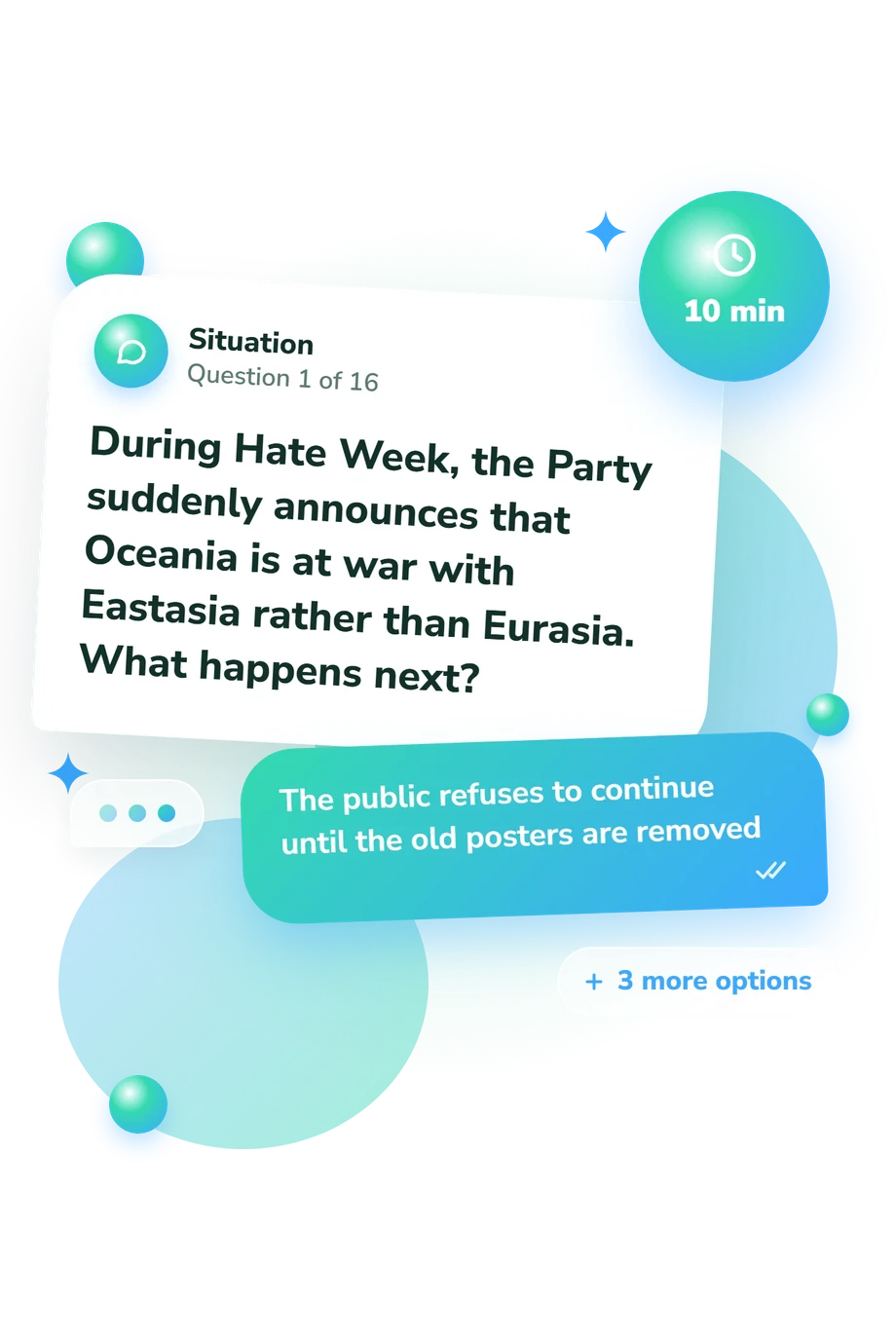
Example Questions From the Test
- Rewriting old newspaper reports in the Records Department
- Teaching new vocabulary in the Research Department
- Preparing Hate Week speeches for the Fiction Department
- Maintaining novel-writing machines in the Fiction Department
- He needs somewhere to hide forged Ministry records
- It appears to offer a private place where he and Julia can meet
- He plans to use it for secret meetings with Parsons
- It gives him access to a prohibited shortwave radio
- He wants Winston to repair a malfunctioning speakwrite
- He needs help correcting a Times article
- He offers to show Winston the latest Newspeak dictionary
- He invites Winston to help organize Hate Week
1984 Part 2 Quiz - Description and methodology of the test
Students preparing for a class discussion can use the 1984 part 2 quiz to organize the section’s turning points, relationships, and political arguments. This 1984 book 2 quiz also helps focus preparation on the material most likely to need explanation or evidence. Its result highlights which answers were secure and which points deserve attention before the conversation.
What This Assessment Explores
Part 2 moves from private resistance to exposure, ideological explanation, and coercive control. In the 1984 part two quiz, the questions check whether readers connect events with motives, symbols, and the political logic surrounding Goldstein’s book.
The recurring areas are:
- Plot sequence shows whether reversals, meetings, arrests, and revelations are placed accurately.
- Character motives show how Winston, Julia, and O’Brien act within resistance, loyalty, and control.
- Symbols and settings show whether the paperweight, rented room, and Golden Country carry wider meaning.
- Political ideas show whether arguments about hierarchy, war, propaganda, memory, and power are understood.
These themes feed the 1984 Part 2 Knowledge scale (0-16): Foundations to revisit (0-6) means core elements need review; Developing command (7-12) reflects a sound grasp with details to revisit; Strong command (13-16) indicates clear understanding of major events, symbols, and arguments.
Methodology and Evidence Base
Each item presents one question with four answer choices. Some ask for an exact event or detail; others ask what a character’s action, a symbol, or a political claim reveals. One point is awarded for each correct response, so the total reflects performance on this question set and recall of Part 2 events, characters, and arguments.
The 1984 Part 2 knowledge quiz uses a text-based method: the respondent’s choices are compared with keyed answers for this fixed set of questions. The result bands describe performance on this question set rather than population norms or clinical thresholds.
The questions draw on Orwell’s novel for the plot, characters, symbols, and arguments being tested. Strub’s analysis of panoptical control offers a lens for surveillance, telescreens, secrecy, and mental submission. Bohovyk and Bezrukov’s study of conspiracy, propaganda, and mistrust offers a further lens for the novel’s political communication; neither secondary source validates this questionnaire.
Memory, attention, rereading, and interpretation of an answer choice can affect performance, so the score is a current snapshot of performance on the Part 2 questions.
- Orwell, George. Nineteen Eighty-Four. London: Secker & Warburg, 1949.
- Bohovyk, Oksana, and Andrii Bezrukov. "Narrating Conspiracy Theories: A Paradoxical Ethics of Otherness, Propaganda and Mistrust." ENTHYMEMA, no. 34, 2024, pp. 164-179. 10.54103/2037-2426/18614.
- Strub, Harry. "The Theory of Panoptical Control: Bentham's Panopticon and Orwell's Nineteen Eighty-Four." Journal of the History of the Behavioral Sciences, vol. 25, no. 1, 1989, pp. 40-59. 10.1002/1520-6696%28198901%2925%3A1%3C40%3A%3AAID-JHBS2300250104%3E3.0.CO%3B2-W
Updated: