
Death of a Salesman Quiz
How the Scales are Structured
Who Usually Takes This Test?
See How You Compare
Below is a preview of how scores are typically distributed across each scale.
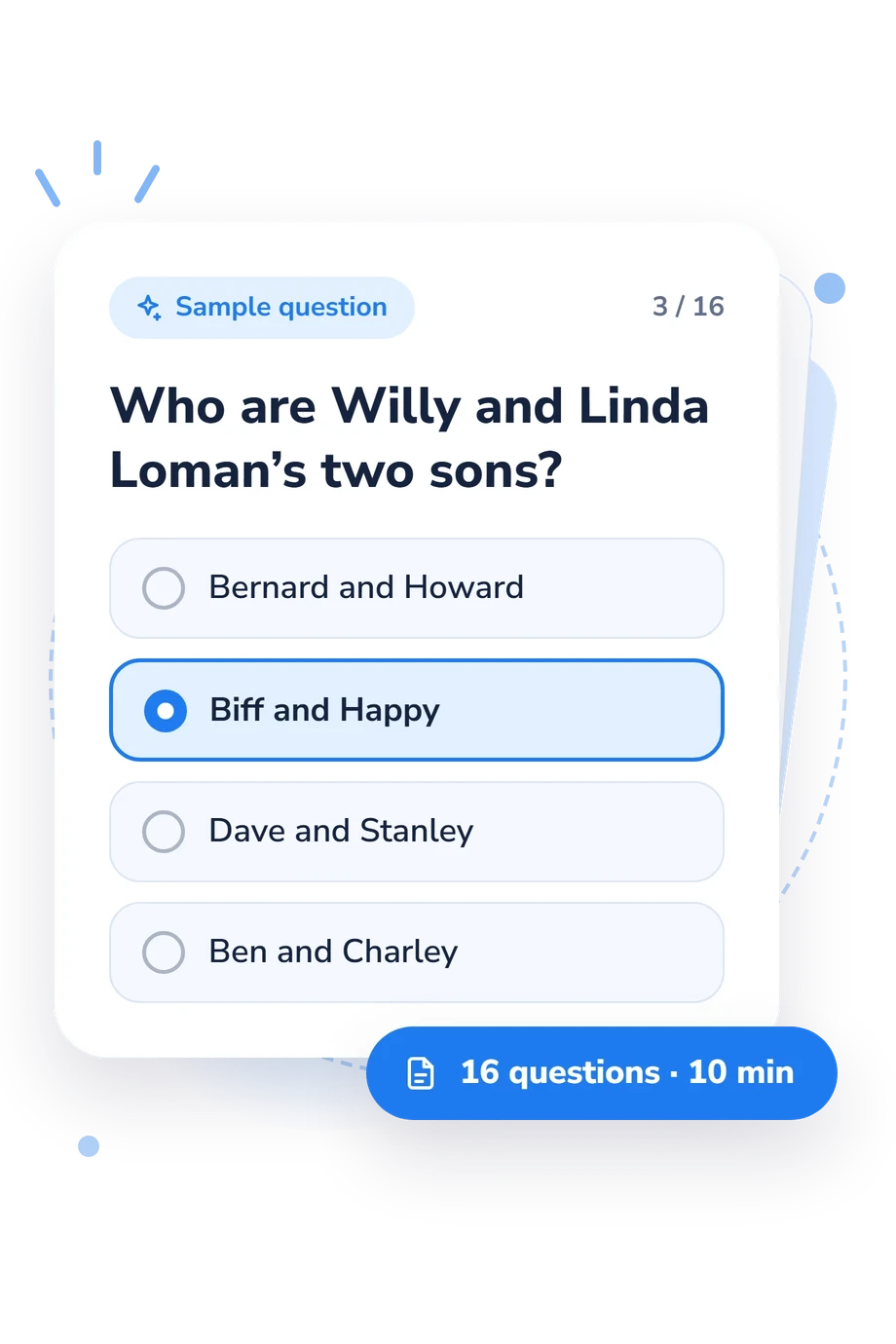
Example Questions From the Test
- Carpentry and home repair
- Insurance management
- Traveling sales
- Restaurant ownership
- Bernard and Howard
- Biff and Happy
- Dave and Stanley
- Ben and Charley
- Gold
- Timber
- Diamonds
- Oil
Death of a Salesman Quiz - Description and methodology of the test
Readers revising Arthur Miller’s drama, preparing for class discussion, or returning to it after a performance can use the death of a salesman quiz to check how securely the text has stayed with them. The exercise joins recall to interpretation, so the result can indicate whether broad rereading may be useful. It offers a focused play knowledge quiz covering characters, events, themes, and symbols.
What This Assessment Explores
Rather than measuring literary taste, the questionnaire checks recognition and interpretation of details in the drama. It suits readers studying or revisiting the play, including students, teachers, and theatre audiences. It connects plot knowledge with recurring images and the pressures shaping the Loman family.
The questions examine four connected areas:
- Character knowledge shows whether you can identify the Lomans and their relationships.
- Plot knowledge shows whether you can place important actions and consequences.
- Theme knowledge shows how you connect ambition, identity, family conflict, and social pressure.
- Symbol knowledge shows whether you recognize meanings carried by stockings, seeds, the flute, and the rubber hose.
The single scale is Death of a Salesman Knowledge, scored from 0-16. Foundation to Build covers 0-6, Developing Understanding covers 7-12, and Strong Command covers 13-16. These bands describe performance on the quiz, not overall literary ability.
Methodology and Evidence Base
Each item offers four answer choices and asks for the option that best fits the play. The format combines factual recall with interpretation, moving among character relationships, plot turns, symbolic objects, historical pressures, and major conflicts. The result is reported on the displayed 0-16 scale and shown in one of the three result bands.
Arthur Miller’s 1949 play supplies the primary textual basis for details about characters, events, objects, and dramatic outcomes. Roudané’s critical discussion helps clarify the play’s poetic patterns and recurring images, while Murphy and Abbotson’s casebook connects the drama with its sources and historical issues. The play and these literary works provide content and interpretive context, but they do not constitute psychometric validation or norms for this online quiz.
For readers using the quiz for revision, a higher band indicates stronger performance on these items, not mastery of every scholarly interpretation. Memory, prior study, and personal judgments about ambiguous scenes can affect answers. The result indicates overall performance on these items, while closer rereading is needed to examine particular themes, symbols, or relationships.
- Miller, Arthur. Death of a Salesman: Certain Private Conversations in Two Acts and a Requiem. New York: The Viking Press, 1949.
- Roudané, Matthew C. “Death of a Salesman and the Poetics of Arthur Miller.” In The Cambridge Companion to Arthur Miller, edited by Christopher Bigsby, 60-85. Cambridge: Cambridge University Press, 2006. 10.1017/CCOL052155019X.005
- Murphy, Brenda, and Susan C. W. Abbotson. Understanding Death of a Salesman: A Student Casebook to Issues, Sources, and Historical Documents. Westport, CT: Greenwood Press, 1999.
Updated: