
Fake News Quiz
How the Scales are Structured
Who Usually Takes This Test?
See How You Compare
Below is a preview of how scores are typically distributed across each scale.
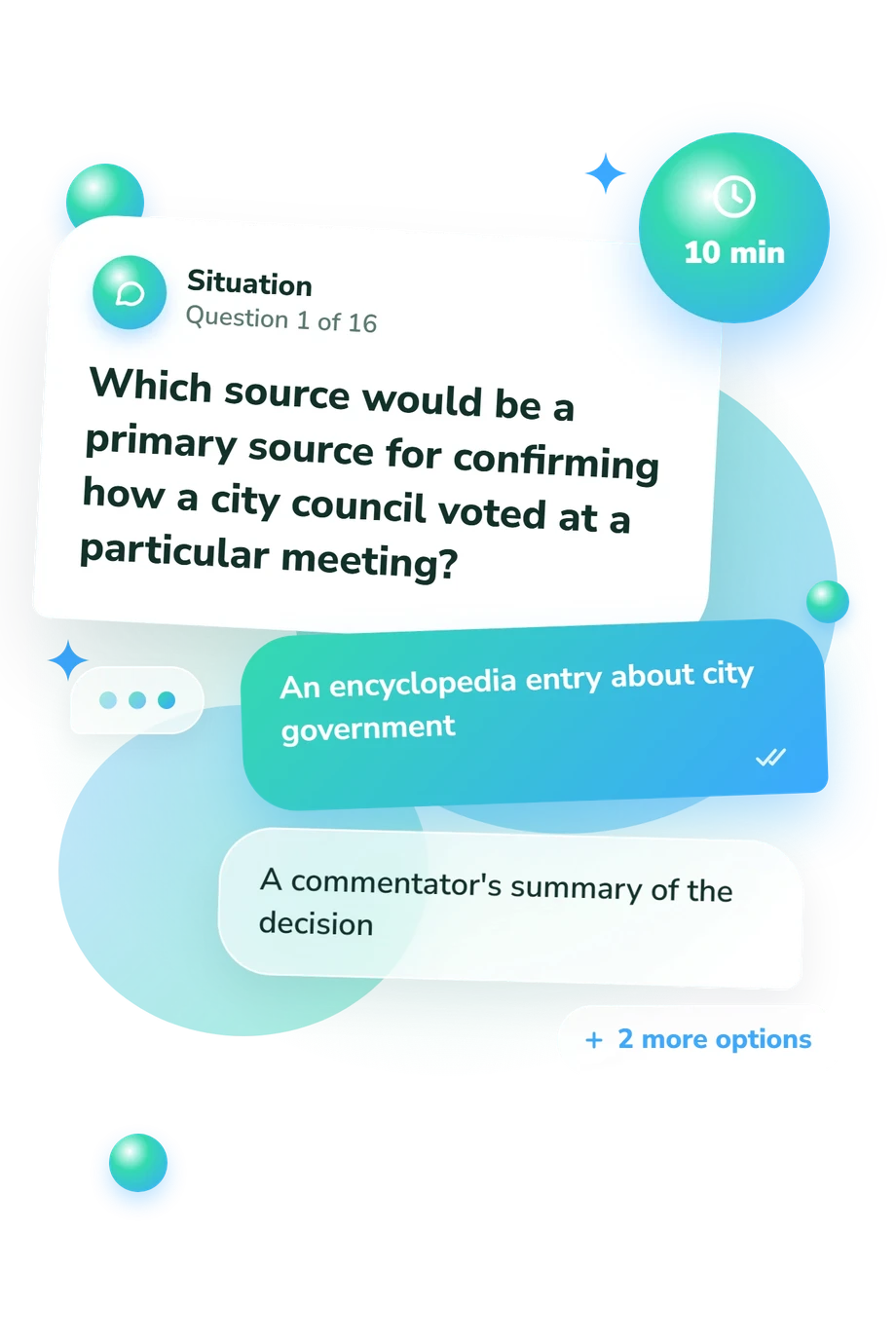
Example Questions From the Test
- An encyclopedia entry about city government
- A commentator's summary of the decision
- A social media poll about the decision
- The council's official minutes or complete meeting recording
- Whether the press release includes photographs of researchers
- The original research, including its methods, sample, findings, and funding
- Whether the company's other products have positive reviews
- How many news outlets copied the press release
- The newspaper has launched a regional edition
- The article has been independently syndicated
- The site may be impersonating a trusted publisher
- The newspaper has corrected its original web address
Fake News Quiz - Description and methodology of the test
For readers who want to pause before sharing a claim, the fake news quiz offers practice with core news-literacy knowledge. It helps learners, educators, families, and adults decide which verification answer is best supported in a given situation. Educators can use this questionnaire as a misinformation quiz for students to discuss why one answer is better supported than another. Its single result places demonstrated knowledge in one of three descriptive bands.
What This Assessment Explores
The questions focus on practical judgments made when information looks urgent, emotional, authoritative, or widely shared. They ask respondents to distinguish primary from secondary sources, trace claims to original evidence, notice missing context, and assess satire, impersonation, images, charts, headlines, and corrections.
As a fake or real news quiz, this assessment asks respondents to distinguish reliable from misleading claims and select appropriate verification checks. Its result indicates knowledge of misinformation concepts and verification, not behavior outside the questionnaire.
The question themes are the following. Together, they describe one knowledge result, not separate scores:
- Source provenance indicates knowledge of original records, publishers, and corroborating coverage.
- Evidence and context indicate knowledge of methods, dates, funding, full wording, and independent reporting.
- Visual and cognitive literacy indicates recognition of image history, distorted presentation, confirmation bias, urgency, and the difference between a clue and proof.
Methodology and Scientific Basis
Each item presents a short scenario with four choices, and the respondent selects the option reflecting sound verification practice. The set covers source authority, original research, dates, provenance, context, visual evidence, misleading presentation, and corrections.
Civic Online Reasoning from McGrew and colleagues in 2018 supplies the conceptual anchor: it emphasizes investigating sources and testing claims against evidence. The questionnaire is conceptually consistent with those skills, not an adaptation. Fake News Acumen by Nagel, published in 2022, Jones-Jang and colleagues' News Media Literacy Scale from 2021, and Ashley and colleagues' news-literacy assessment from 2013 address themes; none validates this version.
The questionnaire displays Fake News Knowledge: 0-16, with Foundations to build (0-6), Developing verifier (7-12), and Strong news literacy (13-16). It does not specify how responses are weighted or converted into the total; it states no standardization procedure, so these bands are descriptive for this questionnaire, not population norms or diagnostic thresholds.
Although this assessment can be approached as a hoax quiz, guessing, attention, familiarity, and prior exposure can affect performance; a strong result cannot guarantee accurate judgment of every future claim.
- McGrew, Sarah; Breakstone, Joel; Ortega, Teresa; Smith, Mark; Wineburg, Sam. 2018. "Can Students Evaluate Online Sources? Learning From Assessments of Civic Online Reasoning." Theory & Research in Social Education, 46(2), 165-193. 10.1080/00933104.2017.1416320
- Nagel, Tyler W. S. 2022. "Measuring Fake News Acumen Using a News Media Literacy Instrument." Journal of Media Literacy Education, 14(1), 29-42. 10.23860/JMLE-2022-14-1-3
- Jones-Jang, S. Mo; Mortensen, Tara; Liu, Jingjing. 2021. "Does Media Literacy Help Identification of Fake News? Information Literacy Helps, but Other Literacies Don't." American Behavioral Scientist, 65(2), 371-388. 10.1177/0002764219869406
- Ashley, Seth; Maksl, Adam; Craft, Stephanie. 2013. "Developing a News Media Literacy Scale." Journalism & Mass Communication Educator, 68(1), 7-21. 10.1177/1077695812469802
Updated: