
What Should I Draw Quiz
How the Scales are Structured
Who Usually Takes This Test?
See How You Compare
Below is a preview of how scores are typically distributed across each scale.
Example Questions From the Test
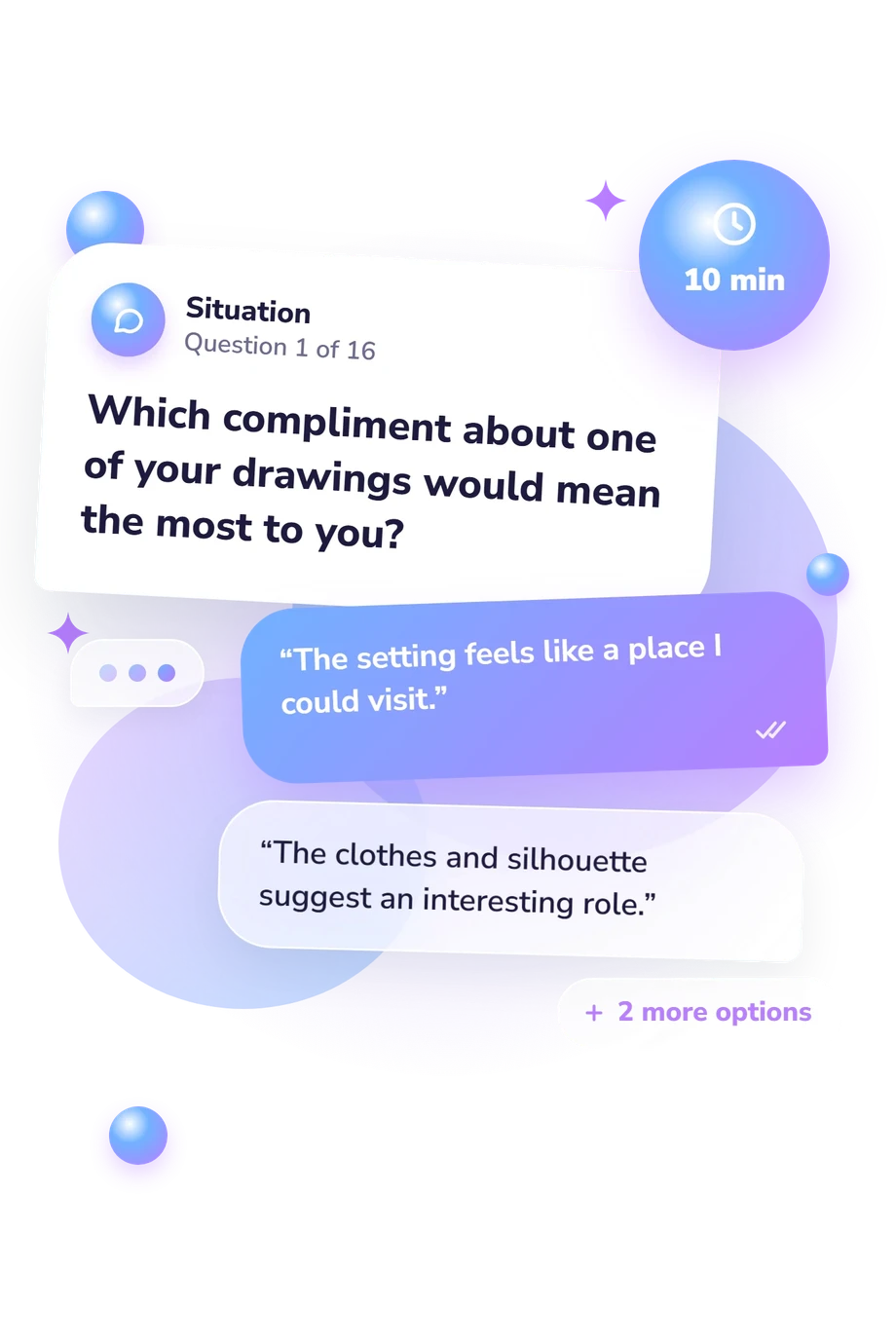
- “The setting feels like a place I could visit.”
- “The clothes and silhouette suggest an interesting role.”
- “I can tell what this person is feeling from the pose.”
- “This character feels like someone with a real personality.”
- The curve and movement of the cat’s whole pose
- The desk arrangement after the cat moves away
- One quick study of a paw or ear
- The cat as a small companion beside a human figure
- A close-up face with a distinctive expression
- A landscape with no people in view
- A full figure whose pose suggests a story
- A wide scene with one tiny person for scale
What Should I Draw Quiz - Description and methodology of the test
For anyone facing a blank page, the What Should I Draw Quiz turns a vague creative impulse into a manageable subject choice. It can also serve as a what should i draw today quiz when you want a direction without surrendering personal taste. Artists, students, and casual sketchers receive a profile of the themes that feel most inviting, giving the next drawing a clear starting point rather than judging artistic ability.
What This Test Measures
The test maps current subject preference, not skill or fixed identity. Its four dimensions make it useful as a what to draw when bored quiz, suggesting a more specific starting direction. These are the reported dimensions:
- Animals & Fantasy Creatures (0-12) measures real and invented beings; Cameo Role 0-4, Creature Spark 5-8, Creature Feature 9-12 mark supporting-to-leading focus.
- Nature & Landscapes (0-12) measures plants, weather, terrain, water, skies, and atmosphere; Background Accent 0-4, Scenic Interest 5-8, Landscape Calling 9-12 mark supporting-to-leading scenery.
- Objects, Spaces & Design (0-12) measures still lifes, architecture, interiors, vehicles, tools, and design; Useful Detail 0-4, Form Explorer 5-8, Design Focus 9-12 mark supporting-to-structural focus.
- Portraits & Characters (0-12) measures people, expressions, poses, clothing, and stories; Supporting Element 0-4, Character Curious 5-8, Human Focus 9-12 mark supporting-to-human-led focus.
Methodology and Evidence Base
Each item presents a familiar creative situation with four answer choices, from café observations to storms, walks, and story prompts. Choosing the most appealing option makes this a self-report preference task, not a performance test. The sixteen responses produce four comparative scores; the highest shows the clearest current affinity, while a one-point gap can support a blended prompt.
Specker and colleagues connect art interest with subject matter, realism, and art knowledge, offering conceptual context here. Thompson's work connects drawing choices with action, experience, and personal meaning, while Specker and colleagues provide a structured example of measuring art interest. These works are related examples, not evidence that this online questionnaire was constructed or validated through them.
Read the result as a snapshot of present motivation: mood, recent experiences, available references, habits, and willingness to experiment can shape an answer. The displayed bands organize comparative reflection rather than present normative or clinical thresholds. As a drawing prompt quiz, it offers a lead subject; a result within one point of the strongest can be combined for a mixed prompt.
- Kettlewell, Neil, Sara Lipscomb, Liz Evans, and Karl Rosston. (1990). The Effect of Subject Matter and Degree of Realism on Aesthetic Preferences for Paintings. Empirical Studies of the Arts, 8(1), 85-93. 10.2190/Y8JA-3GUR-M08C-BPEC
- Thompson, Christine Marme. (1999). Action, autobiography and aesthetics in young children's self-initiated drawings. International Journal of Art and Design Education, 18(2), 155-161. 10.1111/1468-5949.00169
- Specker, Eva, Michael Forster, Hanna Brinkmann, Jane Boddy, Matthew Pelowski, Raphael Rosenberg, and Helmut Leder. (2020). The Vienna Art Interest and Art Knowledge Questionnaire (VAIAK): A Unified and Validated Measure of Art Interest and Art Knowledge. Psychology of Aesthetics, Creativity, and the Arts, 14(2), 172-185. 10.1037/aca0000205
Updated: