
Subjunctive Quiz
How the Scales are Structured
Who Usually Takes This Test?
See How You Compare
Below is a preview of how scores are typically distributed across each scale.
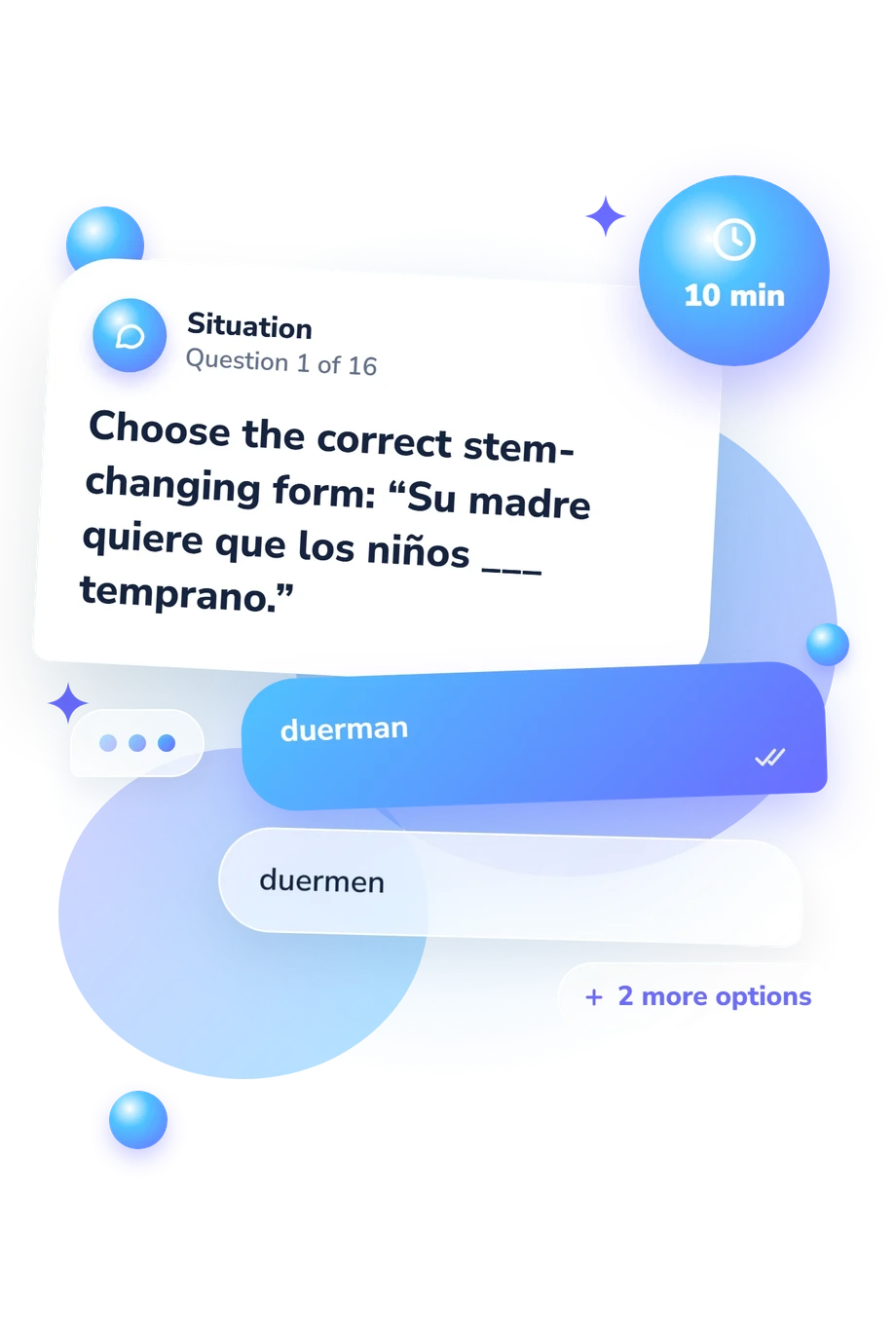
Example Questions From the Test
- duerman
- duermen
- dorman
- dormirán
- pueden
- podrán
- puedan
- podrían
- hablo
- hable
- hablé
- hablaré
Subjunctive Quiz - Description and methodology of the test
Designed for learners who want to check their demonstrated command of Spanish present-subjunctive forms in context, the subjunctive quiz tests right-or-wrong choices involving formation, triggers, and mood. It suits students, independent learners, and anyone revising core grammar. The questions provide practice by linking verb-form recognition with sentence meaning, making the activity useful as a subjunctive practice quiz. The result broadly indicates how often the present subjunctive fits in these contexts.
What This Assessment Explores
The questions test whether you can choose the present subjunctive when sentence meaning requires it. They cover emotion, doubt, recommendation, preference, wishes, possibility, uncertain reference, time, negative commands, and reactions. This Spanish subjunctive assessment helps learners practise mood choice with verb formation.
The items fall into four areas:
- Trigger recognition shows whether you connect doubt, emotion, desire, and recommendation with the subjunctive.
- Form selection shows whether you handle regular, irregular, stem-changing, and spelling-sensitive forms.
- Mood contrast shows whether you distinguish the subjunctive from indicative, future, and conditional alternatives.
- Contextual completion shows whether you apply it in clauses about unknown referents, time, commands, and reactions.
Results use Spanish Present Subjunctive Knowledge (0-16): Foundations to Review (0-6) signals core patterns to revisit, Developing Command (7-12) indicates partial control, and Strong Command (13-16) reflects consistent use across varied sentences.
Methodology and Scientific Basis
Each question presents a Spanish sentence or cue with four answer choices. You select the form that fits its trigger, meaning, and grammatical context. Items include regular, irregular, and stem-changing forms, so rule recognition must be paired with accurate conjugation.
Scoring is direct: each correct response contributes one point, producing a raw total rather than a weighted profile. As a present subjunctive test, it shows performance on sampled constructions, but results can vary with recent study, vocabulary familiarity, attention, and testing context.
Conceptually, the content is consistent with Stokes, Krashen, and Kartchner (1998), whose study addresses acquisition of the Spanish present subjunctive. The grammar distinctions also align with the 2010 manual from the Spanish language academies. Collentine (2010) provides a synthesis of research on learning and teaching the mood. These works support the linguistic framework; they do not establish this questionnaire as a validated adaptation of one published instrument.
Read the result as a focused knowledge snapshot, not a norm-referenced estimate or diagnosis. Selected sentence types cannot represent spontaneous conversation, extended writing, or every use of the mood.
- Stokes, Jeffery, Stephen Krashen, and John Kartchner. “Factors in the Acquisition of the Present Subjunctive in Spanish: The Role of Reading and Study.” ITL - International Journal of Applied Linguistics, nos. 121-122, 1998, pp. 19-25. 10.1075/itl.121-122.02sto
- Real Academia Española and Association of Academies of the Spanish Language. New Grammar of the Spanish Language: Manual. Madrid: Espasa, 2010. ISBN 9788467032819
- Collentine, Joseph. “The Acquisition and Teaching of the Spanish Subjunctive: An Update on Current Findings.” Hispania, vol. 93, no. 1, 2010, pp. 39-51.
Updated: