
Julius Caesar Quiz
How the Scales are Structured
Who Usually Takes This Test?
See How You Compare
Below is a preview of how scores are typically distributed across each scale.
Example Questions From the Test
- Beware the coming battle at Philippi.
- Do not allow Antony to speak in public.
- Beware the Ides of March.
- Do not accept a crown during the festival.
- Antony will offer Brutus a peaceful settlement.
- Cassius intends to betray Brutus during the battle.
- Brutus will see him again at Philippi.
- Octavius will abandon the campaign before dawn.
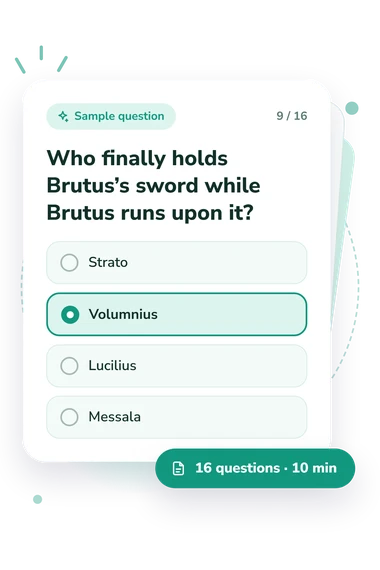
- Strato
- Volumnius
- Lucilius
- Messala
Julius Caesar Quiz - Description and methodology of the test
Students, theatre readers, and learners can use the Julius Caesar Quiz to check their grasp of the play’s political conflict, relationships, and turning points. This Julius Caesar play quiz provides a broad knowledge check across plot, characters, rhetoric, and consequences, making it suitable for study, discussion, or personal preparation. Together, the answers offer a single snapshot of connected recall across the text.
What the Test Measures
The questionnaire tests recall of events and interpretation of the choices that drive the tragedy. Questions about Julius Caesar in this quiz cover public persuasion, private loyalty, political ambition, conspiracy, violence, and the consequences of misjudgment. A strong result reflects connected knowledge of scenes, motives, speeches, and outcomes rather than memory for isolated names.
The result uses one scale, Julius Caesar Knowledge (0-16), with three descriptive bands:
- Building Foundations (0-6) indicates recognition of important elements while sequence, relationships, and major speeches need review.
- Developing Knowledge (7-12) indicates a sound grasp of the plot and central conflict, with some motives or later events less secure.
- Strong Knowledge (13-16) indicates detailed command of the play’s action, rhetoric, characters, and consequences.
These bands help identify useful rereading targets; they do not measure literary quality, writing ability, or the value of a personal interpretation.
Methodology and Evidence Base
Each item asks for the best answer from four choices. The questions cover events, motives, rhetorical tactics, agreements, and consequences, so selecting an option requires connecting details to the play’s political structure. As a Julius Caesar knowledge test, it rewards recall of the text rather than familiarity with its reputation. The questionnaire reports one overall score; no separate weighting rule or subscale calculation is stated.
Its closest source is Julius Caesar (Shakespeare, c. 1599), which supplies the events, speeches, relationships, and outcomes being tested. The content is conceptually consistent with Wills’s discussion of political rhetoric and Jabrael and Lutfi’s analysis of rhetorical devices. Those works support the test’s focus, but this online questionnaire is not presented as an adaptation or validation of either study.
No normative sample or reliability estimate is stated for this questionnaire; its displayed bands are descriptive markers for recall, not comparisons with population norms. Results may shift with recent reading, classroom exposure, memory for wording, and attention. A missed detail does not necessarily show weak understanding, while a correct answer does not demonstrate sophisticated literary analysis.
- Shakespeare, William. Julius Caesar. Edited by Barbara A. Mowat and Paul Werstine. New York: Simon & Schuster, 2011.
- Jabrael, Salah Jameel, and Abbas Fathil Lutfi. “A Cooperative Principle Analysis of Rhetorical Devices in Shakespeare’s Julius Caesar.” Twejer Journal 7, no. 1 (2024): 1145-1168. DOI 10.31918/twejer.2471.42.
- Wills, Garry. Rome and Rhetoric: Shakespeare’s Julius Caesar. New Haven: Yale University Press, 2011.
Updated: