
Finance Career Quiz
How the Scales are Structured
Who Usually Takes This Test?
See How You Compare
Below is a preview of how scores are typically distributed across each scale.
Example Questions From the Test
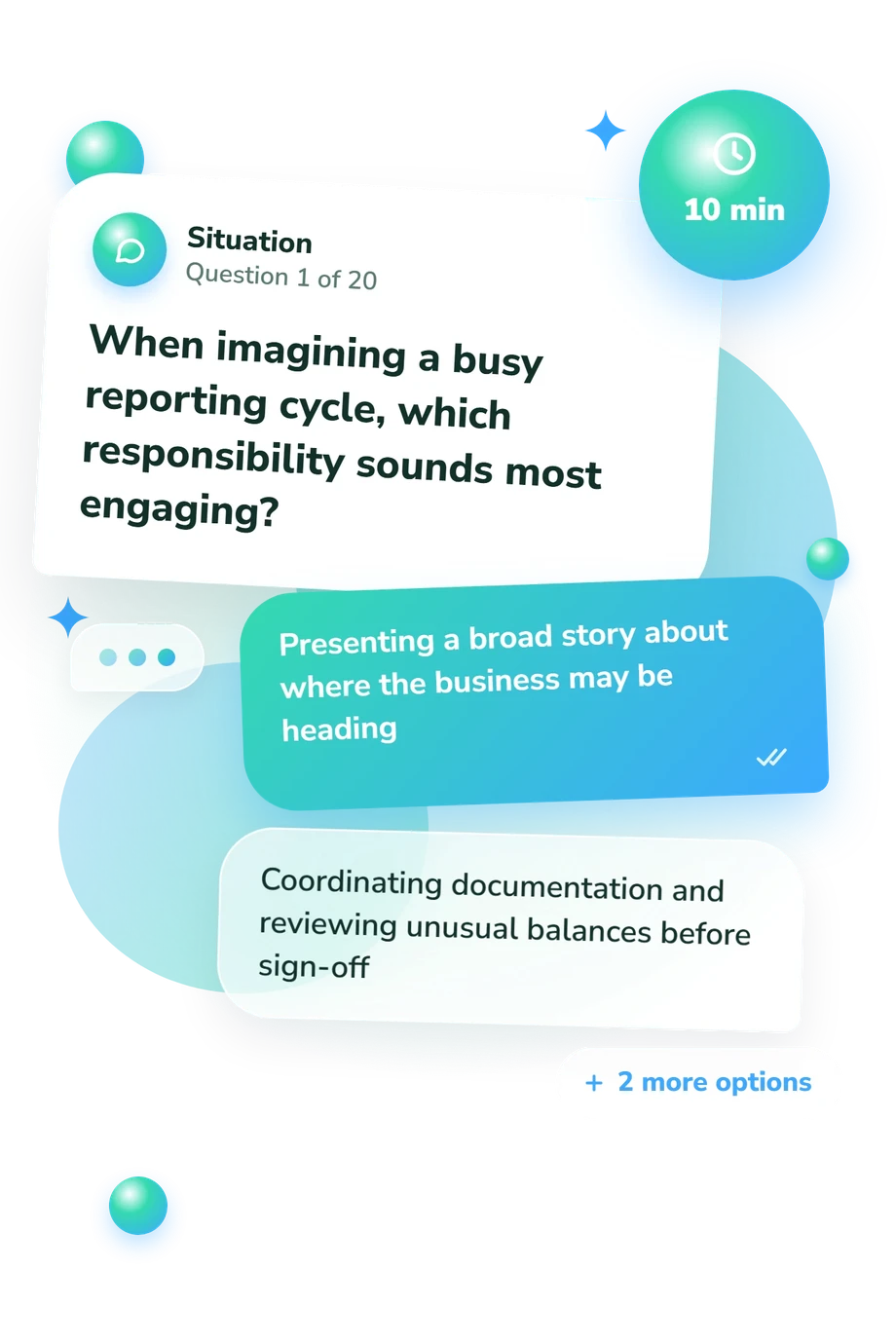
- Presenting a broad story about where the business may be heading
- Coordinating documentation and reviewing unusual balances before sign-off
- Preparing recurring schedules accurately within a defined process
- Following up with teams to collect explanations for major movements
- Updating a forecast as operating assumptions and business conditions change
- Maintaining a reliable report that others use in the forecasting process
- Reviewing external filings for exact compliance with reporting rules
- Collecting budget inputs from department managers
- Avoid forming any view until nearly every uncertainty has been resolved
- Use the available evidence to form a provisional thesis and define what would change it
- Compare several reputable opinions before deciding which case seems strongest
- Focus on a few familiar indicators and revisit the question later
Finance Career Quiz - Description and methodology of the test
People comparing finance roles, choosing a course, or planning a career change can use this finance career quiz to turn broad preferences into a clearer starting point. It focuses on work activities rather than predicting a job title. As a finance career assessment, it can help you consider whether accounting, planning, markets, risk, or corporate analysis deserves closer attention.
What This Assessment Explores
This questionnaire maps attraction to finance situations such as checking evidence, building forecasts, interpreting markets, advising people, and challenging exposure. It suits people exploring finance education or specializations. This quiz helps answer what finance job is right for me by showing preferred work settings and overlapping interests.
The five displayed scales describe these career affinities:
- Accounting & Audit (0-12) reflects accuracy, reconciliation, and documentation.
- Corporate Finance & FP&A (0-12) reflects forecasts, scenarios, and resource allocation.
- Financial Planning & Wealth (0-12) reflects personal goals, trade-offs, and guidance.
- Investments & Markets (0-12) reflects research, valuation, and changing conditions.
- Risk & Compliance (0-12) reflects exposure, controls, and requirements.
Each is shown as Adjacent interest (0-4), Mixed affinity (5-8), or Strong affinity (9-12); scores within one point of another path indicate a blended fit.
Methodology and Evidence Base
Each item presents a finance situation with four response options. Choices contrast preferences for evidence checking, planning, client guidance, market interpretation, and safeguards; they test interest patterns rather than technical knowledge.
Responses form path-specific totals, so the profile compares five affinities rather than selecting one correct occupation. Displayed bands show relative strength, and scores within one point suggest a blended fit. The questionnaire is self-scored, but its totals are not standardized occupational norms.
The approach is conceptually consistent with the O*NET Interest Profiler (Rounds et al., 1999), later structural findings from Warlick et al. (2018), and self-scoring guidance in the 2021 O*NET manual. Holland’s (1997) person-environment theory supports considering how preferences interact with work settings. Its finance categories are specific to this questionnaire, so it is not a re-normed O*NET form or direct adaptation.
Readers deciding whether to major in finance can ground a should i major in finance quiz in this profile, then compare its themes with coursework, skills, practitioner conversations, and finance exposure. Current circumstances, experiences, and self-awareness can influence self-report answers, so the profile remains exploratory rather than conclusive.
- Rounds, James, Cindy M. Walker, Susan X. Day, Lawrence Hubert, Phil Lewis, and David Rivkin. (1999). O*NET Interest Profiler: Reliability, Validity, and Self-Scoring. National Center for O*NET Development.
- Warlick, Craig A., Paul B. Ingram IV, Michael S. Ternes, and Thomas S. Krieshok. (2018). An Investigation Into the Structural Form of the O*NET-Interest Profiler-Short Form. Journal of Career Assessment, 26(3), 503-514. 10.1177/1069072717714544
- Rounds, James, Kevin Hoff, and Phil Lewis, editors. (2021). O*NET Interest Profiler Manual. National Center for O*NET Development.
- Holland, John L. (1997). Making Vocational Choices: A Theory of Vocational Personalities and Work Environments. 3rd ed. Psychological Assessment Resources.
Updated: