
Russian Revolution Quiz
How the Scales are Structured
Who Usually Takes This Test?
See How You Compare
Below is a preview of how scores are typically distributed across each scale.
Example Questions From the Test
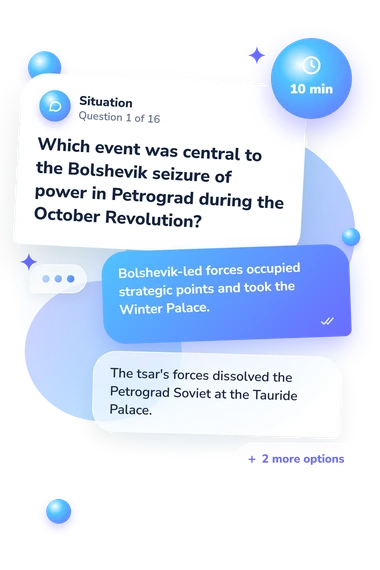
- Bolshevik-led forces occupied strategic points and took the Winter Palace.
- The tsar's forces dissolved the Petrograd Soviet at the Tauride Palace.
- The Constituent Assembly elected Lenin as prime minister.
- Peasant armies entered Petrograd and defeated both Reds and Whites.
- The coexistence of the Provisional Government and the Petrograd Soviet as rival centers of authority
- The competing military commands of the Red Army and White armies
- A coalition in which the Bolsheviks and Socialist Revolutionaries shared all ministries equally
- The division of the imperial throne between Nicholas II and his brother Michael
- A rapid rise in noble landownership caused by the October Manifesto
- The need to mobilize immediately for entry into the First World War
- A constitutional crisis created by the restoration of the Duma
- Economic breakdown and unrest following civil war and War Communism
Russian Revolution Quiz - Description and methodology of the test
Students, history enthusiasts, and anyone revising the upheavals of 1905-1921 can use this assessment to check how securely they connect events, political decisions, and consequences. The Russian Revolution Quiz turns those connections into a focused knowledge check rather than a memory list. Results point to areas needing closer review. This Russian history quiz makes that review more targeted.
What This Assessment Explores
As a quiz about the revolution in Russia, it examines the pressures and decisions surrounding major events. It spans the 1905 upheaval, the 1917 revolutions, civil war, and early Soviet reforms.
The questions focus on three dimensions:
- Chronology shows whether the result reflects a secure sequence from Bloody Sunday to Brest-Litovsk.
- Political conflict measures how well the respondent distinguishes competing institutions and movements.
- Causes and consequences link war, shortages, policy choices, and legitimacy to revolutionary outcomes.
The Russian Revolution Knowledge scale is 0-16: Foundations to build (0-6) points to review of chronology, political groups, and causes; Developing knowledge (7-12) shows major events and ideas are understood but connections need strengthening; Strong knowledge (13-16) reflects a well-developed grasp of sequence, conflict, and significance.
Methodology and Historical Basis
Each item offers a historical prompt and four answer choices. The respondent selects the option that best fits an event, policy, sequence, or political relationship, so the format tests recognition and connection-making rather than extended writing. Distractors commonly differ in date, institution, cause, or consequence.
The result is reported on the displayed knowledge scale; it describes performance on this questionnaire, not general intelligence or political opinion. Prior education, guessing, and current concentration can also affect the result. It emphasizes recognition of relationships among events, policies, institutions, and consequences.
For this Russian Revolution test, Waller (2012), Wade (2017), Daly and Trofimov (2009), and Norris and Sutcliffe (2019) support its historical content only. These secondary works cover chronology, 1917, documentary context, and historical framing; they do not provide validation for the online questionnaire, which is not presented as an adaptation of any one source.
This questionnaire has no established population norms or independent validation statistics, so its bands describe performance within the quiz rather than a standardized level of expertise.
- Sally Waller. History for the IB Diploma: Imperial Russia, Revolutions and the Emergence of the Soviet State 1853-1924. Cambridge University Press, 2012. ISBN 9781107684898.
- Rex A. Wade. The Russian Revolution, 1917. 3rd ed. Cambridge University Press, 2017. 10.1017/9781316417898.
- Jonathan W. Daly and Leonid Trofimov, eds. Russia in War and Revolution, 1914-1922: A Documentary History. Hackett Publishing Company, 2009. ISBN 9780872209879.
- Stephen M. Norris and Benjamin M. Sutcliffe. "Introduction: The Russian Revolution at 100." Revolutionary Russia 32, no. 1 (2019): 1-4. 10.1080/09546545.2019.1603359.
Updated: