
TEAS Practice Quiz
How the Scales are Structured
Who Usually Takes This Test?
See How You Compare
Below is a preview of how scores are typically distributed across each scale.
Example Questions From the Test
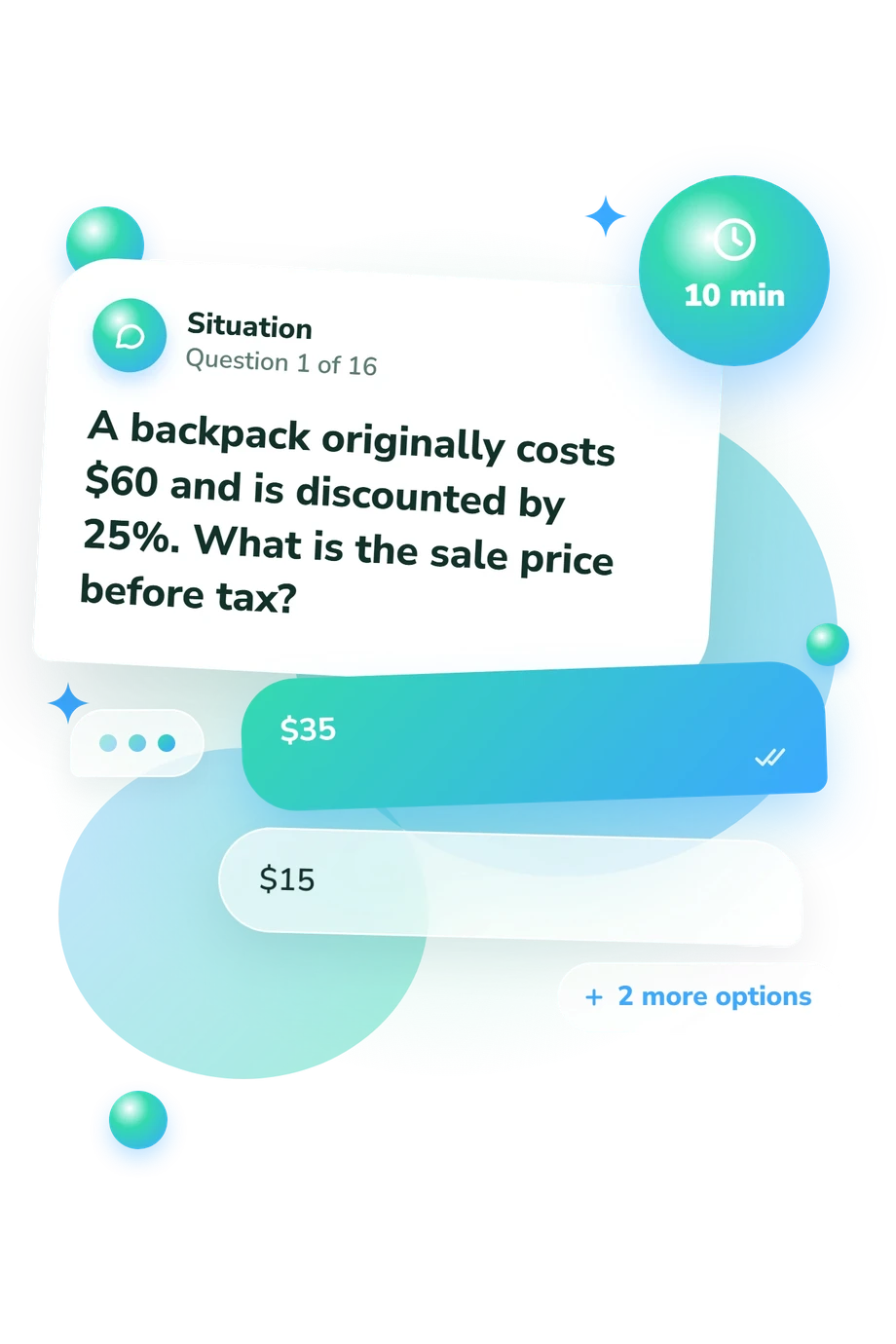
- $35
- $15
- $45
- $48
- In the alveoli
- In the diaphragm
- In the trachea
- In the bronchi
- Golgi apparatus
- Mitochondrion
- Lysosome
- Nucleus
TEAS Practice Quiz - Description and methodology of the test
Prospective nursing students and other TEAS candidates can use the TEAS Practice Quiz to review how they handle sampled reading, mathematics, science, and language tasks. It can support TEAS test prep by showing areas of stronger performance and topics that may need attention, giving study planning a focused starting point without turning the result into a readiness estimate.
What This Assessment Explores
This assessment samples reading, mathematics, science, and English-language performance through questions about evidence, comprehension, calculation, biology, and editing. It shows how respondents handle knowledge and application tasks in the set, rather than measuring personality or clinical behavior. Results can focus TEAS exam practice on content needing attention.
The result covers four sampled areas:
- Reading shows how you identify main ideas, inferences, organization, and precise meaning.
- Mathematics shows how you handle percentages, ratios, perimeter, and algebraic word problems.
- Science examines anatomy, cellular energy, genetics, experimental controls, and evidence.
- English usage shows how you manage agreement, modifiers, punctuation, and vocabulary.
These areas are represented in the TEAS Knowledge scale, 0-16. Foundations to strengthen (0-6) signals core review; Developing knowledge (7-12) reflects usable essentials needing targeted practice; Strong knowledge (13-16) indicates solid command of sampled TEAS-style material. This is a broad practice snapshot.
Methodology and Evidence Base
Each item presents a brief prompt with four answer choices, and the respondent selects the best answer. The set mixes knowledge questions with applied problems, evidence appraisal, inference, and editing. The displayed result follows the stated bands; the questionnaire does not specify how answers are weighted or combined.
Content can be compared with ATI TEAS Version 7, whose outline covers Reading, Math, Science, and English and Language Usage. The outline supplies a content-level comparison. This unofficial practice set is distinct from the official ATI TEAS examination.
Yoo, Zhou, and Phillips (2025), and Wolkowitz and Kelley (2010), examined relationships between TEAS-related performance and nursing outcomes. Their studies provide context about preadmission measures; they do not validate this 16-item questionnaire or establish domain-level evidence. Its standardization, reliability, validity, and predictive accuracy have not been established.
Interpretation is practical: use performance across the sampled material to plan review rather than estimate a later outcome. Coverage is limited to 16 TEAS practice questions; preparation, guessing, fatigue, and testing context can affect results, while absent norms limit comparisons between respondents.
- Hanwook Yoo, Xuechun Zhou, and Beth Phillips. Predictive validity of preadmission assessment on early nursing academic readiness: Impact of COVID-19. Nurse Educator. 2025;50(5):277-282. 10.1097/NNE.0000000000001891
- Assessment Technologies Institute. ATI TEAS, Version 7 Content Outline. Assessment Technologies Institute; 2022.
- Amanda A. Wolkowitz and Jeffrey A. Kelley. Academic predictors of success in a nursing program. Journal of Nursing Education. 2010;49(9):498-503. 10.3928/01484834-20100524-09
Updated: