
Christmas Bible Quiz
How the Scales are Structured
Who Usually Takes This Test?
See How You Compare
Below is a preview of how scores are typically distributed across each scale.
Example Questions From the Test
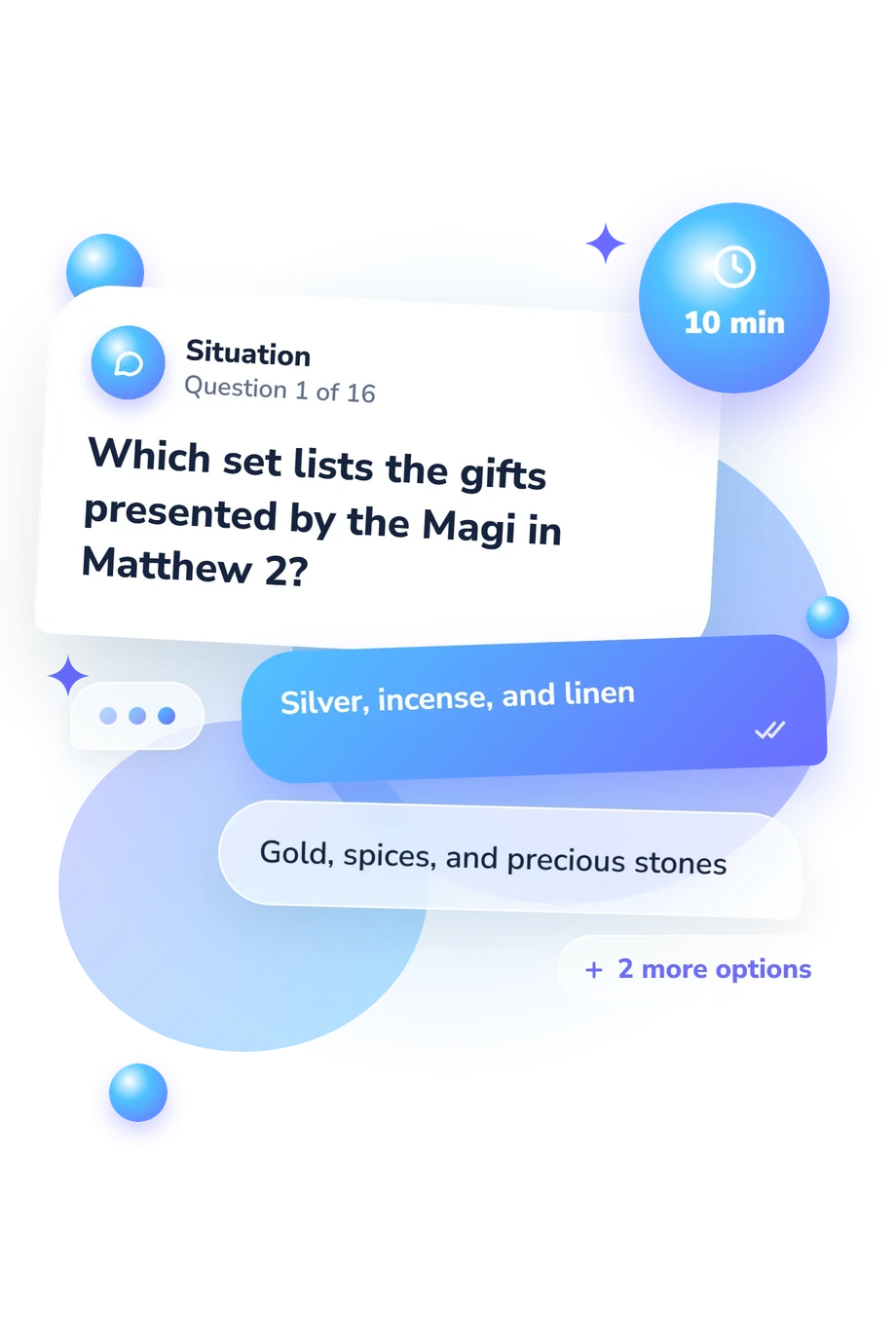
- Silver, incense, and linen
- Gold, spices, and precious stones
- Gold, frankincense, and myrrh
- Bread, wine, and olive oil
- He would be beneath a brightly shining star
- He would be held by a priest from Jerusalem
- He would be wearing a small crown
- He would be wrapped in cloths and lying in a manger
- Ask the religious leaders to judge the matter publicly
- Proceed immediately with the marriage celebration
- Travel to Bethlehem to consult Mary's relatives
- End the relationship quietly to avoid exposing her publicly
Christmas Bible Quiz - Description and methodology of the test
For readers who want to check their grasp of the nativity narratives rather than rely on decorations or retellings, the Christmas Bible Quiz offers a passage-based exercise. It suits personal study, family discussion, Sunday-school review, and anyone comparing what Matthew, Luke, and John actually say. As a quiz about biblical Christmas passages, it highlights details that may deserve closer reading without turning the result into a judgment of faith.
What This Assessment Explores
This assessment measures recognition of people, events, sequence, wording, and setting across Matthew 1-2, Luke 1-2, and John 1. It tests textual recall rather than belief, helping readers separate Gospel details from familiar nativity imagery and later traditions.
Taken together, the questions in this Bible quiz about Christmas form three thematic groups:
- Matthew’s narrative tests recognition of Joseph’s decision, the Magi, Herod, prophecy, and the flight to Egypt.
- Luke’s narrative measures recall of the annunciation, registration, manger, shepherds, and the heavenly message.
- John’s prologue checks recognition of language presenting Jesus as the Word made flesh.
The displayed scale is Christmas Bible Knowledge, 0-16: Foundations to revisit (0-6), Developing knowledge (7-12), and Strong knowledge (13-16). A higher band indicates a more developed grasp of the narratives represented here.
Question Design and Textual Basis
Each item presents four answer options, usually contrasting a precise Gospel detail with a plausible but unsupported alternative. As a Christmas Christian quiz, it tests Bible knowledge through biblical passages rather than attitudes, personality, or spiritual experience. The displayed total and descriptive bands show how securely the respondent recognizes the tested details.
The questions draw on or paraphrase the biblical passages in Matthew 1-2, Luke 1-2, and John 1 rather than reproducing every verse verbatim. Brown's study provides an interpretive framework for the infancy narratives; Davies and Allison support close reading of Matthew, and Green supports close reading of Luke. These sources provide textual and interpretive context. The questionnaire is an unstandardized online knowledge quiz, not an adaptation of them or a published standardized instrument; its bands describe performance on its own items and do not establish reliability, validity, or norms.
A quiz about Christmas Bible facts can show which passages or details merit rereading. Memory, prior Bible study, translation familiarity, and current attention can affect performance, so the bands describe this focused task rather than complete biblical expertise.
- Raymond E. Brown. The Birth of the Messiah: A Commentary on the Infancy Narratives in the Gospels of Matthew and Luke. New updated edition. Doubleday, 1993.
- National Council of the Churches of Christ in the United States of America. New Revised Standard Version Updated Edition. Friendship Press, 2021. Matthew 1-2; Luke 1-2; John 1.
- W. D. Davies and Dale C. Allison Jr. A Critical and Exegetical Commentary on the Gospel According to Saint Matthew, Volume 1: Introduction and Commentary on Matthew I-VII. T&T Clark, 1988. 10.5040/9781472556240.
- Joel B. Green. The Gospel of Luke. New International Commentary on the New Testament. William B. Eerdmans Publishing Company, 1997.
Updated: