
Netiquette Quiz
How the Scales are Structured
Who Usually Takes This Test?
See How You Compare
Below is a preview of how scores are typically distributed across each scale.
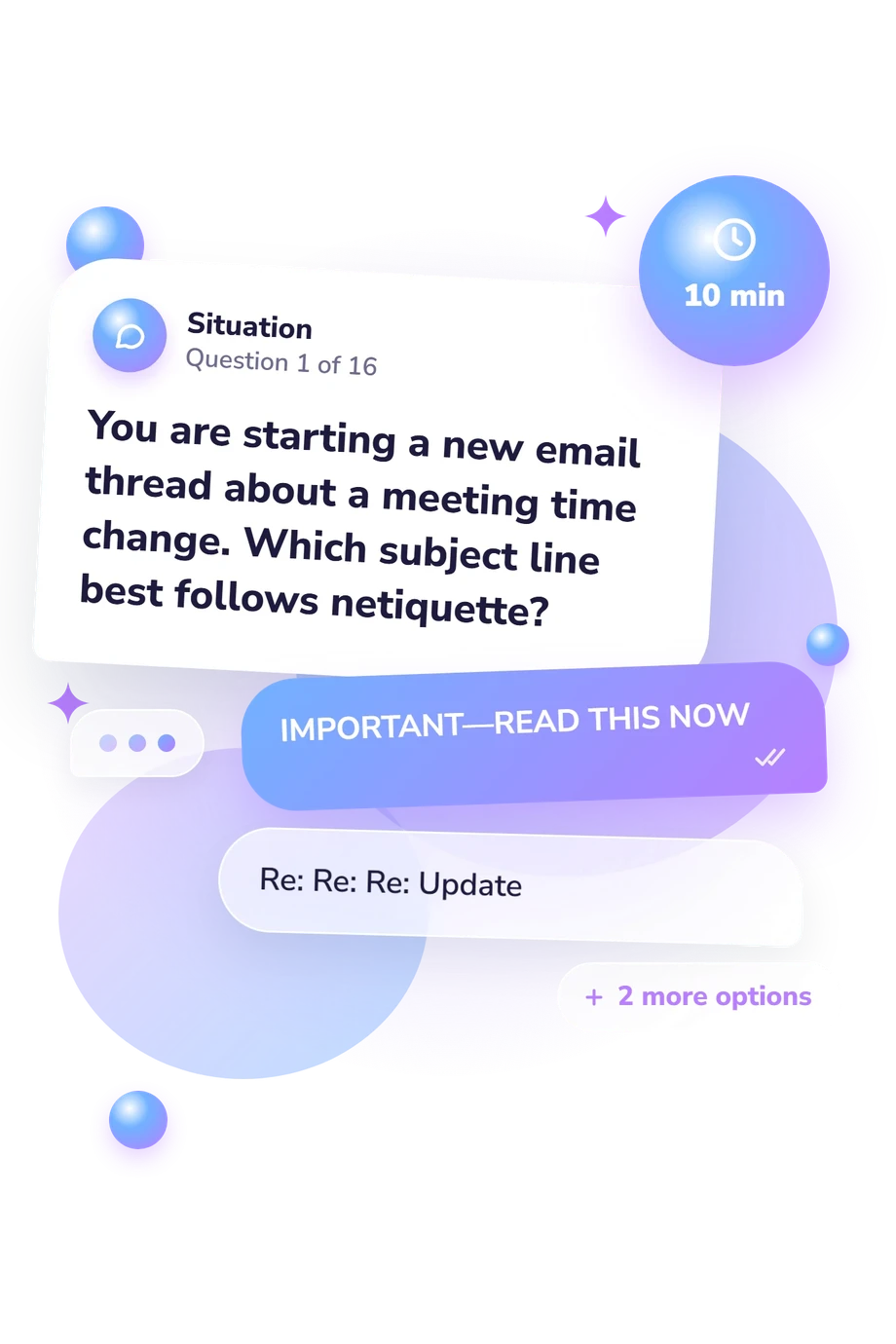
Example Questions From the Test
- IMPORTANT—READ THIS NOW
- Re: Re: Re: Update
- A quick thing about next week
- Tuesday meeting moved to 2 p.m.
- Assume its conventions are identical to every other community's
- Create several posts to discover which ones moderators remove
- Read the rules and observe how members use the space
- Ask members to summarize every rule individually
- Shouting or unusually strong emphasis
- Quoting another person's exact words
- Marking the message as confidential
- Showing that the message is unfinished
Netiquette Quiz - Description and methodology of the test
People who want to communicate thoughtfully online can use this assessment to examine choices in email, forums, messaging, and social platforms. The netiquette quiz is intended for readers seeking a practical profile of current understanding rather than a personality label. This netiquette assessment uses scenarios to review knowledge of digital communication involving clarity, privacy, respect, and participation. Results point to principles worth reinforcing.
What This Assessment Explores
Across the items, the questionnaire examines email, forums, group chats, direct messages, and social platforms. It suits anyone reviewing communication habits; the result describes considerate, clear, context-aware knowledge rather than personality.
These themes contribute to one overall knowledge result:
- Tone and clarity items show how wording and capitalization shape interpretation.
- Privacy and consent items address messages, addresses, screenshots, and identifying details.
- Group communication items cover threads, reply-all, relevance, and repetition.
- Respect and conflict items address correction, disagreement, and restraint.
- Attribution and accessibility items cover creator credit and visual information.
Netiquette Knowledge ranges from 0-16: Foundations to Build (0-6) means you may benefit from reviewing core conventions; Developing Knowledge (7-12) means you understand many common expectations but may miss less obvious applications; Strong Knowledge (13-16) reflects a consistent grasp across varied digital contexts. This netiquette test gives the score practical focus.
Methodology and Evidence Base
Each item presents a brief online scenario with four response options. The respondent selects the choice that best reflects considerate, clear, context-aware practice. Selecting among the four answer choices tests recognition of recommended online communication principles in a hypothetical context, such as why BCC protects privacy or why a relevant thread reduces confusion.
The displayed total summarizes performance across the decisions on a knowledge-oriented scale. Its bands describe familiarity with conventions, not guaranteed behavior; context and intention can change conduct from one interaction to another.
The questionnaire is conceptually consistent with the 2014 study of digital literacy and netiquette awareness by Farshad Nia and Marandi, not an adaptation of it. RFC 1855 supplies practical conventions for email, group communication, privacy, and considerate participation, while Shea’s 1994 book frames netiquette as responsible online conduct.
Because the result depends on recognizing recommended conduct, interpreting hypothetical contexts, and selecting among response options, it may vary with current context and self-awareness; the displayed bands provide interpretation for this questionnaire rather than population norms, so the score is best used for reflection rather than diagnosis.
- Farshad Nia, Sara, and Susan Marandi. (2014). Digital literacy and netiquette: Awareness and perception in EFL learning context. In S. Jager, L. Bradley, E. J. Meima, and S. Thouësny (Eds.), CALL Design: Principles and Practice: Proceedings of the 2014 EUROCALL Conference (pp. 77-82).. 10.14705/rpnet.2014.000198
- Hambridge, Sally. (1995). RFC 1855: Netiquette Guidelines. Internet Engineering Task Force. 10.17487/RFC1855
- Shea, Virginia. (1994). Netiquette. San Francisco: Albion Books. ISBN 0-9637025-1-3
Updated: