
Harry Potter Name Quiz
How the Scales are Structured
Who Usually Takes This Test?
See How You Compare
Below is a preview of how scores are typically distributed across each scale.
Example Questions From the Test
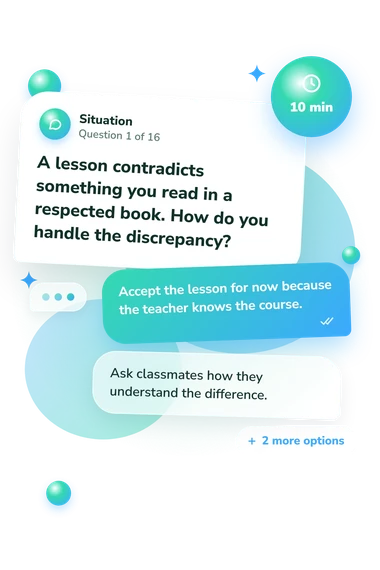
- Accept the lesson for now because the teacher knows the course.
- Ask classmates how they understand the difference.
- Look for an example that could test both explanations.
- Compare multiple sources and examine the assumptions behind each claim.
- Choose a meaningful role that already fits my strengths.
- Prepare privately and decide once I know how ready I am.
- Audition, but also arrange a solid alternative role.
- Go for it fully; the possibility of failure would not stop me.
- Find a nearby teacher or prefect who knows the area.
- Pause long enough to work out where the sound came from.
- Ask a companion to come while you investigate together.
- Move toward the voice immediately, even though you feel nervous.
Harry Potter Name Quiz - Description and methodology of the test
For fans who want to connect fictional house ideals with everyday choices, this questionnaire offers a playful way to examine personal tendencies. The Harry Potter Name Quiz turns dilemmas about courage, loyalty, curiosity, ambition, and strategy into a comparative profile. Read as a Harry Potter personality test, it gives language to preferences that may be easier to discuss than to define.
What This Assessment Explores
The scenarios test choices when values compete-whether to speak up, investigate, include, persist, or pursue a goal. Together, these choices make this a Hogwarts house quiz with four patterns.
These dimensions shape the profile:
- Gryffindor Affinity (0-12) measures brave initiative: Quiet Spark (0-4) is modest boldness, Courage in Motion (5-8) faces discomfort, and Daring Heart (9-12) welcomes risk.
- Hufflepuff Affinity (0-12) measures fairness and follow-through: Selective Support (0-4) balances care, Steady Ally (5-8) cooperates, and Loyal Foundation (9-12) sustains inclusive effort.
- Ravenclaw Affinity (0-12) measures inquiry: Practical Curiosity (0-4) values useful knowledge, Inquiring Mind (5-8) pursues patterns, and Relentless Thinker (9-12) explores deeply.
- Slytherin Affinity (0-12) measures ambition and strategy: Flexible Aspirations (0-4) keeps them secondary, Purposeful Climber (5-8) plans ahead, and Strategic Drive (9-12) positions long term.
The highest is strongest; a score within one point supports a blend.
Methodology and Scientific Basis
Each item presents a social or problem-solving scenario with four response options. Choices cover disagreement, exclusion, leadership, setbacks, puzzles, commitments, risk, and unfamiliar information. As a Harry Potter house quiz, the format samples preferred reactions, so choose what resembles your usual behavior rather than what sounds admirable.
The Pottermore Sorting Hat Quiz is a relevant comparison: Crysel and colleagues linked its house patterns with personality traits. This questionnaire is a separate online four-affinity questionnaire whose themes are conceptually consistent with that work. Jakob and colleagues examined relations among Sorting Hat outcomes, personality, and human values, while Rowling's novel supplies the fictional house framework. The fictional Hogwarts framework gives the profile its interpretive context.
Selected responses contribute to four comparable affinity totals, and the leading total is interpreted alongside any near-tie according to the result rule above. The displayed bands describe levels of affinity, not fixed psychological types, while mood, recent experiences, and self-perception may influence self-reported choices, so treat the profile as a structured reflection on recurring preferences rather than a firm psychological classification.
- Crysel, Laura C., Corey L. Cook, Tatiana Orozco Schember, and Gregory D. Webster. (2015). Harry Potter and the measures of personality: Extraverted Gryffindors, agreeable Hufflepuffs, clever Ravenclaws, and manipulative Slytherins. Personality and Individual Differences, 83, 174-179. 10.1016/j.paid.2015.04.016
- Jakob, Lea, Eduardo Garcia-Garzon, Hannes Jarke, and Fabian Dablander. (2019). The Science Behind the Magic? The Relation of the Harry Potter “Sorting Hat Quiz” to Personality and Human Values. Collabra: Psychology, 5(1), Article 31. 10.1525/collabra.240
- Rowling, J. K. (1997). Harry Potter and the Philosopher's Stone. Bloomsbury Children's Books.