
Riddles Funny Quiz
How the Scales are Structured
Who Usually Takes This Test?
See How You Compare
Below is a preview of how scores are typically distributed across each scale.
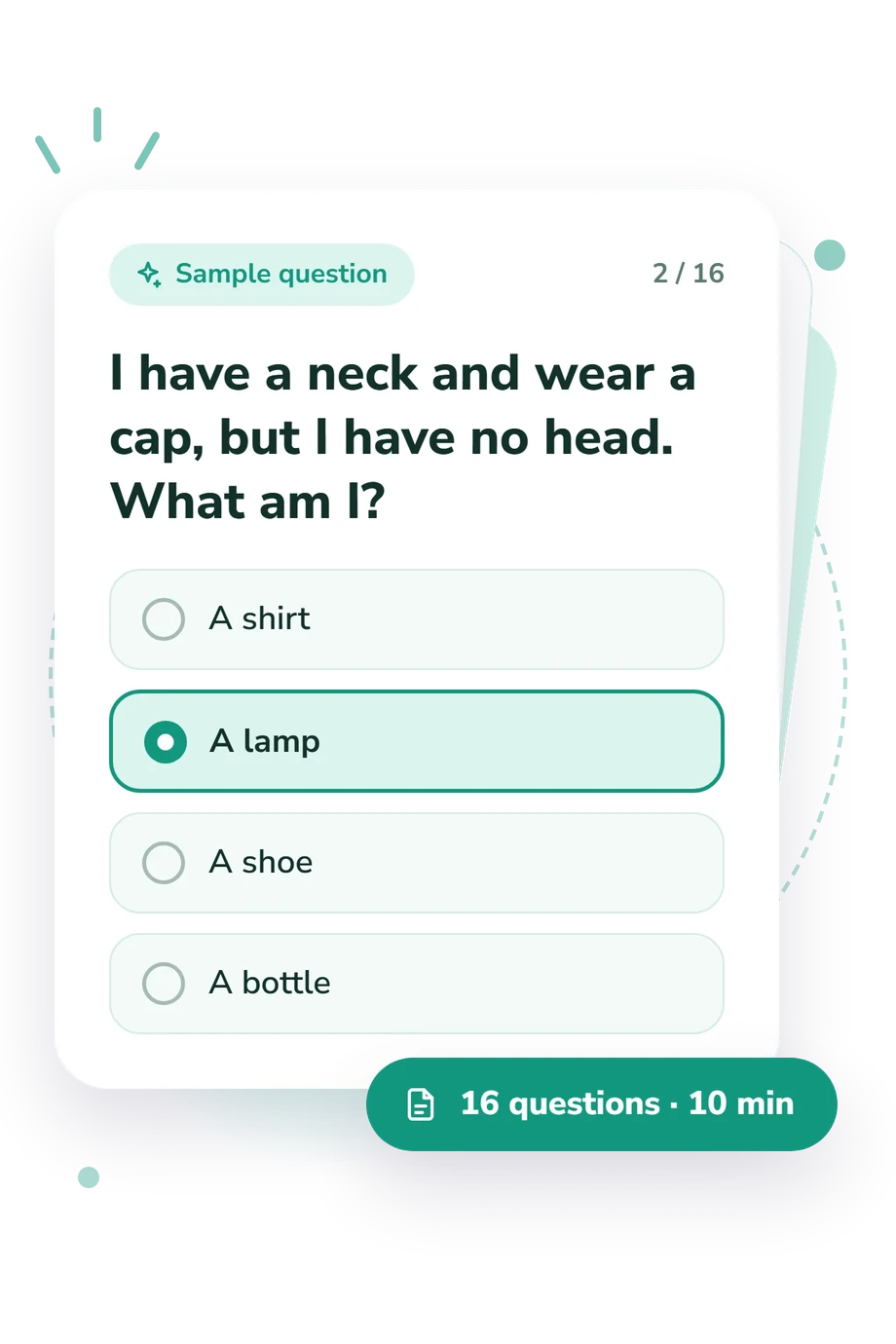
Example Questions From the Test
- A typewriter
- A piano
- A calculator
- A xylophone
- A shirt
- A lamp
- A shoe
- A bottle
- A passport
- A return address
- A postage stamp
- A compass needle
Riddles Funny Quiz - Description and methodology of the test
People who enjoy language play, quick logic, and everyday aha moments can use Riddles Funny Quiz Questions to see how readily they spot the answer behind a misleading clue. The result describes performance on familiar verbal puzzles, making the quiz suitable for casual self-reflection, friendly comparison, or a short mental warm-up. The test presents each clue with four choices, so this riddles quiz with answers lets you review the intended solution after choosing.
What This Quiz Measures
The questions test whether you move beyond a clue’s literal surface and recognize the wordplay, association, or practical relationship leading to the answer. They suit readers seeking an entertaining exercise in verbal reasoning with familiar situations, rather than a broad measure of intelligence.
Examples involve objects, body parts, silence, changes in size, and everyday tools. Reviewing the quiz riddles and answers can reveal which clue patterns feel immediate or need a second reading.
Funny Riddles Knowledge runs from 0-16: Riddle Rookie, 0-6; Clever Clue-Catcher, 7-12; Wordplay Whiz, 13-16. The overall score reflects recurring clue-solving tasks:
- Literal-to-figurative shifts show whether you move beyond surface details.
- Object-function recognition shows whether you identify items by their use.
- Compact logic helps you resolve misdirection between competing interpretations.
Methodology and Evidence Base
Each item presents a brief verbal clue with four answer choices. Solving means identifying the intended referent while resisting a plausible literal reading. The scoring rule awards one point for every correct answer, so the total reflects successful solutions rather than speed, eloquence, or general intelligence.
Its playful design makes this a funny riddles quiz built around compact language, ambiguity, and a shift in perspective. Fowles and Glanz offer the closest conceptual comparison through work on verbal-riddle comprehension and clue interpretation. Dienhart explains how linguistic tension and pragmatic expectations make one reading yield to another. Purser, Van Herwegen, and Thomas provide conceptual background on riddle comprehension and appreciation, not evidence about this questionnaire’s reliability, norms, or validity.
The questionnaire is conceptually consistent with these works, not an adaptation of their published instruments. Its bands are descriptive, and no standardization or psychometric validation is established for the online version; those studies do not validate it. Familiarity with riddles, language proficiency, cultural references, attention, and guessing can affect performance, making the score a snapshot of this wordplay set.
- Fowles, Barbara, and Marcia E. Glanz. “Competence and talent in verbal riddle comprehension.” Journal of Child Language, vol. 4, no. 3, 1977, pp. 433-452. 10.1017/S0305000900001781
- Dienhart, John M. “A linguistic look at riddles.” Journal of Pragmatics, vol. 31, no. 1, 1999, pp. 95-125. 10.1016/S0378-2166(98)00056-3
- Purser, Harry R. M., Jo Van Herwegen, and Michael S. C. Thomas. “The development of children’s comprehension and appreciation of riddles.” Journal of Experimental Child Psychology, vol. 189, 2019, article 104709. 10.1016/j.jecp.2019.104709
Updated: