
Tell-Tale Heart Quiz
How the Scales are Structured
Who Usually Takes This Test?
See How You Compare
Below is a preview of how scores are typically distributed across each scale.
Example Questions From the Test
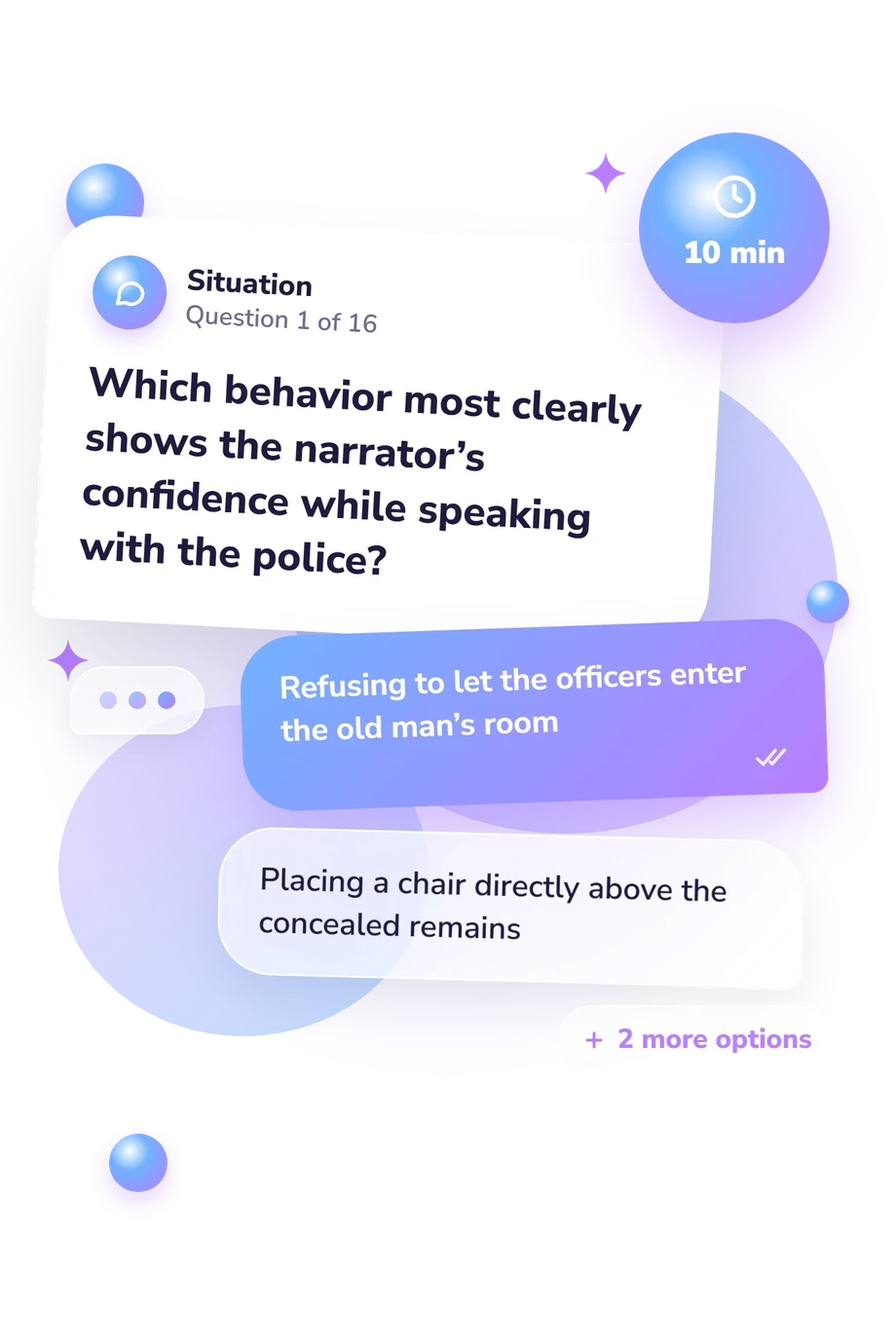
- Refusing to let the officers enter the old man’s room
- Placing a chair directly above the concealed remains
- Claiming never to have known the old man
- Leaving the house while the officers conduct their search
- The beating of the dead man’s heart beneath the floor
- A clock ticking inside the old man’s room
- Someone knocking repeatedly at the front door
- The officers tapping their feet against the floor
- Buries it beneath stones in the cellar
- Places it in a trunk to be carried out later
- Dismembers it and hides the pieces beneath the floorboards
- Leaves it in bed and stages a natural death
Tell-Tale Heart Quiz - Description and methodology of the test
Readers who want to check their grasp of Poe’s short fiction can use this assessment as a focused close-reading exercise. Performance on the tell tale heart quiz offers a practical check of recall, inference, and interpretation. It is suitable for students, book-club participants, and anyone revisiting the story. Your answers to the Tell-Tale Heart quiz questions show which details deserve another look.
What This Assessment Explores
Questions examine how the narrator’s actions, explanations, and perceptions shape the murder’s meaning. As a Tell-Tale Heart reading quiz, the assessment combines plot recall with close reading of motive, setting, irony, imagery, and the gap between the narrator’s claims and the events.
These dimensions show what each result reflects:
- Plot and sequence show whether the reader can follow the approach, murder, concealment, and police visit.
- Narrator and perspective indicate recognition of contradictions and unreliability.
- Imagery and symbolism show whether the reader recognizes literary details such as the eye, darkness, lantern, and heartbeat.
- Inference and theme show how fear, guilt, sanity, and confession are connected.
Results appear on The Tell-Tale Heart Knowledge scale, scored 0-16: Beginning Reader (0-6), Developing Close Reader (7-12), or Accomplished Close Reader (13-16). The bands move from partial recognition of events to strong command of plot, perspective, imagery, irony, and themes.
Methodology and Evidence Base
Each item uses four-option multiple choice. Prompts ask for factual recall, interpretation of behavior, or an inference supported by the narrative, so the task tests reading of Poe’s text rather than a psychological profile. The questionnaire presents a bounded knowledge score across the listed bands; item weighting is not specified.
The source text is Poe’s story, which supplies the events, descriptions, and narrative cues tested here. This is a story-specific online knowledge check: a Poe story comprehension test that asks readers to connect factual recall with textual evidence. Kulchytska and Kakapych’s 2023 analysis supports its focus on unreliable narration, especially the tension between the narrator’s claims and the events he describes.
Because this is a story-specific online self-check, it has no stated norms or clinical status. Performance can shift with memory, rereading, classroom discussion, and the reader’s judgment about explicit fact versus interpretation. A result is best used to identify passages or ideas for closer review, not to generalize beyond this selected set of questions.
- Poe, Edgar Allan. “The Tell-Tale Heart.” The Pioneer, vol. I, no. 1, January 1843, pp. 29-31.
- Kulchytska, Olha, and Tetiana Kakapych. “The Unreliable Narrator in Edgar Allan Poe’s ‘The Tell-Tale Heart.’” Folium, special issue, 2023, pp. 92-96. 10.32782/folium/2023.3.13
Updated: