
Am I Emotionally Unstable Quiz
How the Scales are Structured
Who Usually Takes This Test?
See How You Compare
Below is a preview of how scores are typically distributed across each scale.
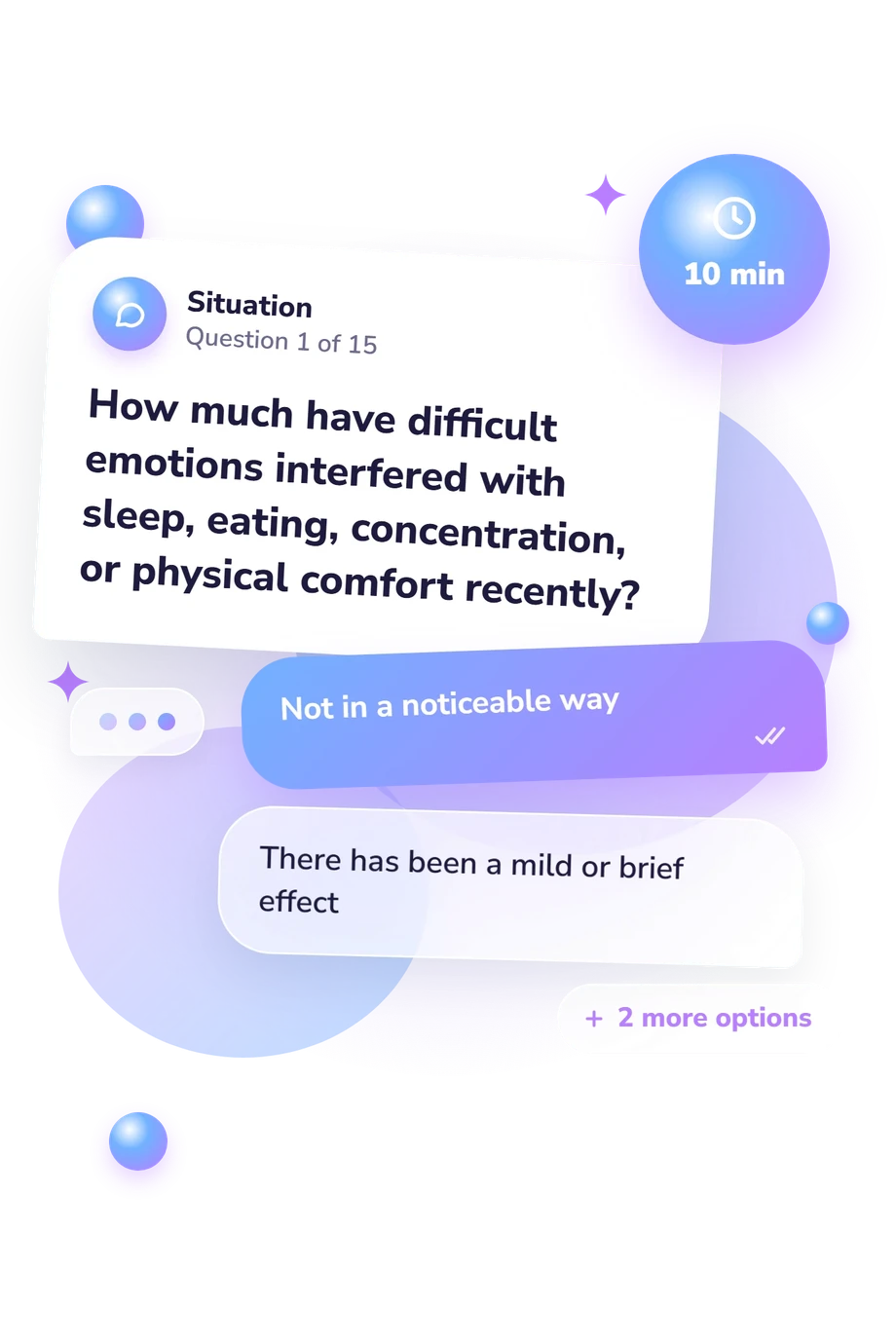
Example Questions From the Test
- Not in a noticeable way
- There has been a mild or brief effect
- The effect has recurred or disrupted part of my routine
- The effect has been severe enough that I cannot meet basic needs or function normally
- Not during the past few weeks
- Occasionally, but the intensity remained manageable
- Repeatedly, and it was difficult to think clearly in the moment
- Often, with intensity that felt frightening or beyond my control
- I notice it but do not experience a major emotional change
- I feel uneasy and wonder about it for a while
- I become very distressed or assume the relationship is in trouble
- My feelings can swing rapidly between panic, anger, and rejection
Am I Emotionally Unstable Quiz - Description and methodology of the test
People seeking a clearer picture of recent emotional reactions can use the Am I Emotionally Unstable Quiz as a structured self-reflection exercise. The concern behind an emotional stability quiz is narrowed here to whether recent intensity, slow recovery, impulsive behavior, safety concerns, or disruption to ordinary responsibilities deserve closer attention. The result organizes these patterns into practical areas to review.
What This Assessment Explores
These questions examine emotional regulation under pressure rather than a permanent personality label. They cover conflict, rapid shifts, lingering distress, difficulty calming down, regretted actions, risky behavior, safety, and disruption to daily responsibilities. Recent functioning matters more than a broad label: this quiz asks whether you are mentally stable, and the result highlights areas for reflection or support.
Three result dimensions organise these patterns:
- Emotional Intensity and Shifts (0-15) measures strong or rapidly changing reactions. Bands: No indicators endorsed (0), Some concern present (1-2), Action warranted (3-15).
- Emotional Recovery Strain (0-15) measures lingering distress and difficulty settling. Bands: No indicators (0), Some concern present (1-2), Action warranted (3-15).
- Impulse, Safety, and Daily Impact (0-15) measures impulsive behavior, safety, and routine disruption. Bands: No indicators endorsed (0), Some concern present (1-2), Action warranted (3-15).
Methodology and Scientific Basis
Each item describes a recent situation and offers four ordered responses, moving from little or no disruption toward greater intensity, persistence, consequence, or loss of control. This self-report format captures the respondent’s view of what happened.
Responses are grouped into three dimensions rather than one global score, so the result of an am i emotionally stable quiz should be read through the experiences endorsed and how serious they were.
Because the bands are unvalidated reflective summaries, not clinical cutoffs, any concerning response matters independently and a score-3 red flag takes priority; stress, memory, self-awareness, and disclosure shape answers, so totals cannot explain every pattern, while immediate danger or self-harm risk requires emergency or crisis support.
The closest conceptual anchor is the Brief Emotion Dysregulation Scale (Wycoff et al., 2024), focused on intensity, control, and consequences. The questionnaire is also conceptually consistent with Gratz and Roemer’s Difficulties in Emotion Regulation Scale and Carpenter and Trull’s review of emotion-dysregulation components, offering context rather than a verdict from a how mentally stable are you quiz; it is not an adaptation of those works.
- Wycoff, Andrea M., Sarah A. Griffin, Ashley C. Helle, Alison M. Haney, Ashley L. Watts, and Timothy J. Trull. "The Brief Emotion Dysregulation Scale: Development, Preliminary Validation, and Recommendations for Use." Assessment 31, no. 2 (2024): 335-349. 10.1177/10731911231161800
- Gratz, Kim L., and Lizabeth Roemer. "Multidimensional Assessment of Emotion Regulation and Dysregulation: Development, Factor Structure, and Initial Validation of the Difficulties in Emotion Regulation Scale." Journal of Psychopathology and Behavioral Assessment 26, no. 1 (2004): 41-54. 10.1023/B:JOBA.0000007455.08539.94
- Carpenter, Ryan W., and Timothy J. Trull. "Components of Emotion Dysregulation in Borderline Personality Disorder: A Review." Current Psychiatry Reports 15, no. 1 (2013): 335. 10.1007/s11920-012-0335-2
Updated: