
Physical vs Chemical Properties Quiz
How the Scales are Structured
Who Usually Takes This Test?
See How You Compare
Below is a preview of how scores are typically distributed across each scale.
Example Questions From the Test
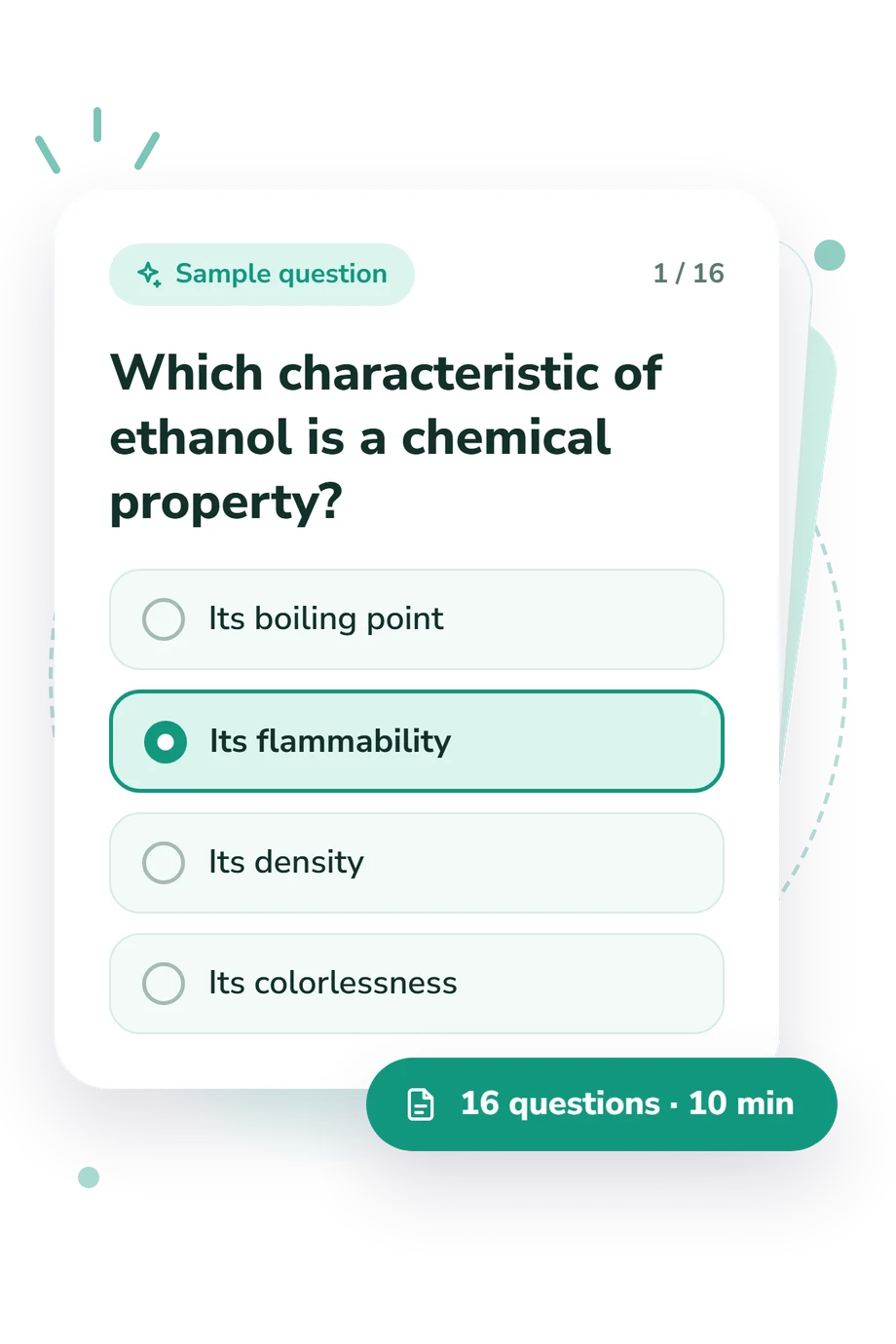
- Its boiling point
- Its flammability
- Its density
- Its colorlessness
- Heat of combustion
- Reactivity with oxygen
- Acidity
- Melting point
- Solubility
- Density
- Flammability
- Reactivity with acids
Physical vs Chemical Properties Quiz - Description and methodology of the test
Learners deciding which basic chemistry concepts need review can use this physical vs chemical properties quiz to identify areas where their understanding needs attention. This physical and chemical properties quiz also supports vocabulary review, interpretation of laboratory observations, and practice explaining why a property belongs in one category rather than the other.
What This Assessment Measures
The assessment tests whether learners can distinguish observable physical properties from chemical properties, which describe a substance’s capacity or tendency to undergo chemical change. It suits learners using this chemistry classification quiz to check their understanding.
Questions use cases such as color, density, melting point, solubility, flammability, rusting, ductility, and reactions with acids. To make the distinction concrete, questions about physical properties within this assessment ask learners to apply definitions to laboratory and everyday situations.
The question set covers reasoning areas:
- Observable traits are identified as features that leave chemical identity unchanged.
- Chemical properties describe capacities or tendencies to burn, rust, decompose, or react with acids.
- Classification links an observation to what it reveals about a material.
- Applications show how properties support separation, material selection, and experiment interpretation.
The result places performance on the physical-versus-chemical classification task into a displayed knowledge band.
Methodology and Evidence Base
Each item offers four choices and asks for a definition, a classification, or the property relevant to a situation. The format checks recognition and application, while unfamiliar examples or imprecise reading can affect performance.
The catalogue reports one scale, Physical vs Chemical Properties Knowledge, with a 0-16 range. Results appear as Foundations to Review (0-6), Developing Knowledge (7-12), or Strong Knowledge (13-16). These bands describe increasing accuracy on the tested distinction, not general scientific ability.
Its conceptual framework is consistent with Neth et al. (2016): physical properties can be observed or measured without changing chemical identity, whereas chemical properties concern the capacity to undergo change. Attention to alternative conceptions also connects with DeFever et al. (2015) and Mulford and Robinson (2002). The questionnaire is conceptually consistent with these works, not an adaptation of their published instruments.
For learners, this online chemistry classification quiz covering physical and chemical properties provides a focused learning snapshot. The displayed bands are descriptive categories for performance on these questions, so interpret the score alongside the specific examples and the learner’s chemistry work.
- Edward J. Neth, Paul Flowers, William R. Robinson, Klaus Theopold, and Richard Langley. Chemistry: Atoms First. Houston, TX: OpenStax, 2016. Section 1.3, "Physical and Chemical Properties."
- Ryan S. DeFever, Heather Bruce, and Gautam Bhattacharyya. "Mental Rolodexing: Senior Chemistry Majors’ Understanding of Chemical and Physical Properties." Journal of Chemical Education 92, no. 3 (2015): 415-426. 10.1021/ed500360g
- Douglas R. Mulford and William R. Robinson. "An Inventory for Alternate Conceptions among First-Semester General Chemistry Students." Journal of Chemical Education 79, no. 6 (2002): 739-744. 10.1021/ed079p739
Updated: