
Spanish Subject Pronouns Quiz
How the Scales are Structured
Who Usually Takes This Test?
See How You Compare
Below is a preview of how scores are typically distributed across each scale.
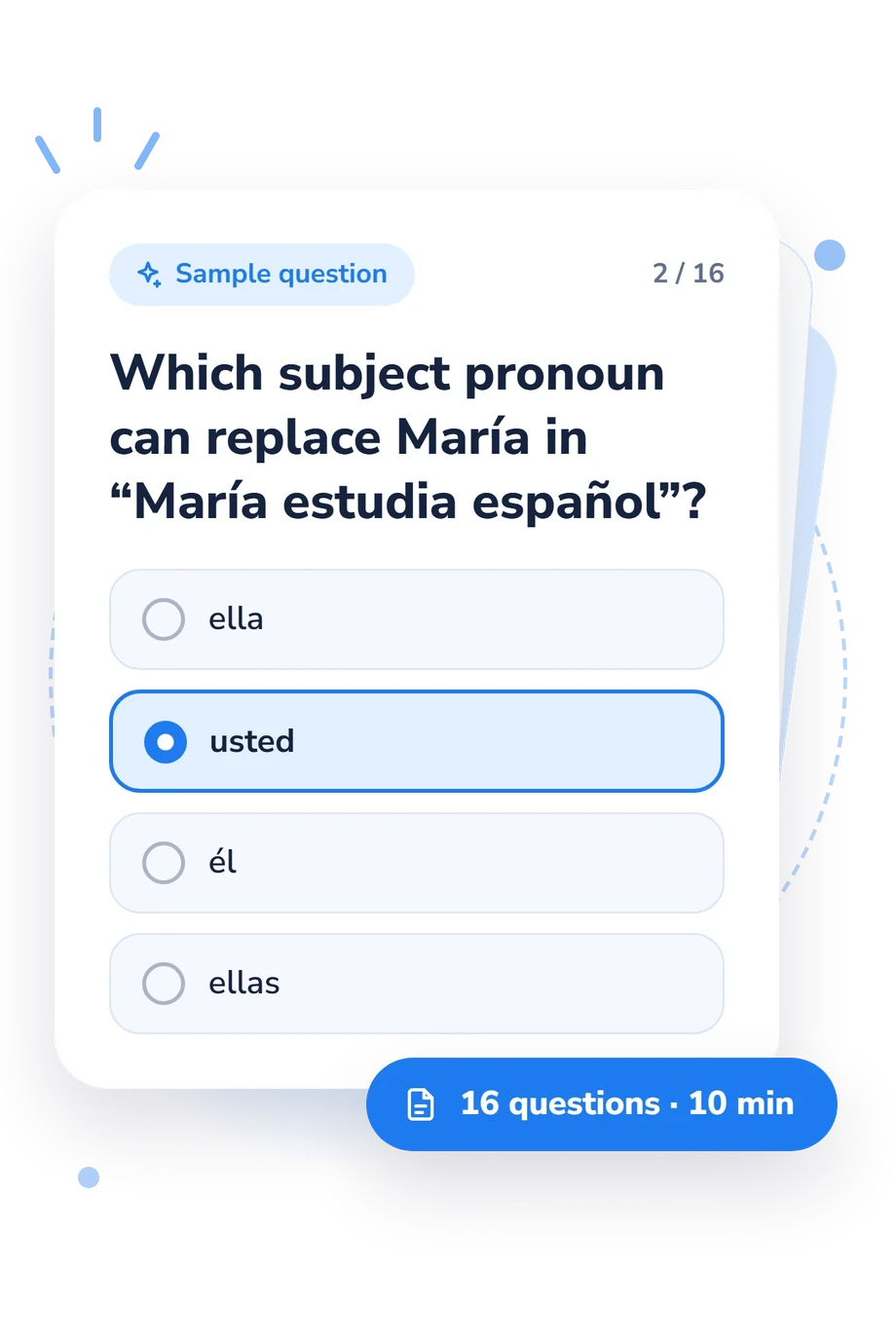
Example Questions From the Test
- Spanish sentences never require a subject.
- The object pronoun always identifies the subject.
- The verb ending often indicates the subject’s person and number.
- Word order always reveals the subject’s identity.
- ella
- usted
- él
- ellas
- ella
- tú
- usted
- vosotras
Spanish Subject Pronouns Quiz - Description and methodology of the test
For learners who want to check a specific part of Spanish grammar, the Spanish Subject Pronouns Quiz offers a focused way to examine recognition and use of common forms. It suits students, independent learners, and anyone revising before further practice. This quiz on Spanish pronouns links forms with context rather than asking for isolated translation alone. The result indicates overall knowledge of this topic.
What This Assessment Explores
The questions test person, number, gender, verb agreement, address, omitted subjects, and regional choices such as vos, vosotros, and ustedes. Questions in this subject pronouns in Spanish quiz connect forms with sentence context in this assessment.
Results appear on the Spanish Subject Pronouns Knowledge scale, scored from 0-16, with Foundations to review (0-6), Developing knowledge (7-12), and Strong knowledge (13-16). It measures recognition and application in standard contexts and major regional distinctions within this topic. The questions examine these aspects, while the single score reflects overall performance across them:
- Person and number show who is speaking, being addressed, or being discussed.
- Gender and plurality show whether related forms fit the people described.
- Verb agreement checks whether the pronoun matches the present-tense form.
- Address choices distinguish familiar, formal, singular, and plural situations.
- Omitted subjects and regional forms test interpretation of context, including voseo.
Methodology and Evidence Base
Each item presents a short grammar question, sentence, or scenario with four answer choices. This Spanish subject pronoun test asks you to choose the form that fits the grammatical role and context, including reference, agreement, address, omission, and regional practice. It is a focused knowledge check rather than a self-report.
Its grammatical framework is conceptually consistent with Butt, Benjamin, and Moreira (2019), whose treatment of subject pronouns covers person, number, omission, and address. The questionnaire's treatment of standard forms is conceptually consistent with the grammatical descriptions in Batchelor and San José (2010), while questions about vos and regional variation are also consistent with Mason and Nicely (1995). The online questionnaire is not a reproduction or validated adaptation of any one published instrument.
Scoring yields one topic-specific result from selected answers and organizes it into descriptive bands. These bands describe performance on subject pronouns, not general Spanish proficiency. Together, the score reflects recognition and application across these forms. Performance may reflect recent study, guessing, familiarity with a regional variety, or uncertainty about context. Read it as a guide to targeted practice.
- Butt, John, Carmen Benjamin, and Antonia Moreira Rodríguez. A New Reference Grammar of Modern Spanish. 6th ed., Routledge, 2019. Chapter 12, “Personal pronouns, subject.”
- Batchelor, R. E., and Miguel Ángel San José. A Reference Grammar of Spanish. Cambridge University Press, 2010. 10.1017/CBO9780511845604.
- Mason, Keith, and Kenneth Nicely. “Pronouns of Address in Spanish-Language Textbooks: The Case for vos.” Foreign Language Annals, vol. 28, no. 3, 1995, pp. 360-370. 10.1111/j.1944-9720.1995.tb00805.x
Updated: