
Rounding Quiz
How the Scales are Structured
Who Usually Takes This Test?
See How You Compare
Below is a preview of how scores are typically distributed across each scale.
Example Questions From the Test
- 4 meters
- 46 meters
- 5 meters
- 0 meters
- 200
- 230
- 240
- 237
- 1,200
- 1,250
- 2,000
- 1,300
Rounding Quiz - Description and methodology of the test
People who want a clear check of rounding accuracy can use this rounding quiz to see how confidently they apply place-value rules. It also serves as a rounding numbers quiz, covering the difference between an exact value and a useful approximation. The result points to skills that are secure and those that deserve focused practice.
What This Assessment Measures
Rounding is a place-value decision: the digit immediately to the right of the target position determines whether that position stays the same or increases. Questions use whole numbers, decimals, measurements, populations, and estimates.
The questions make it a rounding off numbers quiz: they check whether you can identify the place, choose the nearest permitted value, and apply the rule that 5 or greater rounds up. They also test whether you understand what an approximation represents.
Results use one Rounding Knowledge scale from 0-16: Foundations to build (0-6), Developing accuracy (7-12), and Strong rounding knowledge (13-16). These bands summarize this quiz, not overall mathematical ability. The tested areas are:
- Place value shows whether you select the correct target digit before rounding.
- Decimal precision shows whether the rounded answer keeps the requested number of places.
- Estimation and magnitude reveal how well rounded values support practical calculations.
Methodology and Evidence Base
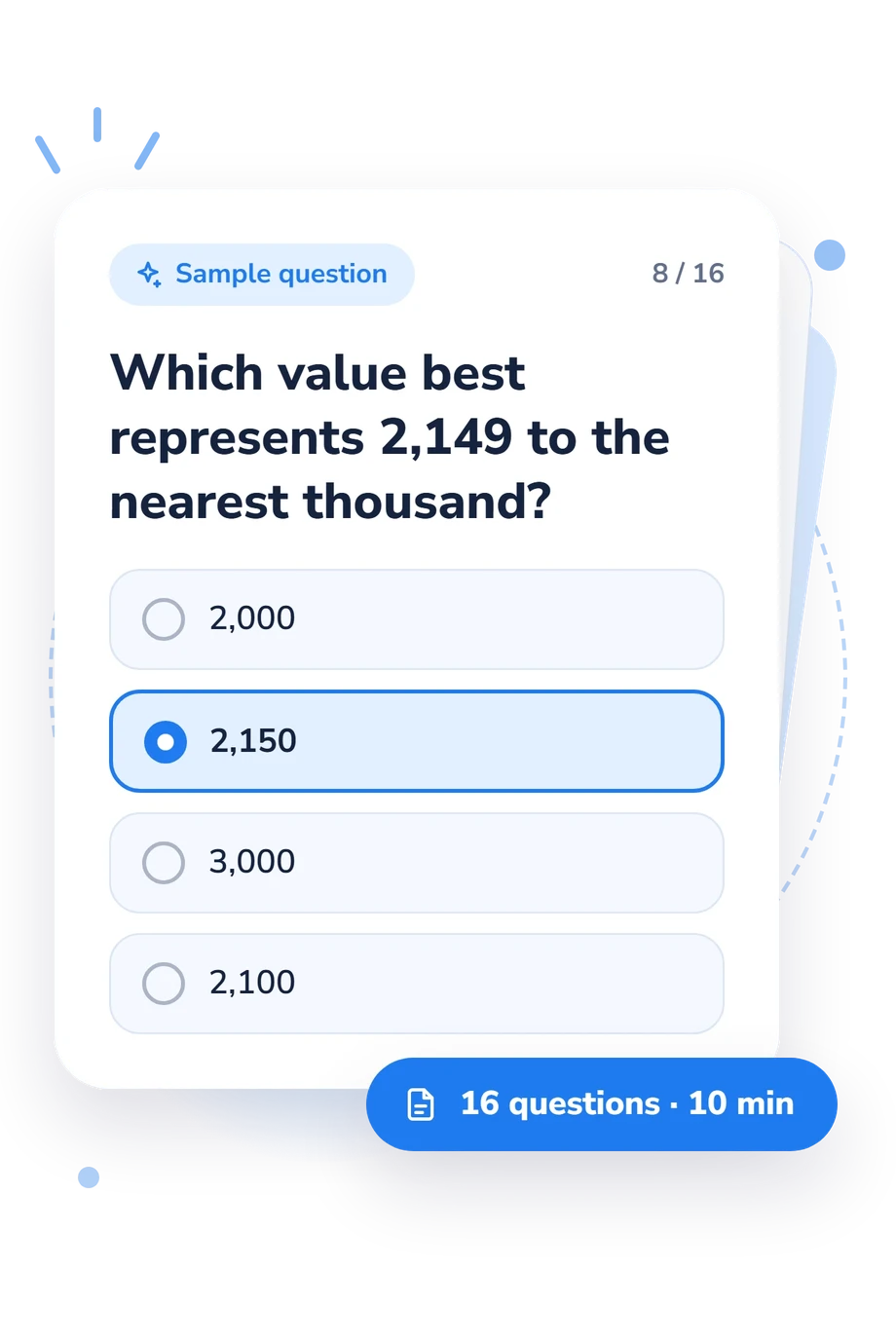
Each item presents a numerical situation with four answer choices. Tasks ask you to round to a specified place, set decimal precision, estimate a sum, identify the deciding digit, or compare an exact value with its approximation. This format tests procedure and interpretation.
The scoring display gives a total and places it in a named result band; it states no separate weighting or conversion rule. Interpretation should therefore follow the displayed total rather than inferred cutoffs.
The questionnaire is conceptually consistent with Hativa’s 1993 work on rounding and number sense. Mason and Zazkis (2019) explain why rounded values should not be treated as exact, while the Common Core mathematics standards provide the expected place-value and rounding context. It is not an adaptation or validation of these sources. As a rounding whole numbers quiz, it is useful for practising whole-number skills, while decimal examples broaden its coverage.
It is an online knowledge check; attention, familiarity with conventions, and performance on these place-value, decimal, estimation, and interpretation tasks can affect the result, which is best read as a focused snapshot of rounding skill.
- Hativa, Nira. (1993). Constructing conceptual knowledge and promoting "number sense" from computer-managed practice in rounding whole numbers. Mathematics Education Research Journal, 5(2), 124-151. 10.1007/BF03217191
- Mason, John, and Rina Zazkis. (2019). Fooled by Rounding. Digital Experiences in Mathematics Education, 5(3), 252-265. 10.1007/s40751-019-00055-2
- National Governors Association Center for Best Practices and Council of Chief State School Officers. (2010). Common Core State Standards for Mathematics. Washington, DC: National Governors Association Center for Best Practices and Council of Chief State School Officers.
Updated: