
Natural Resources Quiz
How the Scales are Structured
Who Usually Takes This Test?
See How You Compare
Below is a preview of how scores are typically distributed across each scale.
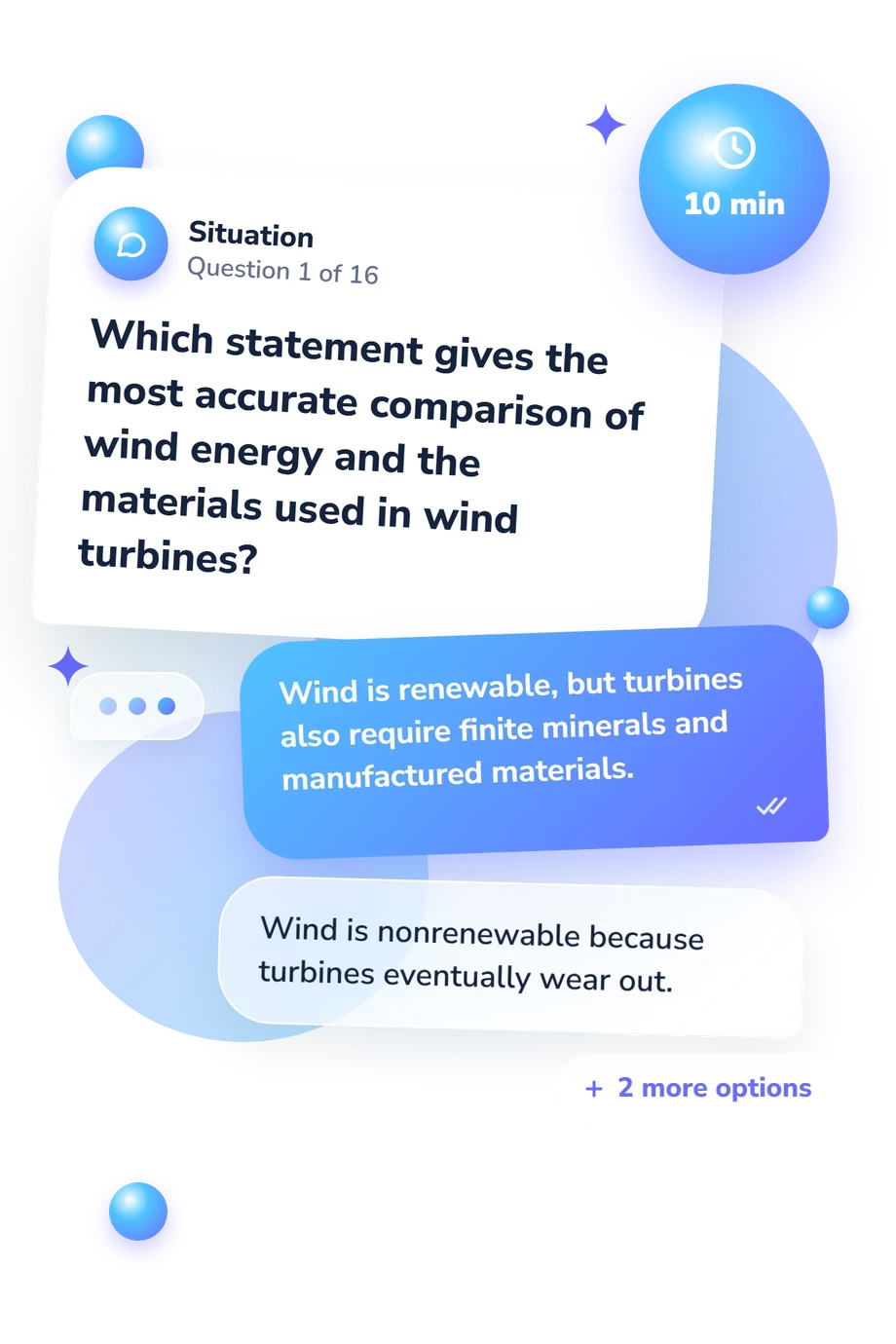
Example Questions From the Test
- Chemical energy in the panel becomes nuclear energy.
- Solar radiation is converted into electrical energy.
- Electrical energy from the grid becomes solar radiation.
- Thermal energy underground becomes electrical energy.
- Removing vegetation between growing seasons
- Ploughing straight downhill to drain water faster
- Using contour planting or terraces to slow runoff and retain soil
- Leaving the soil bare so it dries quickly
- Sunlight
- Wind
- Natural gas
- Flowing water
Natural Resources Quiz - Description and methodology of the test
For learners, educators, and environmentally curious readers, the natural resources quiz offers a focused way to examine practical understanding of how water, land, energy, materials, and ecosystems are used. It connects basic definitions with applied choices, showing how resource principles guide decisions about use, protection, and long-term availability. A natural resource knowledge test like this is most useful when its concepts are connected to decisions about consumption, conservation, and shared resources.
What This Assessment Explores
Questions target knowledge rather than personal attitudes. They distinguish renewable from nonrenewable resources, connect extraction with long-term consequences, and ask for management choices that protect future supply. Topics include water, forests, fisheries, soil, energy, and ecosystem services.
By asking respondents to apply resource-conservation principles in practical situations, this resource conservation assessment connects replenishment, depletion, efficiency, shared-resource pressures, and ecological benefits.
These are the main question themes contributing to the single knowledge score:
- Natural Resources Knowledge (0-16) measures understanding of natural resources and sustainable management: Foundations to build (0-6), Developing knowledge (7-12), or Strong knowledge (13-16).
- Renewability and depletion show whether use is judged against replenishment and formation rates.
- Conservation and sustainable management show whether choices protect future supply and habitats.
- Efficiency and ecosystem services show whether the respondent recognizes reduced demand, material recovery, and benefits supplied by ecosystems.
Methodology and Scientific Basis
Each item uses a factual or applied scenario followed by four answer choices. The respondent selects the option that best fits the environmental principle, so the format tests recognition and application rather than agreement. Its result summarizes performance across the knowledge items; read the displayed bands as knowledge levels, not as personality, motivation, or environmental virtue.
Conceptually, the questionnaire is consistent with Cordeiro and Sayler (1994), who examined environmental and natural-resource knowledge. It also shares a conceptual focus with sustainability knowledge assessment approaches discussed by Zwickle et al. (2014) and Kuehl et al. (2023). Those studies do not validate, norm, or establish the scoring of this online questionnaire; they address related environmental-resource knowledge contexts, not the validity, norms, or scoring of this test.
The displayed bands summarize performance on these items; they provide neither population comparison nor clinical interpretation. Results can vary with prior coursework, familiarity with terminology, attention, and the ability to recognize the best answer under test conditions. Use the score as a snapshot of current understanding, then follow uncertain areas into broader study or reflection.
- Cardeiro, Robert W., and Rodney D. Sayler. 1994. Student Knowledge of Environmental and Natural Resource Issues in the Pacific Northwest. Journal of Natural Resources and Life Sciences Education 23(2): 132-136. 10.2134/JNRLSE.1994.0132
- Zwickle, Adam, Tomas M. Koontz, Kristina M. Slagle, and Jeremy T. Bruskotter. 2014. Assessing sustainability knowledge of a student population. International Journal of Sustainability in Higher Education 15(4): 375-389. 10.1108/IJSHE-01-2013-0008
- Kuehl, Colin, Aaron C. Sparks, Heather Hodges, and Eric R. A. N. Smith. 2023. Exploring sustainability literacy: developing and assessing a bottom-up measure of what students know about sustainability. Frontiers in Sustainability 4: 1167041. 10.3389/frsus.2023.1167041
Updated: