
Thesis Statement Quiz
How the Scales are Structured
Who Usually Takes This Test?
See How You Compare
Below is a preview of how scores are typically distributed across each scale.
Example Questions From the Test
- Local governments should expand street-tree programs to reduce summer heat, manage stormwater, and improve pedestrian comfort in underserved neighborhoods.
- There are many reasons to discuss street trees in an essay.
- Local governments, trees, and streets are all important topics for communities.
- Street trees are trees planted beside streets by local governments and other groups.
- City A and City B both experience floods and have developed responses.
- Although both cities expanded drainage systems, City A emphasizes engineered barriers while City B combines drainage with restored wetlands, revealing different approaches to long-term resilience.
- This paper will compare flood management in two different cities.
- Flood management involves water, infrastructure, planning, and many other subjects.
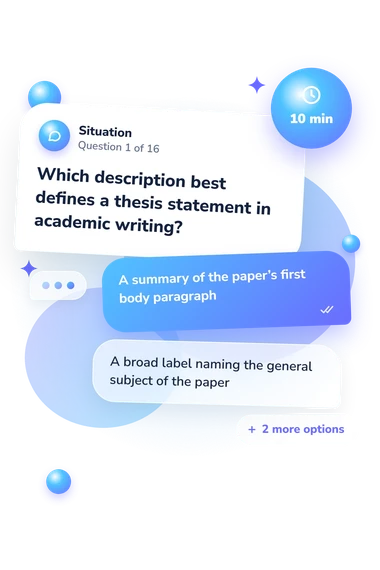
- A summary of the paper’s first body paragraph
- A broad label naming the general subject of the paper
- A list of every source that will appear in the paper
- A focused claim that expresses the paper’s central position or controlling insight
Thesis Statement Quiz - Description and methodology of the test
Students and writers who want to judge the quality of an academic claim can use this thesis statement quiz to practise a specific skill: recognizing a focused, arguable position and matching it to evidence and paragraph structure. Your thesis quiz result can reveal strengths in thesis construction and indicate what to revise before drafting or submitting an essay.
What This Assessment Explores
These questions distinguish a central claim from a topic label, announcement, summary, or fact. They test whether a statement is focused, arguable, properly qualified, supported by evidence, and aligned with an essay’s structure, including when research or drafting requires revision.
For learners practising argumentative or analytical writing, this academic thesis quiz presents familiar classroom decisions rather than isolated definitions.
One displayed scale, Thesis Statement Knowledge, runs from 0-16 across three result bands:
- Foundation to Build (0-6) indicates a need to separate focused claims from topics, facts, and announcements.
- Developing Command (7-12) shows growing understanding with further practice needed in scope, evidence, qualification, and revision.
- Strong Command (13-16) reflects consistent recognition and application of effective thesis features.
Methodology and Evidence Base
Each item offers four answer choices and asks you to select the strongest definition, thesis, revision, or match between a claim and an essay’s structure. One point goes to each correct answer, so the total reflects the writing decisions sampled here, not a personality trait or clinical condition.
The content is conceptually consistent with Miller and Pessoa (2016), whose study addresses thesis statements, topic sentences, and organization in undergraduate argument writing. It also connects with Booth and colleagues’ research-writing guidance and Toulmin’s model of supported, qualified claims. The questionnaire is not an adaptation or standardized administration of these works; they supply a conceptual frame, not validation of this online version.
The result is best read as a snapshot of how you handle common academic-writing judgments at completion. In this thesis statement test, the bands are performance descriptions, not population norms or proof of writing ability in every context. Self-administered multiple-choice results can be influenced by attention, prior instruction, terminology, and the limited situations represented. Use the outcome to choose practice, then test those skills in your own drafts.
- Miller, Ryan T., and Silvia Pessoa. “Where’s Your Thesis Statement and What Happened to Your Topic Sentences? Identifying Organizational Challenges in Undergraduate Student Argumentative Writing.” TESOL Journal 7, no. 4 (2016): 847-873. 10.1002/tesj.248
- Booth, Wayne C., Gregory G. Colomb, Joseph M. Williams, Joseph Bizup, and William T. FitzGerald. The Craft of Research. 5th ed. Chicago: University of Chicago Press, 2024.
- Toulmin, Stephen E. The Uses of Argument. Cambridge: Cambridge University Press, 1958. 10.1017/CBO9780511840005
Updated: