
Orchid vs Dandelion Quiz
How the Scales are Structured
Who Usually Takes This Test?
See How You Compare
Below is a preview of how scores are typically distributed across each scale.
Example Questions From the Test
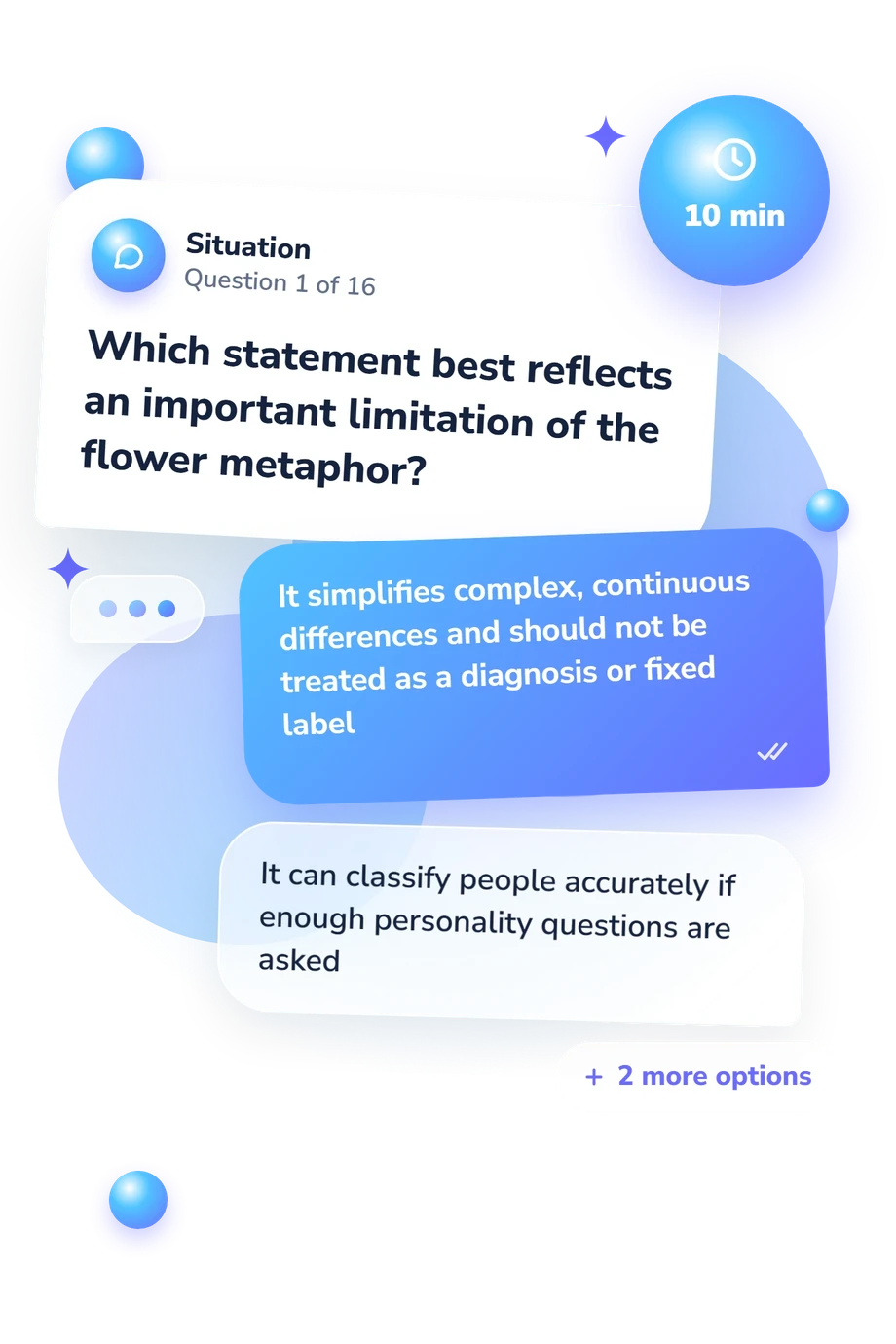
- It simplifies complex, continuous differences and should not be treated as a diagnosis or fixed label
- It can classify people accurately if enough personality questions are asked
- It describes two medically recognized conditions with standard diagnostic criteria
- It applies only to children and has no relevance to later development
- The student is an orchid because noise sensitivity is sufficient for classification
- The student has a psychological disorder that explains the reaction
- The student is generally unable to cope with demanding environments
- Very little about overall environmental sensitivity; context and repeated patterns would be needed
- Fixed intelligence
- Classical conditioning
- Environmental sensitivity
- Attachment classification
Orchid vs Dandelion Quiz - Description and methodology of the test
People seeking an introduction to environmental sensitivity can use the orchid vs dandelion quiz to check whether they understand the model rather than merely recognize its labels. It suits readers exploring child development, parenting, education, or reactions to changing circumstances. For readers learning how the orchid metaphor applies to children, this environmental sensitivity quiz checks their understanding of the ideas without assigning a flower type to a person.
What This Assessment Explores
The questionnaire tests whether readers can apply the flower metaphor, especially the idea that environmental sensitivity can amplify responses to difficult and supportive conditions. As a knowledge quiz about the differential susceptibility framework, it measures understanding of the model rather than personal sensitivity.
Its questions examine these connected themes:
- Environmental sensitivity covers responsiveness to relationships, stressors, resources, culture, and physical surroundings.
- Differential susceptibility means greater sensitivity can bring more difficulty in adverse settings and more benefit in supportive ones.
- The flower labels are simplified metaphors, so one reaction cannot establish a stable category, disorder, or fixed personality.
The result indicates how clearly the reader understands these distinctions: a higher band reflects command of the model, not personal sensitivity. It suits students, parents, educators, and curious adults comparing their grasp of supportive and difficult contexts.
Methodology and Evidence Base
Its orchid vs dandelion test format uses single-best-answer questions with four response options. The alternatives distinguish careful interpretations from overstatements, such as treating one event as proof of a flower type or resilience as immunity to stress. The displayed score is the Orchid vs Dandelion Knowledge scale, ranging from 0-16. Its bands are Foundations to build (0-6), Developing understanding (7-12), and Strong understanding (13-16). They describe quiz knowledge only, not a person’s flower type or psychological profile.
The evidence base includes the 2018 study by Lionetti and colleagues, which discusses low-, medium-, and high-sensitivity patterns, plus the 2005 study by Boyce and Ellis and the 2007 study by Belsky and colleagues on heightened responses to environmental context. The questionnaire is conceptually consistent with those publications, not an adaptation or validation of them.
Interpretation should stay close to the concepts tested: the result indicates how well the respondent recognized the model’s careful distinctions. Performance may reflect prior reading, language comprehension, and familiarity with research terminology, so the bands describe understanding rather than environmental reactivity.
- Lionetti, Francesca, Arthur Aron, Elaine N. Aron, G. Leonard Burns, Jadzia Jagiellowicz, and Michael Pluess. "Dandelions, tulips and orchids: evidence for the existence of low-sensitive, medium-sensitive and high-sensitive individuals." Translational Psychiatry 8 (2018), article 24. 10.1038/s41398-017-0090-6
- Boyce, W. Thomas, and Bruce J. Ellis. "Biological sensitivity to context: I. An evolutionary-developmental theory of the origins and functions of stress reactivity." Development and Psychopathology 17, no. 2 (2005): 271-301. 10.1017/S0954579405050145
- Belsky, Jay, Marian J. Bakermans-Kranenburg, and Marinus H. van IJzendoorn. "For Better and For Worse: Differential Susceptibility to Environmental Influences." Current Directions in Psychological Science 16, no. 6 (2007): 300-304. 10.1111/j.1467-8721.2007.00525.x
Updated: