
2010s Music Quiz
How the Scales are Structured
Who Usually Takes This Test?
See How You Compare
Below is a preview of how scores are typically distributed across each scale.
Example Questions From the Test
- We Found Love
- Only Girl (In the World)
- Where Have You Been
- Stay
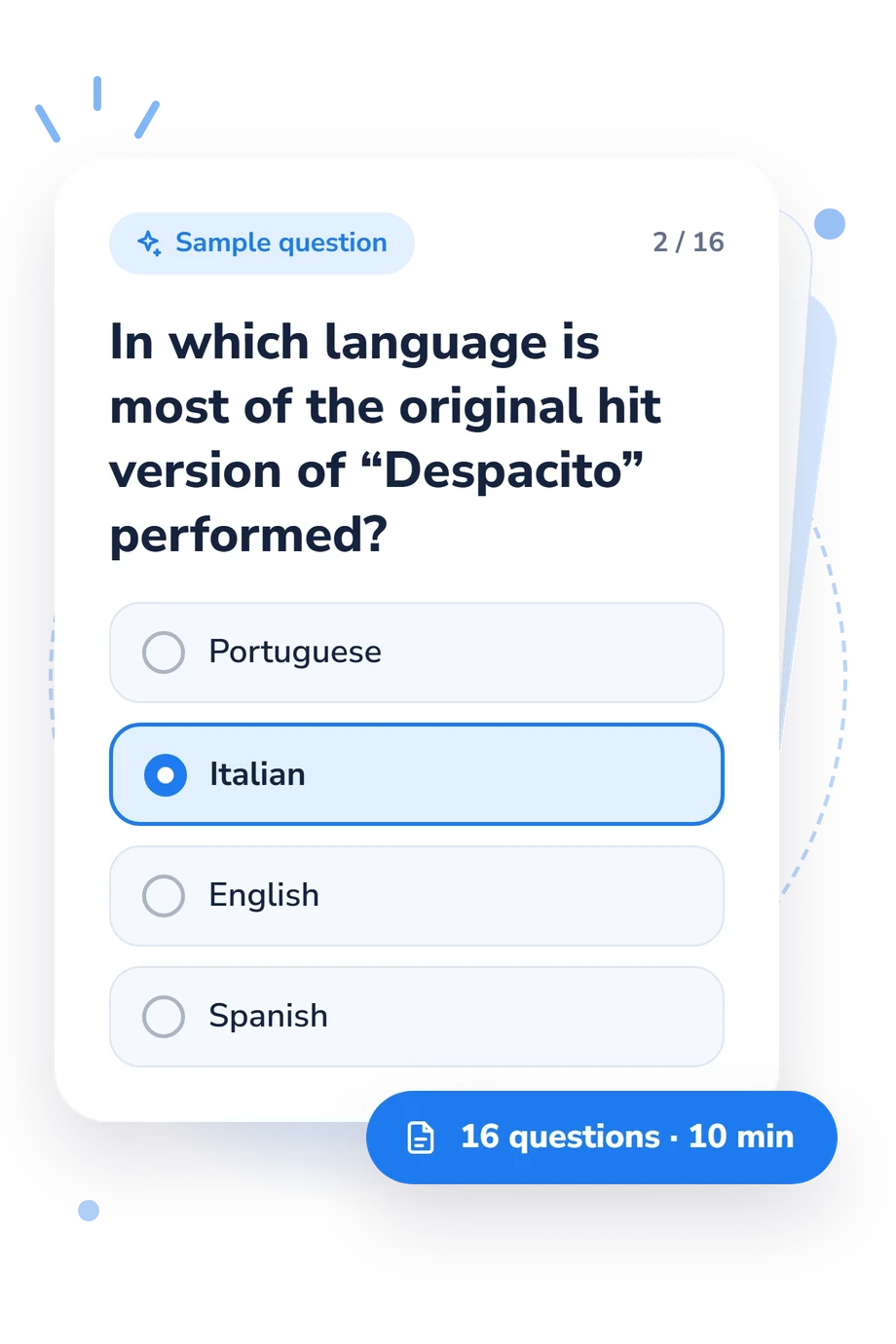
- Portuguese
- Italian
- English
- Spanish
- The Weeknd
- Bruno Mars
- Justin Timberlake
- Pharrell Williams
2010s Music Quiz - Description and methodology of the test
Listeners who want to revisit a defining decade can use this assessment to gauge how confidently familiar 2010s material comes to mind, including its music milestones. The 2010s music quiz is intended for anyone whose playlists include mainstream pop, hip-hop, dance, R&B, and crossover hits. Its 2010s song quiz format gives listeners a focused profile of decade recall, whether they followed chart music closely or are revisiting it later.
What This Assessment Explores
Rather than measuring taste or opinion, the questionnaire tests recognition of 2010s music. Items connect lyrics, voices, performers, albums, release timing, and milestones with the correct answer. Its 2010s music trivia format gives listeners a quick profile of decade recall, whether they followed chart music closely or are revisiting it later.
The result has one dimension, 2010s Music Knowledge (0-16): Foundation: 0-6; Developing: 7-12; Strong: 13-16. These bands describe breadth and accuracy across songs, lyrics, performers, albums, and music milestones, not musical taste.
The item themes contributing to that profile are:
- Lyric recognition shows whether memorable lines lead you to the right song.
- Performer recognition shows whether you connect a recording with its singer.
- Album and timeline context indicates how well you place tracks within the decade.
- Milestones and crossover knowledge reflects recall of videos, collaborations, and genre blends.
Methodology and Scientific Basis
Each item presents four answer choices and asks for a song, artist, singer, album, language, release position, or milestone. The four-choice format spans the full decade, making this test of 2010s music a structured measure of recognition across several kinds of musical information. The displayed score summarizes performance across the set; the questionnaire does not state how answers are weighted.
The questionnaire is conceptually consistent with McKellar and Cohen (2015), whose research shows how brief musical excerpts can be identified through learned familiarity. Spivack and colleagues (2019) provide a collective-memory perspective on why some popular songs remain more widely recognized than others, while Krumhansl (2017) connects familiarity with listening habits and cultural exposure across time. These sources support the recognition-and-memory framework, but they do not standardize or validate this questionnaire.
Interpret the outcome as a snapshot of recall shaped by listening history, language, cultural exposure, and current context. Fixed choices allow guessing, and unequal exposure to genres can affect performance; a strong result indicates accurate recognition of the clues, not general musicianship.
- McKellar, Jessica Lynn, and Annabel J. Cohen. "Identification of Thin Slices of Music by University Students in Prince Edward Island." Canadian Acoustics: Journal of the Canadian Acoustical Association, vol. 43, no. 3, 2015, pp. 88-89.
- Spivack, Stephen, Sara Jordan Philibotte, Nathaniel Hugo Spilka, Ian Joseph Passman, and Pascal Wallisch. "Who remembers the Beatles? The collective memory for popular music." PLoS ONE, vol. 14, no. 2, 2019, e0210066. 10.1371/journal.pone.0210066
- Krumhansl, Carol Lynne. "Listening Niches across a Century of Popular Music." Frontiers in Psychology, vol. 8, 2017, article 431. 10.3389/fpsyg.2017.00431
Updated: