
What Type of Life Coach Should I Be Quiz
How the Scales are Structured
Who Usually Takes This Test?
See How You Compare
Below is a preview of how scores are typically distributed across each scale.
Example Questions From the Test
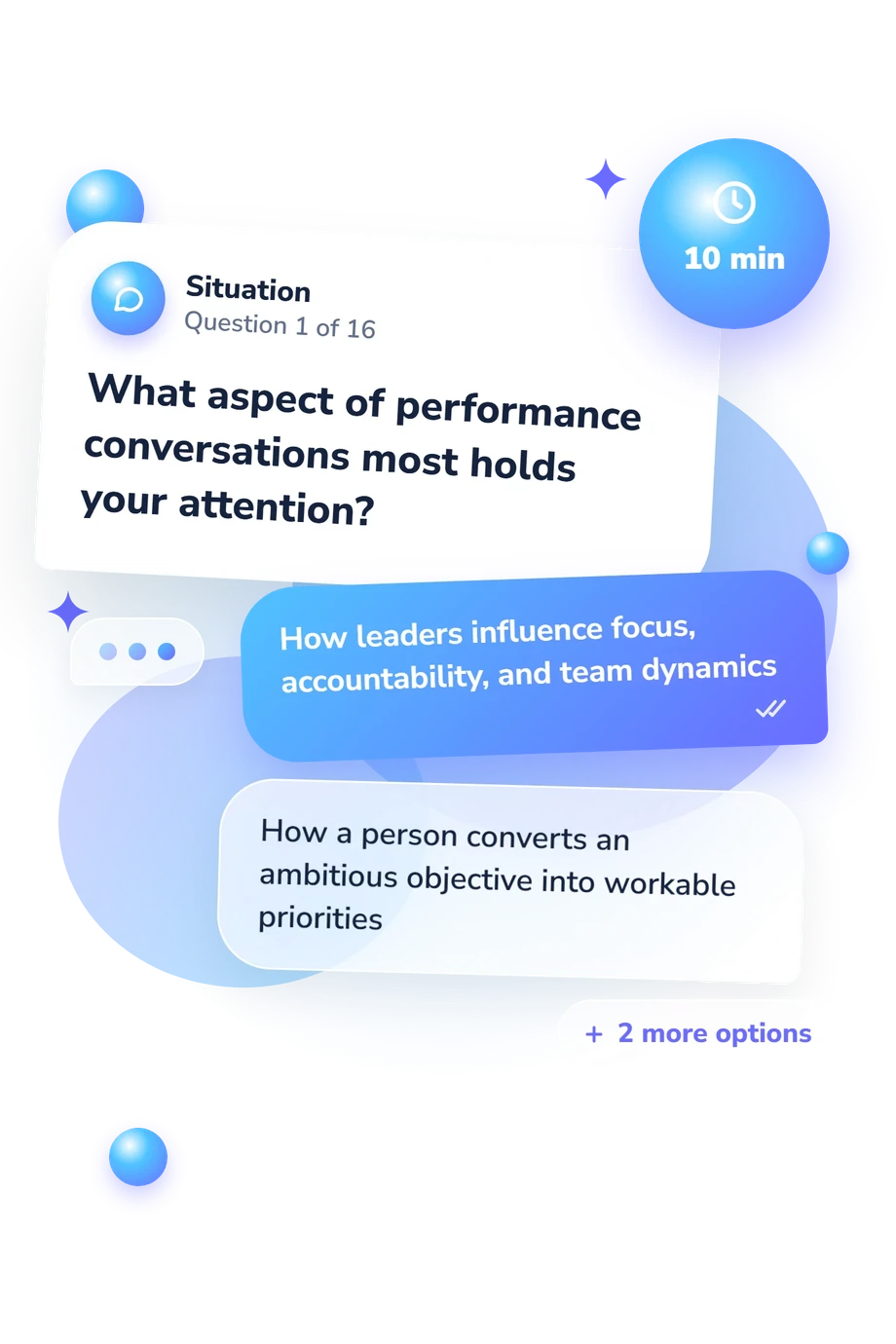
- How leaders influence focus, accountability, and team dynamics
- How a person converts an ambitious objective into workable priorities
- How confidence affects whether someone speaks up
- How personal routines support consistency away from work
- A director preparing to lead a team through a major change
- A manager balancing strategic priorities with urgent demands
- A professional considering a move into a different career
- An individual redesigning their weekend wellness habits
- How people choose careers that match their strengths
- How habits become easier through cues and environment
- How expectations and boundaries shape close relationships
- How a difficult conversation can be prepared for and structured
What Type of Life Coach Should I Be Quiz - Description and methodology of the test
People considering coaching as a professional direction can use the What Type of Life Coach Should I Be Quiz to identify which client themes feel most engaging. This life coach quiz offers a structured way to reflect on preferred problems, conversations, and kinds of change. Results are most useful when compared with your training, experience, and the work you want to build.
What This Assessment Explores
The questions cover work choices, team influence, communication, boundaries, routines, and behavior change. Anyone exploring coaching can use the profile to notice which client themes attract their interest and reflect on a possible life coaching niche.
The four outcome scales are:
- Career & Transition Coach (0-12) measures interest in helping with work choices and transitions.
- Leadership & Performance Coach (0-12) reflects interest in leading teams, setting priorities, and sustaining execution.
- Relationship & Communication Coach (0-12) indicates attraction to communication, boundaries, and recurring interaction patterns.
- Wellness & Habit Coach (0-12) captures interest in practical behavior change and sustainable routines.
All four use the same displayed bands: Secondary interest 0-4, Promising option 5-8, and Strong affinity 9-12. Secondary interest may complement another niche; Promising option shows meaningful interest; Strong affinity marks consistent attraction.
Methodology and Scientific Basis
This coaching career quiz is a self-report preference profile. Each item presents a coaching situation with four possible directions for attention or intervention, showing what the respondent would notice, explore, or help a client practise. The format compares four outcome scores rather than assigning one type.
The highest result marks strongest current affinity, and any outcome within one point contributes to a blended direction. The profile reflects interest, not competence, certification, or guaranteed effectiveness.
Career themes are conceptually consistent with Hatala and Hisey’s career coach competency model, while wellness themes align with the Well-Being Coaching Inventory developed by Harenberg and colleagues. This questionnaire is not presented as an adaptation of those sources.
Because it measures preferences in hypothetical situations, answers can shift with current goals, experience, mood, or self-perception. It can help sketch a possible coaching direction, but it does not establish credentials, competence, or likely business success; use it alongside reflection and practical exploration.
- International Coaching Federation. (2023). 2023 ICF Global Coaching Study. Lexington, KY: International Coaching Federation.
- Hatala, John-Paul, and Lee Hisey. (2011). Toward the development and validation of a career coach competency model. Performance Improvement Quarterly, 24(3), 101-122. 10.1002/piq.20117
- Harenberg, Sebastian, Gary Sforzo, Rosie Hunter, Erika Jackson, and Margaret Moore. (2025). The Well-Being Coaching Inventory (WCI): Questionnaire Development and Validation. American Journal of Lifestyle Medicine, 19(6), 908-925. 10.1177/15598276251320573
Updated: