
8th Grade Science Quiz
How the Scales are Structured
Who Usually Takes This Test?
See How You Compare
Below is a preview of how scores are typically distributed across each scale.
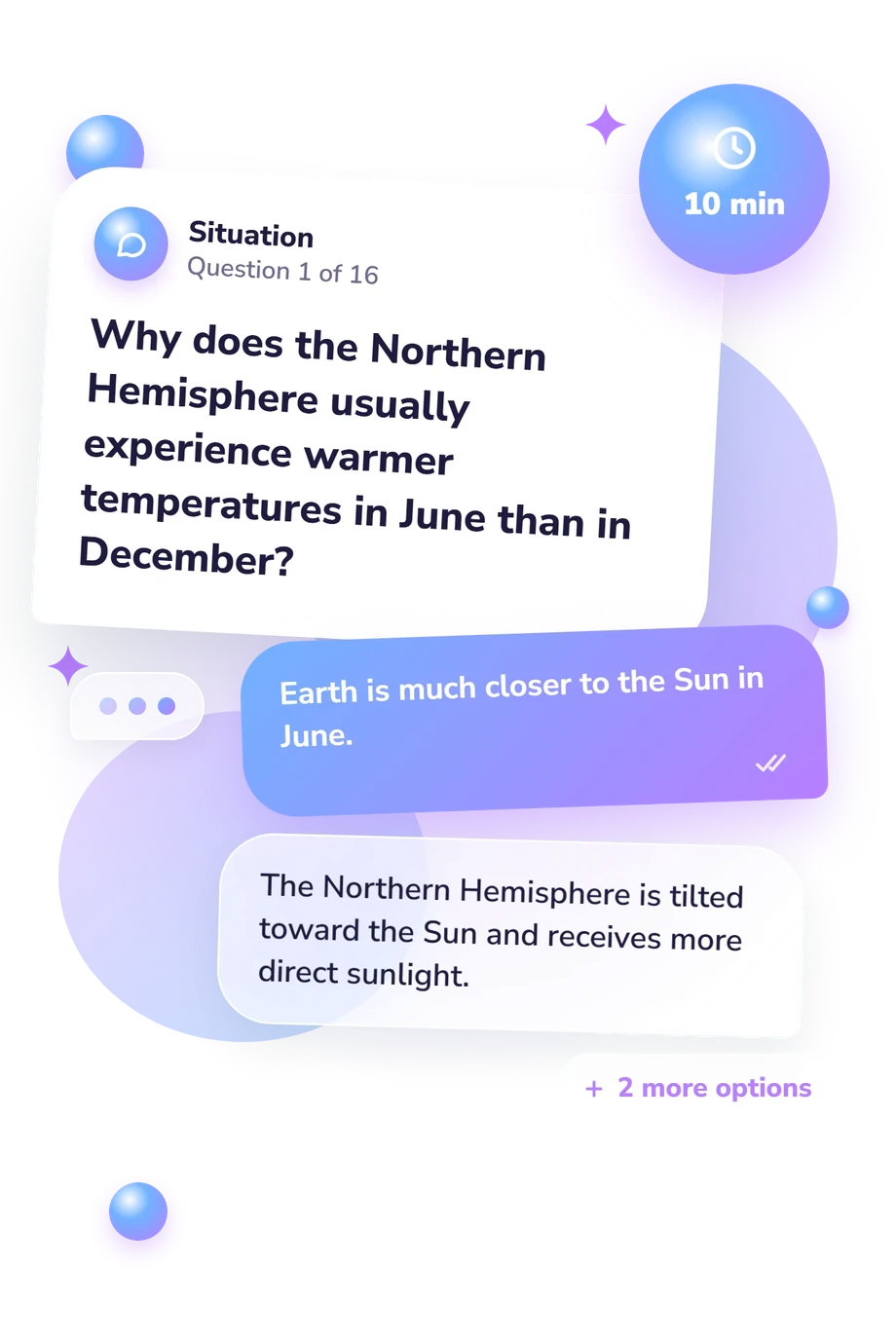
Example Questions From the Test
- It becomes a negatively charged ion.
- It becomes a positively charged ion.
- Its atomic number increases by one.
- Its nucleus loses one proton.
- Metamorphic rock
- Sedimentary rock
- Igneous rock
- Weathered rock
- Evaporation
- Precipitation
- Condensation
- Sublimation
8th Grade Science Quiz - Description and methodology of the test
For learners checking their middle-school science understanding, the 8th grade science quiz offers a focused way to connect classroom concepts with short reasoning tasks. Students, families, and educators can use this eighth grade science quiz to identify ideas that feel secure and topics that deserve review. The broad result helps learners choose which concepts to revisit and recognize areas where their understanding is already strong.
What This Assessment Explores
Across the items, the test samples Earth and space science, physical science, life science, and scientific reasoning. Situations address seasons, density, atoms, rocks, forces, cells, inheritance, ecosystems, plate motion, chemical change, and experimental variables. Learners combine factual recall with application, explanation, prediction, and simple calculation.
Learners can use questions and answers from this 8th-grade science quiz to practice applying concepts; uncertain responses can guide review without promising answer explanations. Results are a snapshot of sampled knowledge, not every science unit.
The displayed result uses the 8th Grade Science Knowledge scale (0-16), with three bands:
- Building Foundations (0-6) indicates that core ideas are emerging and review of vocabulary, models, or cause-and-effect relationships may help.
- Developing Knowledge (7-12) shows understanding of many concepts, with uncertain topics worth revisiting.
- Strong Knowledge (13-16) reflects solid command of the sampled concepts and their application.
Methodology and Scientific Basis
Each item presents a science situation and four answer choices. The learner selects the best explanation, prediction, process, or calculation, combining content knowledge with scientific reasoning. As an online science quiz for class 8, this test checks classroom learning through applied examples rather than timed performance.
The result is mapped to the displayed bands; no percentile, age-based norm, or domain-specific score is supplied. As a science quiz for grade 8, this test can identify review priorities by showing which concepts merit another look.
Content choices are conceptually consistent with the TIMSS 2019 Science Framework, which connects science content with cognitive practices. They also correspond to frameworks used by the National Assessment Governing Board and the National Research Council. The questionnaire's topics and reasoning emphasis are conceptually consistent with these named frameworks.
Prior instruction, wording familiarity, concentration, and guessing may affect scores, and a short sample cannot represent every grade-level standard. Read the broad band alongside classroom work, then connect it with concepts such as forces, cells, or experimental variables to select review topics and decide which ideas need more practice.
- Centurino, Victoria A. S., and Lee R. Jones. (2017). TIMSS 2019 Science Framework. In Ina V. S. Mullis and Michael O. Martin (Eds.), TIMSS 2019 Assessment Frameworks (pp. 27-56, Chapter 2). Chestnut Hill, MA: TIMSS & PIRLS International Study Center, Boston College.
- National Assessment Governing Board. (2019). Science Framework for the 2019 National Assessment of Educational Progress. Washington, DC: National Assessment Governing Board.
- National Research Council. (2012). A Framework for K-12 Science Education: Practices, Crosscutting Concepts, and Core Ideas. Washington, DC: The National Academies Press. 10.17226/13165.
Updated: