
What YA Book Should I Read Quiz
How the Scales are Structured
Who Usually Takes This Test?
See How You Compare
Below is a preview of how scores are typically distributed across each scale.
Example Questions From the Test
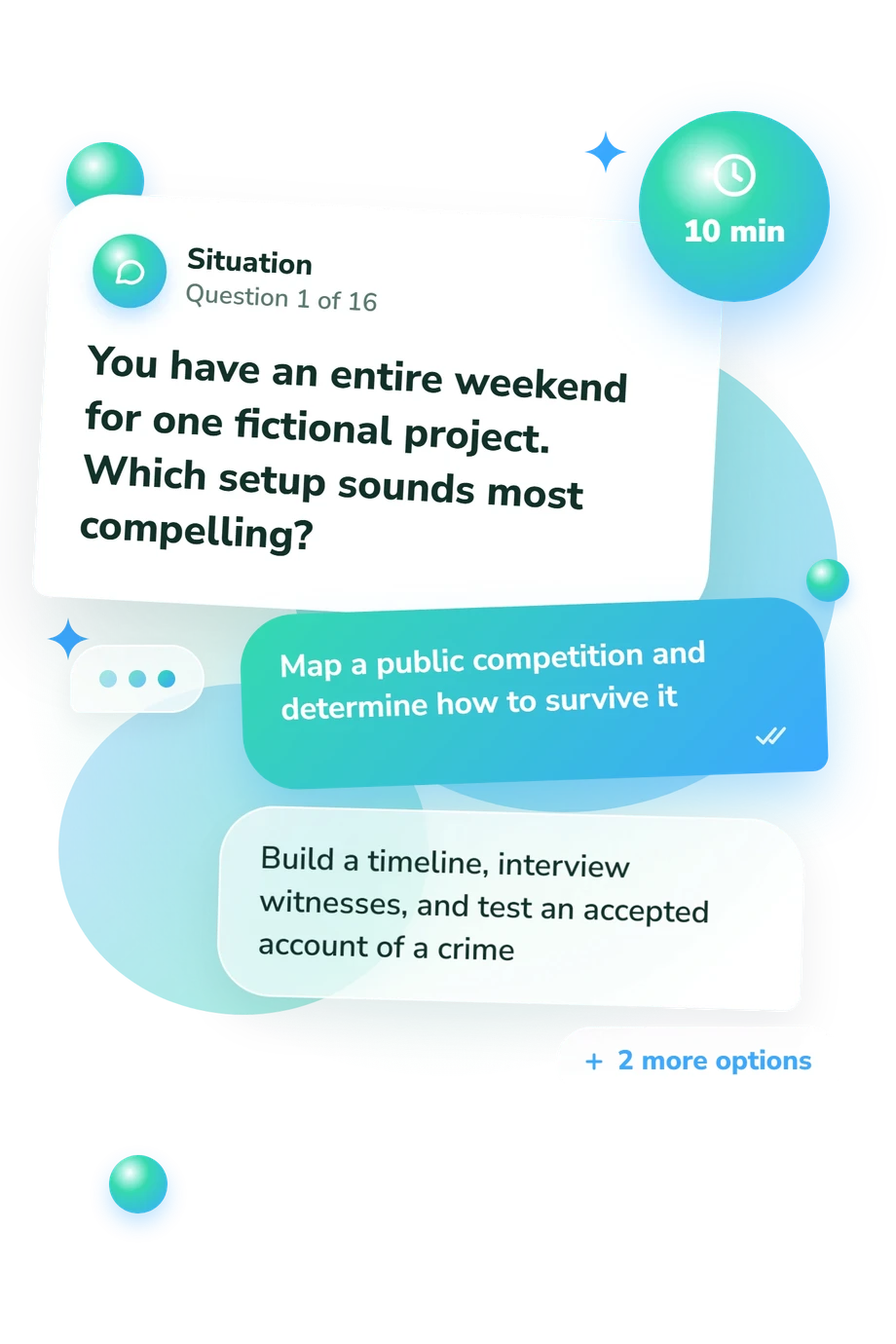
- Map a public competition and determine how to survive it
- Build a timeline, interview witnesses, and test an accepted account of a crime
- Recruit experts for a theft that everyone considers impossible
- Explore a city with someone you have only just met
- Follow a stranger through the city while a surprising connection develops
- Search several locations for evidence tied to an unresolved case
- Gather a team and study the security around a valuable target
- Prepare for a public confrontation with a powerful authority
- Detailed clue analysis interrupted by difficult witness interviews
- Sharp crew banter woven through an elaborate operation
- Romantic chemistry mixed with debates about fate, science, and identity
- Personal feelings emerging during urgent, dangerous action
What YA Book Should I Read Quiz - Description and methodology of the test
Readers choosing among specific story ingredients can use the What YA Book Should I Read Quiz to compare how strongly four named titles fit their preferences, from clue work and crew strategy to survival decisions and intimate conversation.
As a YA reading recommendation quiz, it clarifies whether pacing, viewpoint structure, moral pressure, or relationship-focused dialogue matters most before a reader chooses between these books.
What This Assessment Explores
The questionnaire compares story ingredients rather than assigning a fixed identity. Its YA book quiz format considers pacing, protagonists, tension, themes, viewpoints, and endings across four named books.
The four title-specific affinity scores are:
- A Good Girl's Guide to Murder (0-12) measures affinity for methodical amateur investigation, with Different shelf 0-4, Possible match 5-8, and Strong match 9-12.
- Six of Crows (0-12) measures affinity for a multi-viewpoint heist with found-family tension and magic, with Different shelf 0-4, Possible match 5-8, and Strong match 9-12.
- The Hunger Games (0-12) measures affinity for strategic survival under moral pressure, with Different shelf 0-4, Possible match 5-8, and Strong match 9-12.
- The Sun Is Also a Star (0-12) measures affinity for a dialogue-led one-day romance involving fate, science, culture, and family expectations, with Different shelf 0-4, Possible match 5-8, and Strong match 9-12.
Methodology and Evidence Base
Each prompt in this young adult book quiz presents four choices about a story setup, pace, protagonist, relationship, tension, or ending. Selecting the most appealing option creates a structured self-report comparison across the four title-specific scores, rather than testing recall, literary knowledge, or ability.
Interpret the displayed results as comparative indications of fit: closer alignment means that more of the associated story ingredients appealed in these choices, while weaker alignment means less appeal. Several books may therefore emerge as plausible matches, without guaranteeing one next read.
The adolescent book-choice study by Wilkinson and colleagues links book selection with enjoyment, identity, context, and reasons for choosing or avoiding books. Birdi’s study of genre-fiction readers supports examining reading preferences through structured construct ratings. This questionnaire is conceptually consistent with both studies, not an adaptation of either, and those findings do not validate its scores.
Because it is self-report, results may shift with mood, recent reading, title familiarity, and self-awareness; they capture preferences at one moment rather than a stable reading profile.
- Katherine Wilkinson, Valentina Andries, Danielle Howarth, Jane Bonsall, Shari Sabeti, and Sarah McGeown. 2020. “Reading During Adolescence: Why Adolescents Choose (or Do Not Choose) Books.” Journal of Adolescent & Adult Literacy, 64(2), 157-166. 10.1002/jaal.1065
- Briony Birdi. 2014. “Genre fiction readers: a quantitative exploration of provided construct ratings.” Journal of Documentation, 70(6), 1054-1075. 10.1108/JD-02-2014-0039
Updated: