
Baby Boomer Quiz
How the Scales are Structured
Who Usually Takes This Test?
See How You Compare
Below is a preview of how scores are typically distributed across each scale.
Example Questions From the Test
- The Korean War armistice in 1953
- The Woodstock festival in 1969
- The Challenger disaster in 1986
- The fall of the Berlin Wall in 1989
- 2011
- 2001
- 2006
- 2016
- 1945
- 1964
- 1978
- 1980
Baby Boomer Quiz - Description and methodology of the test
Readers who want a focused way to revisit U.S. postwar history can use this assessment to check recognition of the generation’s defining context. The baby boomer quiz is suited to learners, trivia enthusiasts, and anyone reviewing twentieth-century events. As a baby boomer history test, it shows how confidently you connect demographic change with politics, culture, technology, and public life.
What This Assessment Measures
This assessment measures knowledge of the U.S. baby boom and the historical setting in which the generation came of age. Questions about baby boomer history cover birth years, demographics, politics, civil rights, war, education, popular culture, energy, work, and voting; they also test chronology, causation, and policy recognition.
The main themes represented by the items are:
- Demography and chronology place the generation within its birth range and timeline.
- Politics and social change cover rights, institutions, civic events, and public responses.
- Culture and technology cover music, media, space, energy, and workplace change.
The displayed scale is Baby Boomer Knowledge, scored from 0-16. Building Foundations (0-6) means you recognize some era features but may need to strengthen its timeline and turning points. Developing Knowledge (7-12) reflects a useful grasp with gaps among politics, culture, and social change. Strong Knowledge (13-16) indicates a well-developed understanding of associated events and chronology.
Methodology and Evidence Base
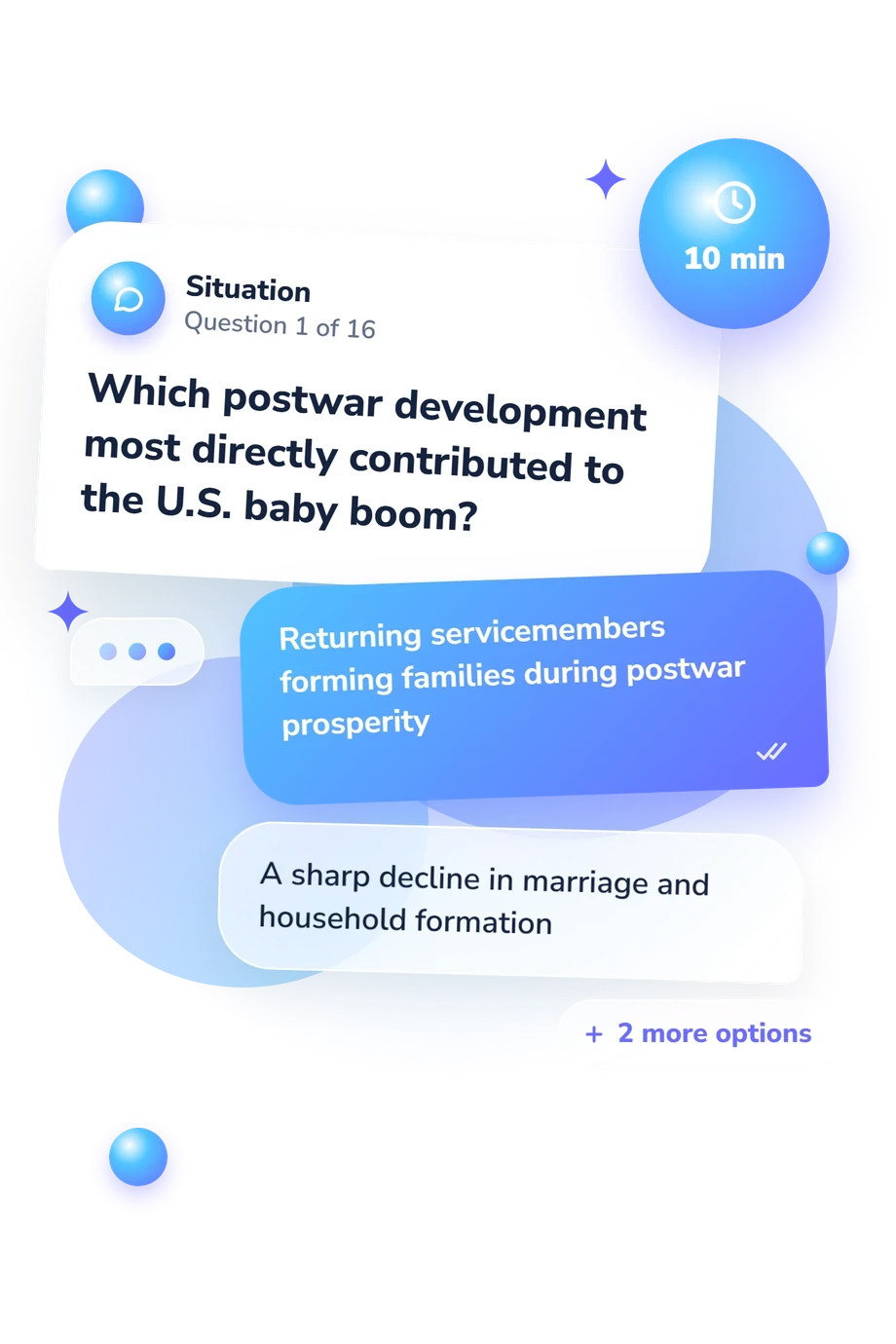
Each item presents a historical question with four answer choices. The method is objective knowledge testing: the score counts correct answers and maps the total to the displayed result band. It tests recall, chronology, causation, and comparison rather than personality or identity.
As a baby boomer knowledge test, it checks historical connections. Gillon (2004) provides the closest broad account of the generation’s demographic scale and social influence. Easterlin (1961) supplies context for the postwar birth increase, Bouk (2018) examines how population research defined the category, and Russell and Whalley (2019) support the inclusion of film and popular culture.
Together, these works support the subject framing, but the online questionnaire is not an adaptation or standardized administration of any one of them.
Interpretation should stay specific to these items. A high result indicates stronger performance on the tested material, while a lower result identifies topics for review rather than a fixed ability. Education, age, media exposure, memory, and cultural familiarity can affect answers. Because this version has no reported norms, reliability estimates, or validation data, it is best used as a concise historical self-check.
- Gillon, Steve. Boomer Nation: The Largest and Richest Generation Ever, and How It Changed America. New York: Free Press, 2004. ISBN: 9780743229470.
- Bouk, Dan. “Generation Crisis: How Population Research Defined the Baby Boomers.” Modern American History 1, no. 3 (2018): 321-342. 10.1017/mah.2018.31.
- Easterlin, Richard A. “The American Baby Boom in Historical Perspective.” American Economic Review 51, no. 5 (1961): 869-911. JSTOR stable 1813841.
- Russell, James, and Jim Whalley. Hollywood and the Baby Boom: A Social History. New York: Bloomsbury Academic, 2019. ISBN: 9781501353901.
Updated: