
Operating Systems Quiz
How the Scales are Structured
Who Usually Takes This Test?
See How You Compare
Below is a preview of how scores are typically distributed across each scale.
Example Questions From the Test
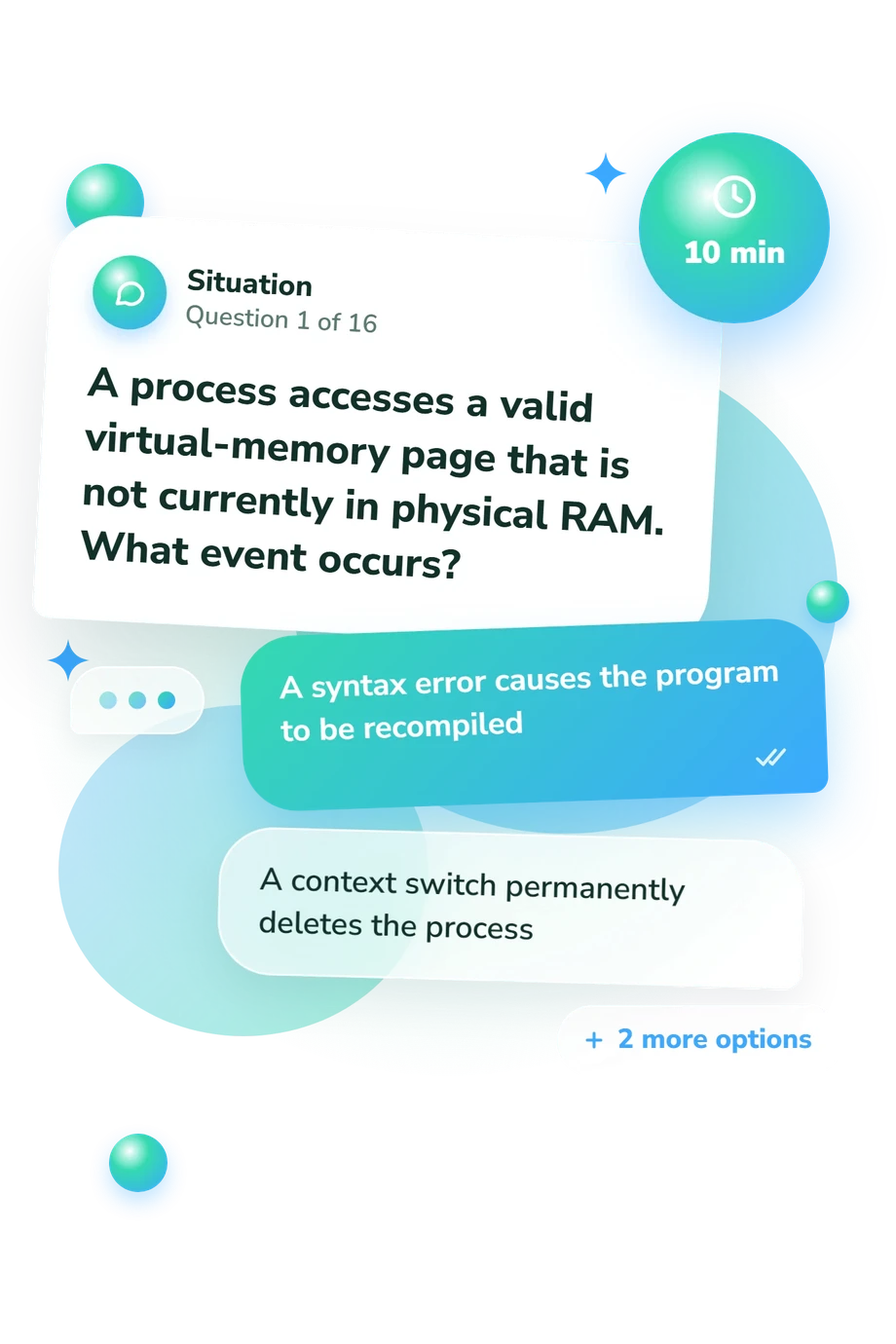
- A syntax error causes the program to be recompiled
- A context switch permanently deletes the process
- A page fault lets the operating system bring the required page into RAM
- A boot failure forces the computer to restart
- Selecting which process receives the next CPU time slice
- Translating source code into processor instructions
- Assigning network addresses to devices on a local network
- Organizing named files and directories on a storage device
- Their CPU registers and current instruction pointers
- Their individual call stacks and local stack frames
- The process's code, heap data, and open resources
- Their unique thread identifiers and scheduling states
Operating Systems Quiz - Description and methodology of the test
People learning computer architecture, preparing for systems coursework, or revisiting technical fundamentals can use this operating systems quiz to see whether familiar terms connect into a working model. This operating system online quiz suits students and self-directed learners who want a focused review. The result places overall knowledge in a broad band, giving learners a general sense of their current grasp of operating-system fundamentals.
What This Assessment Explores
The questionnaire checks how an operating system mediates between applications and hardware. It covers system calls, booting, file systems, permissions, interrupts, device access, scheduling, context switches, virtual memory, page faults, fragmentation, threads, semaphores, and deadlock prevention. Across this OS quiz, the items test whether familiar terms connect into mechanisms used in real computing situations.
The reported scale is Operating Systems Knowledge (0-16), which uses correct answers to represent command of core operating-system ideas rather than general intelligence or programming ability. The result is grouped into three bands:
- Foundations to build (0-6) indicates that core hardware, memory, file, and process concepts need more review.
- Developing knowledge (7-12) shows solid system basics with gaps in concurrency, protection, or memory management.
- Strong knowledge (13-16) reflects reliable understanding that transfers to common technical situations.
Methodology and Scientific Basis
The format presents operating system quiz questions with answers among four available choices, covering system roles, booting, memory, protection, scheduling, files, interrupts, and synchronization. Each item asks the learner to identify the mechanism that fits a short systems scenario. Scoring is direct: each correct response earns one point, while guessing and familiarity with terminology can affect the result.
Conceptually, the questionnaire is consistent with Operating Systems Concept Inventory (Webb & Taylor, 2014), but it remains a separate online questionnaire rather than a documented adaptation or restandardization of that inventory. The available responses in the os quiz questions and answers let learners connect a selected choice to the underlying principle instead of memorizing isolated terms.
The textbooks by Silberschatz, Galvin, and Gagne and by Arpaci-Dusseau and Arpaci-Dusseau support its coverage of core operating-system mechanisms. No norming sample, reliability estimate, or diagnostic threshold is established for this version. Interpret the score as a snapshot of current knowledge, since recent instruction, context, and response accuracy can influence performance.
- Webb, Kevin C., and Cynthia Taylor. "Developing a pre- and post-course concept inventory to gauge operating systems learning." In Proceedings of the 45th ACM Technical Symposium on Computer Science Education (SIGCSE '14), 103-108, 2014. 10.1145/2538862.2538886.
- Silberschatz, Abraham, Peter B. Galvin, and Greg Gagne. Operating System Concepts, 10th ed. John Wiley & Sons, 2018. ISBN 978-1-119-32091-3.
- Arpaci-Dusseau, Remzi H., and Andrea C. Arpaci-Dusseau. Operating Systems: Three Easy Pieces. Arpaci-Dusseau Books, 2018.
Updated: