
Early Bird or Night Owl Quiz
How the Scales are Structured
Who Usually Takes This Test?
See How You Compare
Below is a preview of how scores are typically distributed across each scale.
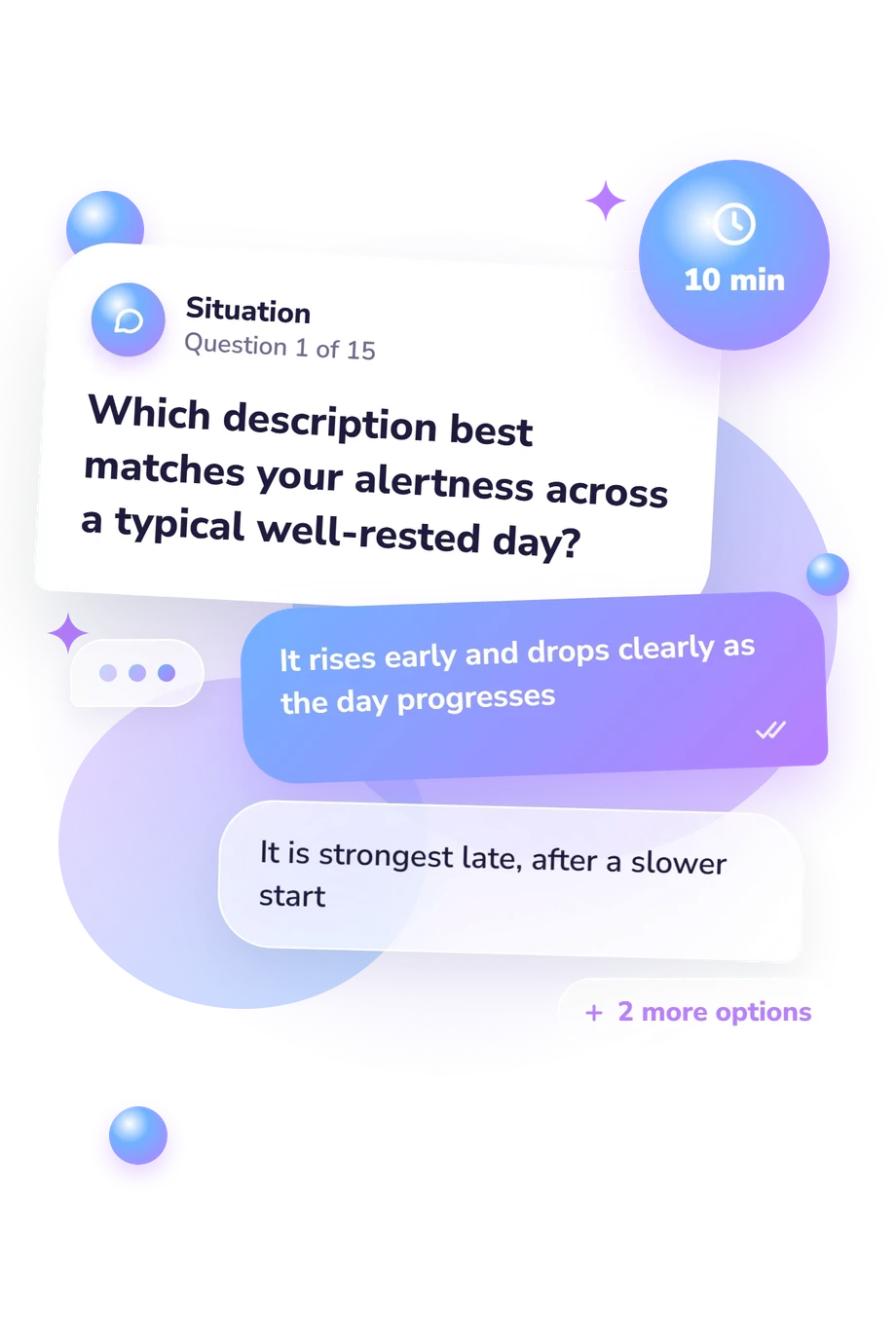
Example Questions From the Test
- Around 6:00 or 7:00 a.m.
- Around 9:30 or 10:30 a.m.
- Around 1:00 or 2:00 p.m.
- Around 8:00 or 9:00 p.m.
- 7:00 to 9:00 p.m.
- 1:00 to 3:00 p.m.
- 9:00 to 11:00 a.m.
- 7:00 to 9:00 a.m.
- 6:00 a.m., to get the earliest possible start
- 8:00 a.m., with a reasonably early departure
- 10:00 a.m., avoiding both a dawn start and a late arrival
- 10:00 p.m., making use of the late hours
Early Bird or Night Owl Quiz - Description and methodology of the test
People who want to understand why early starts, late evenings, or flexible schedules feel different can use this assessment to examine their preferred daily timing. It can also serve as a morning person vs night person quiz, helping readers compare natural timing with work, study, and social demands. The focus is preference rather than performance. The early bird or night owl quiz then shows where the strongest affinity lies without treating one schedule as universally better.
What This Assessment Explores
Questions cover alertness, preferred starts, waking ease, evening engagement, bedtime, and responses to temporary schedule shifts. The result links timing preferences with everyday demands, so this night owl quiz distinguishes among several daily patterns.
The three result dimensions are:
- Early Bird Affinity (0-15) shows how naturally early waking and morning activity fit your rhythm; bands are Weak morning pull (0-5), Moderate morning pull (6-10), and Strong early-bird affinity (11-15).
- In-Between Affinity (0-15) shows comfort with midrange hours and modest shifts; bands are Specialized timing (0-5), Some middle flexibility (6-10), and Strong in-between affinity (11-15).
- Night Owl Affinity (0-15) shows preference for later alertness and evening activity; bands are Weak evening pull (0-5), Moderate evening pull (6-10), and Strong night-owl affinity (11-15).
The highest score is strongest; scores within one point create a blended result. These bands describe preference rather than sleep quality.
Methodology and Scientific Basis
Each item offers four response choices describing realistic situations rather than a simple clock scale: demanding work, early appointments, creative activity, late tasks, bedtime, and schedule changes. This structure samples preference across contexts instead of letting one answer define the profile.
Responses produce three displayed affinity scores from 0 to 15. The scores are compared with one another: the highest is strongest, while scores within one point form a blended result. The profile can show whether evening preference is strong, moderate, weak, or closely matched by another pattern.
Conceptually, the questionnaire is consistent with the Morningness-Eveningness Questionnaire (Horne & Östberg, 1976), a foundational self-report approach to morningness and eveningness. It is not presented as a validated adaptation of that instrument. Smith, Reilly, and Midkiff (1989) offer relevant comparison work on circadian questionnaires, and Roenneberg, Wirz-Justice, and Merrow (2003) describe chronotype as a broader daily-timing pattern.
As a night owl personality quiz, this tool gives descriptive self-reflection, not population norms or clinical classification. Current routines, sleep debt, obligations, and self-awareness can influence self-report, so the result should not be treated as a diagnosis.
- James A. Horne and Olov Östberg (1976). A self-assessment questionnaire to determine morningness-eveningness in human circadian rhythms. International Journal of Chronobiology, 4(2), 97-110. 10.1177/0748730405285278
- C. S. Smith, C. Reilly, and K. Midkiff (1989). Evaluation of three circadian rhythm questionnaires with suggestions for an improved measure of morningness. Journal of Applied Psychology, 74(5), 728-738. 10.1037/0021-9010.74.5.728
- Till Roenneberg, Anna Wirz-Justice, and Martha Merrow (2003). Life between Clocks: Daily Temporal Patterns of Human Chronotypes. Journal of Biological Rhythms, 18(1), 80-90. 10.1177/0748730402239679
Updated: